Close Menu
Scientific-Professional Society for Disasaster Risk ManagementScientific-Professional Society for Disasaster Risk Management
    Facebook X (Twitter) Instagram
    Facebook X (Twitter) Instagram YouTube LinkedIn TikTok
    Scientific-Professional Society for Disasaster Risk ManagementScientific-Professional Society for Disasaster Risk Management
    Contact
    • About
      • History
      • President
      • Members
      • Secretary
      • Documentation
        • Statute
        • Communication Strategy
        • Work Information Booklet
        • Seminar Programs
        • Training Programs
        • Regulations on Identification Cards, Badges, and Uniforms
        • Cooperation Agreements
        • Organization Flyer
        • Membership Application Form
      • Membership
      • Contact SPS-DRM
    • Publication
      • Books
      • Collection of papers
      • Scientific papers
      • Broschure
      • Flyers and Posters
      • International journal (IJDRM)
    • IJDRM
      • Volume 8, Number 1
      • Volume 7, Number 2
      • Volume 7, Number 1
      • Volume 6, Number 2
      • Volume 6, Number 1
      • Volume 5, Number 2
      • Volume 5, Number 1
      • Volume 4, Number 2
      • Volume 4, Number 1
      • Volume 3, Number 2
      • Volume 3, Number 1
      • Volume 2, Number 2
      • Volume 2, Number 1
      • Volume 1, Number 2
      • Volume 1, Number 1
    • ProSafeNet
    • Science
      • International Institute
      • Research Projects
      • Research Collaboration
      • International Conference
    • Education
      • Training
      • Seminars
    • Media
      • Gallery / Training Photo Archive
      • Donations and Sponsorships
    • Posts
      • Announcements
    Scientific-Professional Society for Disasaster Risk ManagementScientific-Professional Society for Disasaster Risk Management
    Home»News»Istraživanje – Fire safety behavior model for residential buildings: Implications for disaster risk reduction
    News

    Istraživanje – Fire safety behavior model for residential buildings: Implications for disaster risk reduction

    EditorBy EditorMay 2, 2022Updated:May 2, 2022No Comments3 Mins Read
    Facebook Twitter LinkedIn Telegram Pinterest Tumblr Reddit WhatsApp Email
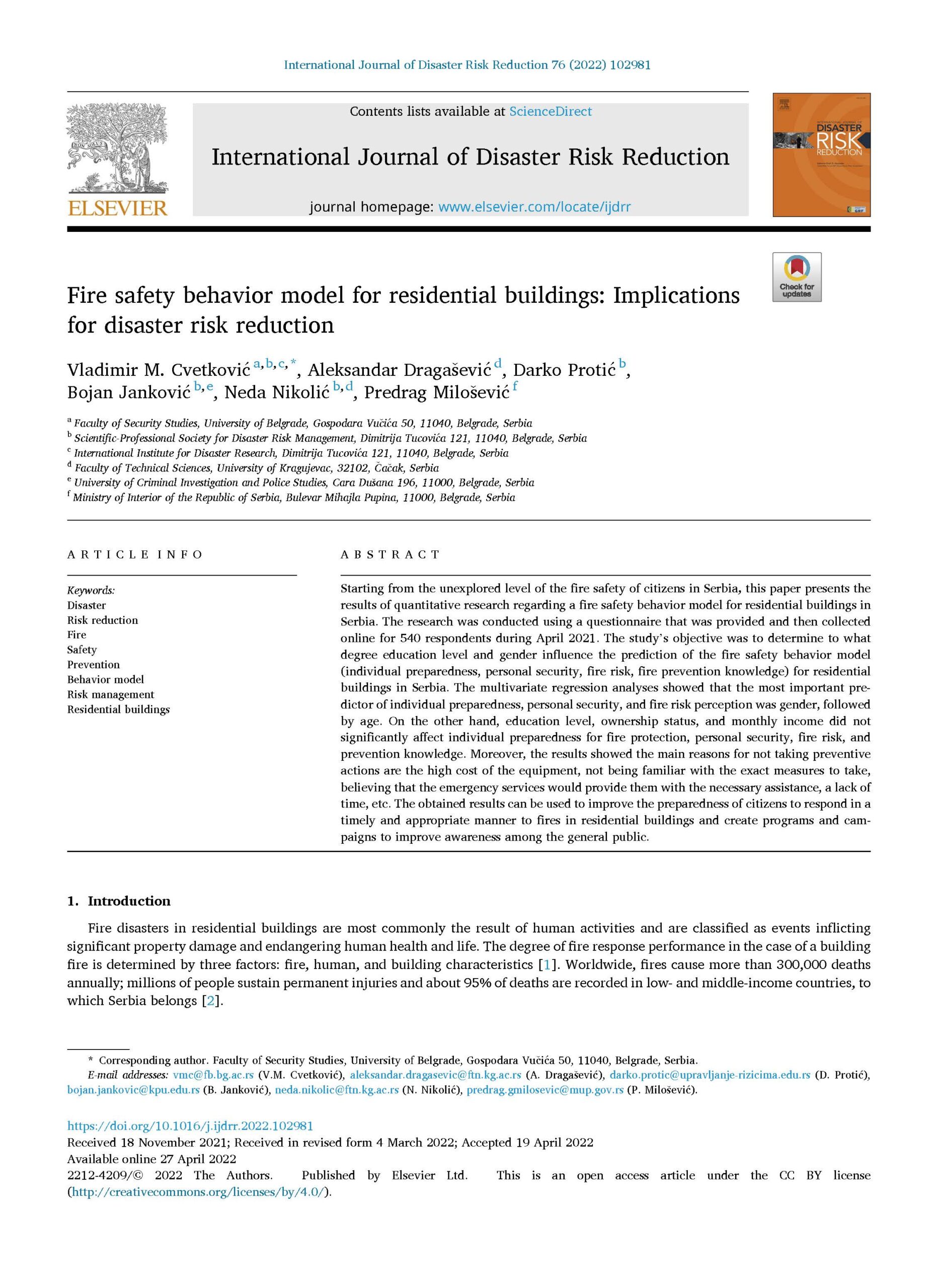
    Pages from 1 s2.0 S221242092200200X main Istraživanje - Fire safety behavior model for residential buildings: Implications for disaster risk reduction
    Naučno-stručno društvo za upravljanje rizicima u vanrednim situacijama, Beograd. Obuke, edukacije, seminari, kursevi - Medjunarodni institut za istraživanje katastrofa.
    Share
    Facebook Twitter LinkedIn Pinterest Email
    Poštovani, sa ponosom vas obaveštavamo da je naučno-istraživački rad ,,Fire Safety Behavior Model for Residential Buildings: Implications for Disaster Risk Reduction”,
    prihvaćen za publikovanje u vrhunskom međunarodnom časopisu International Journal of Disaster Risk Reduction (ISSN 2212-4209), Publisher: Elsevier Limited, United Kingdom
    Cvetković, V. M., Dragašević, A., Protić, D., Janković, B., Nikolić, N., & Milošević, P. (2022). Fire safety behavior model for residential buildings: Implications for disaster risk reduction. International Journal of Disaster Risk Reduction, 76, 102981. 
    doi:https://doi.org/10.1016/j.ijrrr.2022.102981 
    Q1 (M21) kategorije, najbolje rangiranih 25% svetskih međunarodnih časopisa, sa impakt faktorom – 4.776
    👉 We are very proud to share with you latest scientific article ,Fire Safety Behavior Model for Residential Buildings: Implications for Disaster Risk Reduction”, just accepted in the journal – International Journal of Disaster Risk Reduction (ISSN 2212-4209).
    👉Impact Factor: 4.776 – Q1 (M21)
    👉High Visibility, Coverage by Leading Indexing Services: indexed within Scopus, SCIE and SSCI (Web of Science), PubMed, MEDLINE, PMC, Embase, GEOBASE, CAPlus/SciFinder, and many other databases.
    📜 Title: Fire Safety Behavior Model for Residential Buildings: Implications for Disaster Risk Reduction
    👉🚓Starting from the unexplored level of the fire safety of citizens in Serbia, this paper presents the results of quantitative research regarding a fire safety behavior model for residential buildings in Serbia. The research was conducted using a questionnaire that was provided and then collected online for 540 respondents during April 2021.
    👉The study’s objective was to determine to what degree education level and gender influence the prediction of the fire safety behavior model (individual preparedness, personal security, fire risk, fire prevention knowledge) for residential buildings in Serbia. The multivariate regression analyses showed that the most important predictor of individual preparedness, personal security, and fire risk perception was gender, followed by age. On the other hand, education level, ownership status, and monthly income did not significantly affect individual preparedness for fire protection, personal security, fire risk, and prevention knowledge.
    👉Moreover, the results showed the main reasons for not taking preventive actions are the high cost of the equipment, not being familiar with the exact measures to take, believing that the emergency services would provide them with the necessary assistance, a lack of time, etc. The obtained results can be used to improve the preparedness of citizens to respond in a timely and appropriate manner to fires in residential buildings and create programs and campaigns to improve awareness among the general public.
    👉Funding: This research was funded by the Scientific–-Professional Society for Disaster Risk Management, Belgrade (https://upravljanje-rizicima.com/, accessed on 16 September 2021) and the International Institute for Disaster Research (https://idr.edu.rs/, accessed on 16 September 2021), Belgrade, Serbia.
    https://www.researchgate.net/publication/360034626_Fire_Safety_Behavior_Model_for_Residential_Buildings_Implications_for_Disaster_Risk_Reduction
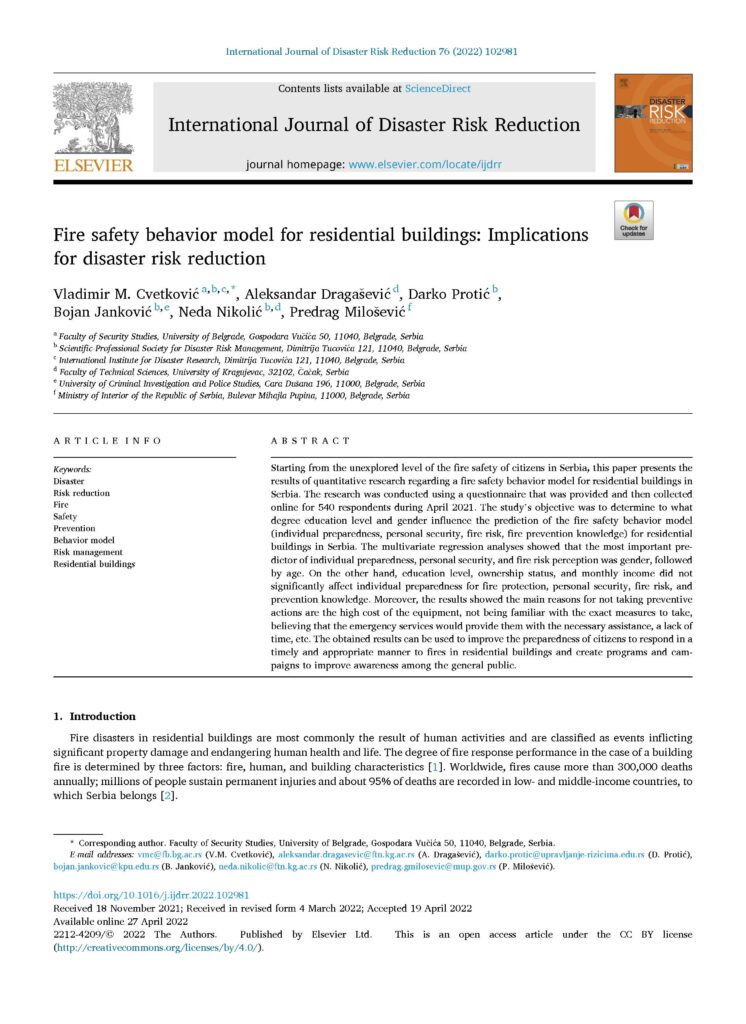
    Pages from 1 s2.0 S221242092200200X main 1 Istraživanje - Fire safety behavior model for residential buildings: Implications for disaster risk reduction
    Share. Facebook Twitter Pinterest LinkedIn Tumblr Telegram Email
    Previous ArticleNAUČNA MONOGRAFIJA – RIZICI OD POŽARA U USTANOVAMA ZA IZVRŠENJE KRIVIČNIH SANKCIJA
    Next Article INTERNATIONAL INSTITUTE FOR DISASTER RESEARCH (IDR), BELGRADE
    Editor
    • Website

    Prof. Dr. Vladimir M. Cvetković is recognized as a leading expert in Disaster Risk Management, with a focus on Risk Reduction, Preparedness, Response, and Recovery. He has authored over 300 scientific papers published in domestic and international journals and proceedings, as well as 30 books.

    Related Posts

    Strategic Cooperation Agreement Signed between ProSafeNet and the Faculty of Security Studies, University of Belgrade

    September 9, 2026

    Adaptive Governance of Disaster and Systemic Risks in Critical Energy Infrastructure: A Complex Adaptive Systems Perspective

    August 21, 2026

    Disaster Victim Identification in India: Forensic Challenges and the Need for a Comprehensive Legal–Policy Framework

    August 21, 2026
    Add A Comment

    Comments are closed.

    Scientific-Professional Society for Disaster Risk Management (SPS-DRM) President’s Office: president@spsdrm.org Administrative Office: secretary@spsdrm.org Belgrade, Serbia | www.spsdrm.org
    Scientific-Professional Society for Disaster Risk Management, Belgrade, Serbia.

    The Association “Scientific-Professional Society for Disaster Risk Management”  (www.spsdr.com) is a non-governmental and non-profit association, established for an indefinite period, for the purpose of achieving objectives related to the advancement of scientific and professional knowledge and practice in the field of disaster risk management, emergencies, security, protection and community resilience, through the implementation of quantitative and/or qualitative research, publishing activities (journals, books and other publications), organizing national and international events, conducting formal and non-formal forms of education and professional development, preparing expert analyses, risk assessments and planning documents, developing digital platforms and knowledge bases, as well as other activities in accordance with the law and this Statute.

    International Journal of Disaster Risk Management

    The International Journal of Disaster Risk Management (IJDRM) is a double-blind peer-reviewed, open-access international scientific journal, published twice a year, dedicated to advancing interdisciplinary research, policy, and professional practice in the fields of disaster risk management, disaster risk reduction, hazards, emergencies, and resilience. The journal provides an international platform for researchers, academics, practitioners, policymakers, emergency managers, and other professionals to exchange knowledge, research findings, and innovative approaches to disaster prevention and management. IJDRM publishes theoretical, empirical, methodological, and applied contributions covering the entire disaster risk management cycle—prevention, mitigation, preparedness, response, recovery, reconstruction, and resilience-building.   www.ijdrm.com

    Scientific-Professional Society for Disaster Risk Management (SPS-DRM)

    Type above and press Enter to search. Press Esc to cancel.