
Publications that turn knowledge into resilience.
Books & Publications
Open each entry for the full description and the original cover image placed at the end of the expanded section.
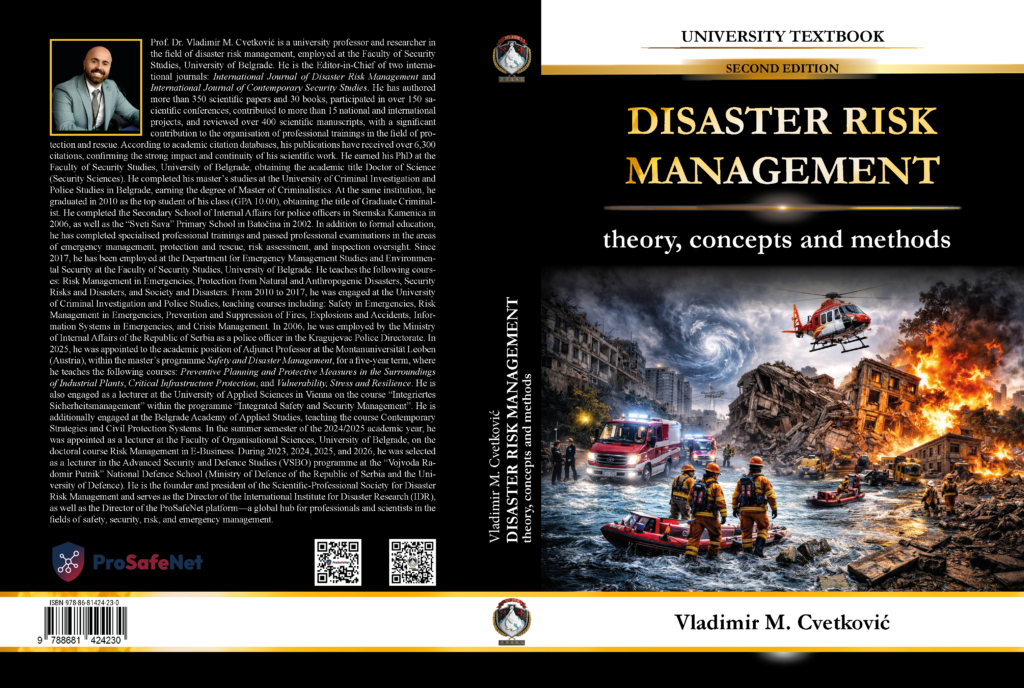
Disaster Risk Management Theory, Concepts and Methods
Disaster Risk Management: Theory, Concepts and Methods
A revised and expanded university textbook integrating contemporary disaster-risk theory with advanced methods for risk assessment, modelling, decision-making, preparedness, response and resilience.
Read full description +
Six years after the first edition, the revised and expanded edition reflects a security environment in which natural and technological risks are increasingly complex, interdependent and capable of producing cascading effects across critical infrastructure, public services, health, the economy and security.
The book substantially expands methods and models of disaster-risk assessment, including hazard-identification techniques, fault-tree and event-tree analysis, bow-tie and barrier analysis, root-cause analysis, Monte Carlo simulation, Bayesian networks, Markov models, extreme-value models, discrete-event simulation, system dynamics, stress testing, toxic-cloud analysis, fire and explosion analysis, domino effects, business-impact analysis and continuity analysis.
It also strengthens risk mapping and registers, vulnerability and resilience assessment, command and coordination, operational centres, situational awareness, warning, evacuation, search and rescue, first aid, public-health measures, secondary-risk management, risk communication, international cooperation, legal frameworks, information technologies and digital decision-support platforms. The work is intended for students, academics, practitioners and decision-makers.
Client Security and Protection in High Risk…
Client Security and Protection in High-Risk Zones
A practice-oriented manual for professionals responsible for client protection in complex and high-security-risk environments.
Read full description +
The manual is intended for professionals engaged in client security and protection in high-risk zones, with particular emphasis on specialized teams operating in the private-security environment. It distinguishes public-sector and private-sector models of protection and examines the operational constraints, resources and responsibilities that shape work in demanding environments.
Its approach combines military-police strategy, small-unit tactics, classical protection principles, field observations and operational procedures. It addresses mission planning, intelligence and financial considerations, international legal issues, team and client safety, hostile-force tactics, equipment, helicopter operations, tactical medicine and the need to adapt procedures to rapidly changing conditions.
The publication emphasizes continuous improvement of operational, technical and medical competencies and is designed as a practical professional reference rather than an idealized representation of protective work.

Exploring Multifaceted Factors Influencing Community Resilience to…
Exploring Multifaceted Factors Influencing Community Resilience to Earthquake-Induced Geohazards: Insights from Montenegro
An interdisciplinary scientific monograph examining demographic, socioeconomic and psychological determinants of community resilience to earthquake-induced geohazards in Montenegro.
Read full description +
The monograph investigates the resilience of local communities to earthquakes in Montenegro, a country located in the seismically active Mediterranean region. It examines how demographic, socioeconomic and psychological characteristics shape preparedness and resilience.
The research framework combines quantitative and qualitative methods, including surveys, interviews, statistical analysis and a comprehensive review of the scientific literature. The study considers variables such as gender, age, education, household size, employment, income, marital status, fear, previous experience and risk perception.
The publication is intended to support government institutions, local communities, non-governmental organizations, researchers and practitioners in developing evidence-based strategies, intervention priorities and programmes for strengthening earthquake resilience.

Community Disaster Resilience in Serbia
Community Disaster Resilience in Serbia
A quantitative study of the demographic and socioeconomic foundations of community disaster resilience in Serbia.
Read full description +
This monograph examines the dynamics that shape the capacity of communities in Serbia to withstand, adapt to and recover from natural disasters. It focuses on the interaction between socioeconomic and demographic characteristics and different dimensions of community resilience.
The research used a questionnaire administered to 321 participants in January 2024 and applied statistical analyses to explore the influence of income, employment, marital status, education, risk perception, gender and age. Snowball sampling supported the development of a diverse participant pool.
The work provides evidence-based implications for policymakers, public institutions, non-governmental organizations and community leaders. It also contributes to the theoretical development of resilience research through the application of an adapted social-resilience framework.

Integrated Disaster Risk Management Preparedness, Mitigation, Response,…
Integrated Disaster Risk Management: Preparedness, Mitigation, Response, and Recovery
A peer-reviewed thematic collection of thirteen scientific papers spanning the full disaster-risk-management cycle and both natural and anthropogenic hazards.
Read full description +
The collection brings together thirteen scientific papers selected to provide a broad view of preparedness, mitigation, response and recovery. The papers underwent expert review and were considered by a scientific and programme committee composed of university professors and specialists.
The volume is organized around three broad areas: management of disasters caused by natural hazards; management of anthropogenic hazards such as nuclear and radiological events, industrial and transport accidents, hazardous materials, war-related destruction, fires and CBRN terrorism; and innovative approaches relevant to both groups of hazards.
The collection is designed to encourage interdisciplinary dialogue and knowledge exchange among researchers, practitioners and decision-makers and to support the further development of effective disaster-risk-management strategies and policies.

Preparedness of High Schools in the Western…
Preparedness of High Schools in the Western Morava Basin in the Republic of Serbia for Disaster Risk Reduction and Emergency Management
A multi-method study of school preparedness, civil-protection cooperation, youth participation and disaster education in the Western Morava Basin.
Read full description +
The study examines the readiness and capacities of secondary schools, civil-society organizations and local governments, including civil-protection departments, for disaster-risk reduction and emergency management in the Western Morava Basin.
It analyses cooperation among schools, civil protection and civil society; youth involvement in disaster-risk-management reform; public-awareness activities; and multisectoral cooperation. Data were obtained from documents, archival materials and surveys of students, teachers and civil-protection personnel and analysed with parametric and non-parametric statistical techniques.
The recommendations emphasize stronger institutional cooperation, practical exercises and evacuation simulations, teacher training, inclusion of parents and civil society, online educational resources, safety-culture education, first aid, closer cooperation with rescue services and greater student participation in preparedness planning.

Human Resource Management in Environmental Security
Human Resource Management in Environmental Security
A multidisciplinary examination of human capital, environmental security, sustainability and the role of local government in environmental protection.
Read full description +
The publication explores the relationship between human-resource management and environmental sustainability in conditions shaped by climate change, resource depletion, ecological imbalance and globalization.
It treats human capital as a strategic resource for environmental protection and examines how local governments can identify, develop and mobilize knowledge, capabilities and organizational potential to improve environmental performance.
The volume combines theoretical frameworks, empirical perspectives and practical applications and addresses environmental stewardship, sustainable resource management, motivational factors and the role of local self-government in mitigating environmental externalities.

Disaster Resilience A Guide for Prevention, Response,…
Disaster Resilience: A Guide for Prevention, Response, and Recovery
A practical guide helping individuals, families and communities understand risk, prepare for emergencies, act during disasters and recover more effectively.
Read full description +
The guide is intended for readers who want to improve preparedness for natural and anthropogenic disasters, including earthquakes, floods, wildfires, fires, workplace accidents, terrorist attacks and pandemics.
It explains practical steps for identifying risks, developing family emergency plans, preparing essential supplies, responding appropriately during emergencies and supporting recovery after a disaster. The book combines practical guidance with research and professional experience from disaster-management practice.
A strong emphasis is placed on community resilience, risk awareness, preparedness before an event and the role individuals can play in building safer communities. The book also encourages professional discussion, research engagement and the use of new technologies in resilience-building.
The Historical Development of the Scientific Professional…
The Historical Development of the Scientific-Professional Society for Disaster Risk Management
An institutional monograph documenting the founding, development, scientific work, education, publishing and research infrastructure of SPS-DRM.
Read full description +
The book traces the origins and development of SPS-DRM from its establishment in June 2018 and explains the role of civil society, researchers and practitioners in advancing disaster-risk management.
It presents the Society's development through research, training, conferences, publishing, public-awareness activities, projects and cooperation between science and professional practice. Particular attention is given to the International Institute for Disaster Research and its role in strengthening disaster research and international cooperation.
The monograph frames research, education and practice as the three pillars of SPS-DRM and documents the contribution of experts, practitioners, students and institutional partners to the development of a broader disaster-resilience community.

The Media System of Bosnia and Herzegovina…
The Media System of Bosnia and Herzegovina and Identity Changes
A multidisciplinary analysis of the media system of Bosnia and Herzegovina, identity formation, digitalization and national-security implications.
Read full description +
The monograph examines the contemporary media system of Bosnia and Herzegovina through media studies, conflict studies, identity theory, sociology, communication studies, political science and security studies, with additional perspectives from ethics, history, international law, political marketing and diplomacy.
It analyses the historical context and development of the media system from 1997 to 2022 and considers how digitalization, new portals, hybrid media and changing audience behaviour influence communication and identity.
The work is structured around communication agents and their social influence, the normative framework of the media system, and the functions of media systems in identity formation and national security.

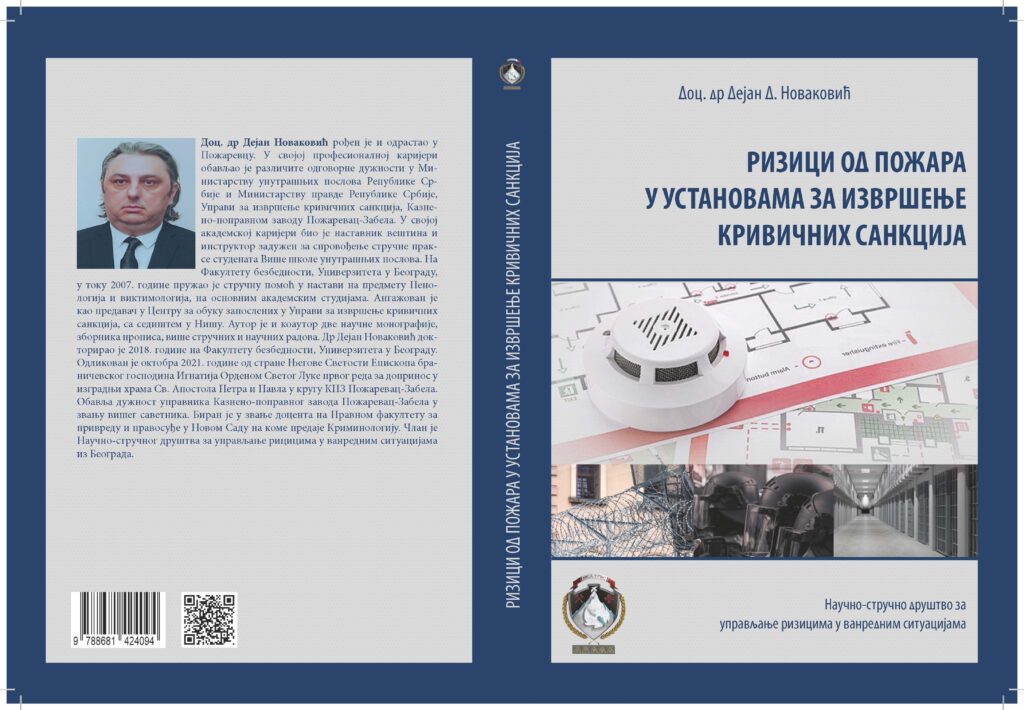
Fire Risks in Correctional Facilities
Fire Risks in Correctional Facilities
A specialized monograph on fire-risk assessment, prevention and fire-protection organization in correctional institutions.
Read full description +
The monograph systematically analyses fire risks in correctional institutions as high-security facilities. It examines risk assessment as the basis for defining protection objectives, responsibilities and measures.
The study addresses organizational and technical causes of fires, employee and inmate training, safety rules, architectural and technical conditions, fire-protection services and the specific challenges of intentional fire-setting in closed institutions.
A case study of the Požarevac-Zabela correctional institution connects theory and long professional experience and supports recommendations for optimizing fire-risk management in correctional facilities.
Tactics for Protection and Rescue in Disasters
Tactics for Protection and Rescue in Disasters
A comprehensive textbook on operational, tactical and strategic protection-and-rescue measures across natural and anthropogenic disasters.
Read full description +
The textbook systematically presents the operational, tactical and strategic aspects of protection and rescue in disasters caused by earthquakes, landslides, avalanches, floods, wildfires, tsunamis, epidemics, volcanic activity, extreme snowfall, nuclear and radiological events, industrial and transport accidents, hazardous materials, war-related destruction and terrorism.
It covers protection-and-rescue measures, management at strategic, tactical and operational levels, the roles of police, fire and rescue units, emergency medical services, the military and civil protection, logistics, communication, decontamination and the organization of national systems.
Dedicated chapters address tactics for lithospheric, hydrospheric, atmospheric, biospheric and technological hazards, terrorist attacks and major fires. The textbook combines research evidence, international experience and practical examples for students and professionals.

Collection of Regulations in the Field of…
Collection of Regulations in the Field of Emergency Situations
A revised and expanded regulatory reference covering national strategies, legislation, bylaws and key international documents relevant to emergency management.
Read full description +
The collection is designed for members of emergency and rescue services, public administration, local government, candidates for professional examinations, researchers and students involved in disaster risk management.
It contains strategic, legal and sub-legal regulations forming the basis of Serbia's disaster protection and rescue system, together with important international strategic documents. It is the revised and expanded successor to the 2019 Collection of Regulations in the Field of Disaster Risk Management.
The publication supports legally grounded decision-making and professional practice across emergency management, fire protection, civil protection, rescue services and disaster-risk assessment.

Legal and Security Aspects of Risk Management…
Legal and Security Aspects of Risk Management in Natural and Anthropogenic Disasters
A thematic collection of twenty-two scientific papers examining legal and security dimensions of risk management across natural and anthropogenic disasters.
Read full description +
The collection brings together twenty-two reviewed scientific papers by professors and researchers addressing contemporary legal and security aspects of disaster-risk management.
Its thematic structure includes legal aspects of natural hazards, legal aspects of anthropogenic disasters, security aspects of natural hazards and security aspects of anthropogenic hazards. Topics range from earthquakes, floods and wildfires to nuclear incidents, critical infrastructure, cyber risks, hazardous materials, fires and CBRN terrorism.
The volume is intended for researchers, students and professionals seeking deeper specialization in disaster studies and provides a multidisciplinary platform for analysing governance, law, security and institutional practice.
Nuclear Disaster Management
Nuclear Disaster Management
A pioneering regional monograph integrating theory and empirical research on prevention, preparedness, response and recovery in nuclear and radiological disasters.
Read full description +
The book examines integrated nuclear-disaster management through prevention and mitigation, preparedness of citizens and institutions, protection-and-rescue response and post-disaster recovery.
It discusses the phenomenology of nuclear disasters, peaceful uses of nuclear energy and nuclear terrorism, while also presenting empirical research on risk perception, public fear, attitudes toward nuclear energy and preparedness of citizens, local communities, government and emergency services.
Quantitative data were analysed using statistical techniques including multiple regression, chi-square tests, one-way ANOVA, t-tests and Pearson correlation, providing an evidence base for strategies and programmes to improve nuclear and radiological preparedness.

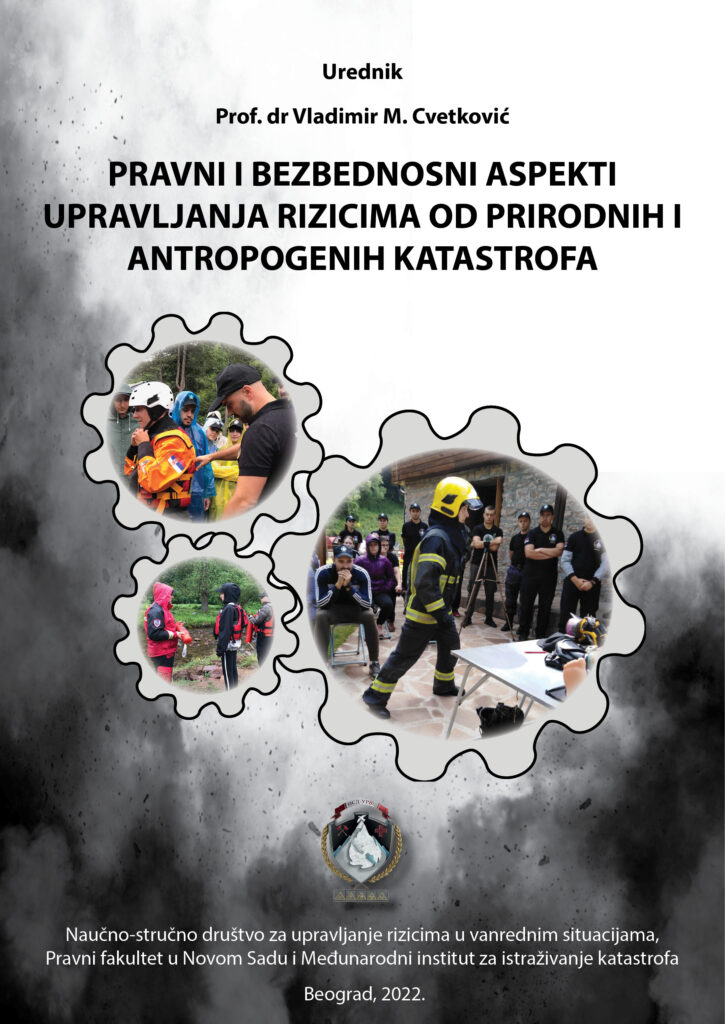
Disaster Myths Truths and Misconceptions
Disaster Myths: Truths and Misconceptions
An evidence-based examination of widespread misconceptions about human behaviour, health, evacuation, panic, aid and social order during disasters.
Read full description +
The monograph reviews widely accepted disaster myths concerning rarity, mortality, technology, morality, evacuation behaviour, temporary settlements, hospital overload, blood donation, disaster syndrome, epidemics, panic and antisocial behaviour.
Its central premise is that disaster behaviour should be evaluated against scientific evidence rather than intuitive or mythological explanations. Alongside theoretical analysis, the book presents quantitative research into the prevalence of disaster myths.
The empirical study included more than 250 respondents in Belgrade and used multiple regression, chi-square tests, ANOVA, t-tests and Pearson correlation. The findings are intended to support more evidence-based preparedness and disaster policy.
Security Risks and Disasters
Security Risks and Disasters
A university-oriented practical handbook combining theoretical exercises, discussion questions and multidisciplinary disaster-studies content.
Read full description +
The handbook is intended primarily for undergraduate and master's students and supports theoretical and practical exercises in disaster studies, security risks and emergency management.
Its thematic units include disaster-research methodology, hazards and disaster phenomenology, vulnerability, resilience, integrated disaster-risk management, prevention and mitigation, preparedness, protection, recovery, information systems and international cooperation.
Each section combines introductory theoretical material with exercises and discussion questions, encouraging active learning while connecting contemporary disaster-science literature with the author's research and teaching experience.

Tactics of Protection and Rescue in Emergency…
Tactics of Protection and Rescue in Emergency Situations: Field Experiences and Lessons Learned
The thematic collection emerging from the First National Three-Day Seminar, featuring thirteen papers on hazards and protection-and-rescue tactics.
Read full description +
The collection followed the First National Three-Day Seminar on protection and rescue held at the Kolarac Endowment in Belgrade from 16 to 18 April 2021. It was developed from research activities by students and young participants.
Thirteen scientific papers address the phenomenology of natural and anthropogenic hazards and protection-and-rescue tactics for earthquakes, landslides, volcanoes, floods, avalanches, storms, droughts, extreme temperatures, epidemics, wildfires, nuclear and radiological events, industrial and transport incidents, hazardous materials, war-related destruction and CBRN terrorism.
The papers were reviewed by seven reviewers, while the seminar's scientific and programme committee included more than ten university professors. The collection is intended to strengthen academic and practical specialization in disaster protection and rescue.

Disaster Risk Management
Disaster Risk Management
A foundational university textbook systematically presenting the contemporary disaster-management cycle: mitigation, preparedness, response and recovery.
Read full description +
The textbook synthesizes theoretical achievements in contemporary disaster-risk management and was designed for undergraduate, master's and doctoral students as well as researchers and emergency-service professionals.
It provides a multidisciplinary framework for identifying, analysing and treating disaster risks and systematically examines measures and activities undertaken during mitigation, preparedness, response and recovery.
The work integrates extensive international and domestic scientific literature, the author's empirical research and long teaching experience. It was developed to meet scientific, professional, pedagogical and methodological standards and to strengthen professional competencies in the emerging discipline of disaster studies.

Collection of Regulations in the Field of…
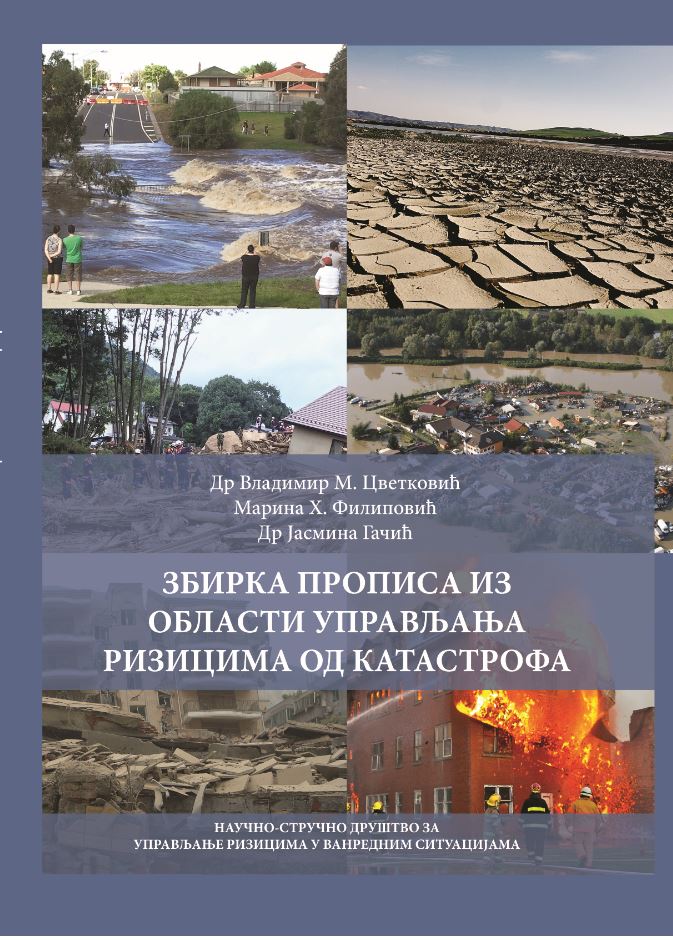
Collection of Regulations in the Field of Disaster Risk Management
The first comprehensive Serbian collection bringing together strategic, legal and regulatory instruments relevant to disaster-risk reduction and emergency response.
Read full description +
The publication was created to support a systematic and multisectoral approach to managing risks from natural and anthropogenic disasters. It compiles the strategic, legal and sub-legal framework on which Serbia's protection-and-rescue system is based.
In addition to national legislation, the collection incorporates major international instruments and reflects the principles of the Sendai Framework for Disaster Risk Reduction, including risk understanding, governance, investment in resilience, preparedness and Build Back Better.
The collection is intended for emergency and rescue services, public administration, local governments, candidates preparing for professional examinations, researchers and students. The original edition contains 1,050 pages.
Risk Management and Disaster Protection and Rescue…
Risk Management and Disaster Protection and Rescue Systems
A practical study handbook linking disaster theory, risk assessment, legal frameworks, preparedness, response, recovery and information systems.
Read full description +
The handbook was designed for theoretical and practical exercises for undergraduate and master's students and is grounded in years of teaching experience in disaster studies.
Its seven thematic units cover disasters and hazards; vulnerability, resilience and research methods; risk-assessment methodology and protection-and-rescue plans; national and international legal frameworks; preparedness and mitigation; response and recovery systems; and information systems and international cooperation.
The work uses exercises, discussion questions and recommended literature to develop active understanding of disaster-risk analysis, governance, protection-and-rescue systems and humanitarian cooperation.

Need a publication, citation or additional information?
Visit the official SPS-DRM publication catalogue for current availability, ordering information and additional resources.