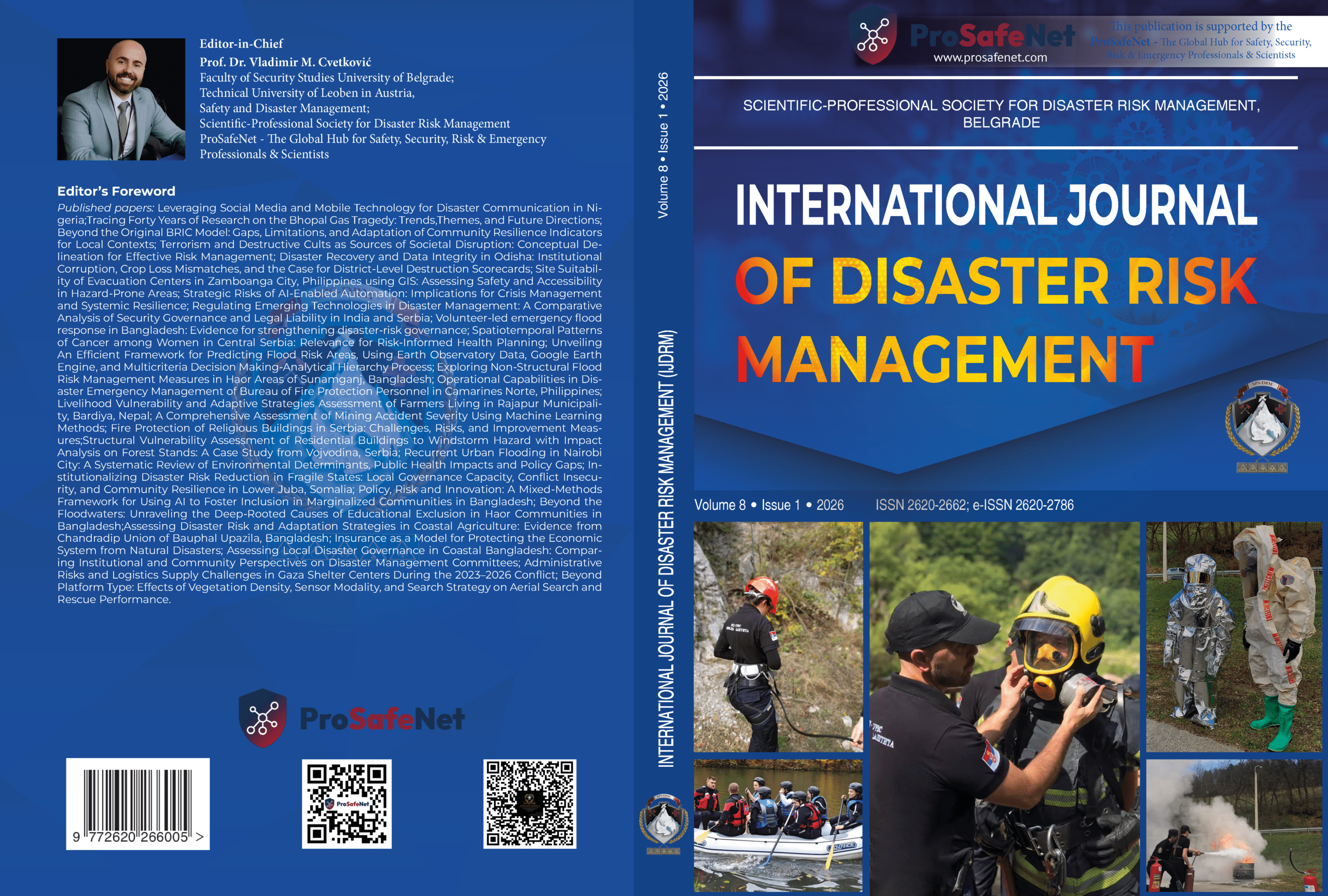
International Journal of
Disaster Risk Management
IJDRM
Advancing interdisciplinary research, policy and professional practice across the entire disaster risk management cycle — from prevention and preparedness to response, recovery, mitigation and resilience.
per year
reviewers
acceptance
review fee
4.0
through Crossref
Research that helps create a safer and more resilient world.
The International Journal of Disaster Risk Management (IJDRM) is a double-blind peer-reviewed, open-access international journal published twice a year. It is dedicated to advancing interdisciplinary research and practical knowledge across disaster and hazard studies, policy and management.
IJDRM provides an international platform for academics, policy-makers, practitioners and humanitarian actors to publish high-quality research concerning natural hazards and disasters, technological and man-made hazards, complex emergencies and global crises.
The journal encourages dialogue and collaboration across disciplines with the goal of reducing disaster risks and strengthening resilience within the broader framework of sustainable development and planetary boundaries.
The Full Disaster Risk Management Cycle
IJDRM welcomes studies addressing all stages of disaster risk management and resilience.
What does IJDRM publish?
The journal welcomes theoretically rigorous, methodologically sound and practice-relevant research across the multidisciplinary field of disaster risk management.
Disaster & Crisis Management
Conceptual frameworks, evolving paradigms and practical approaches to managing diverse hazards and crises.
Risk Awareness, Perception & Assessment
Risk perception, risk communication, early warning systems and decision-making under uncertainty.
Hazard & Vulnerability Analysis
Physical, social, economic and environmental vulnerabilities, multi-hazard assessments and risk-analysis methodologies.
Knowledge & Capacity Building
Disaster education, professional training, public awareness, research innovation and knowledge dissemination.
Risk Governance & Institutional Frameworks
Legal, policy, organisational and community mechanisms for governance and stakeholder coordination.
Prevention, Mitigation, Response & Recovery
Integrated strategies, best practices and implementation at local, national and international levels.
Critical Infrastructure & Continuity
Protection of essential infrastructure, services and systems before, during and after disasters.
Climate Change & Environmental Risks
Climate adaptation, disaster risk reduction, environmental security and nature-based solutions.
Health, Mental Health & Humanitarian Response
Emergency medical services, psychosocial support, humanitarian operations and public-health resilience.
Social Dimensions of Disasters
Equity, inclusion, gender, culture, vulnerable groups, civil society and community resilience.
Share research, evidence and practice.
One journal. Many disciplines.
IJDRM particularly values region-specific case studies, comparative research and context-sensitive analyses that provide transferable lessons across disciplines and geographical contexts.
Continuous publication. No unnecessary waiting.
IJDRM publishes two issues per annual volume and applies a continuous rolling-publication model.
01. Submission
Manuscript submitted through the journal platform.
02. Editorial Screening
Scope, originality, quality, ethics and submission requirements are assessed.
03. Double-Blind Peer Review
Normally reviewed by at least two independent reviewers.
04. Editorial Decision
Decision is based on scholarly quality, reviewer reports and journal policies.
05. Production
Copyediting, proofreading and final typesetting.
06. Online Publication
Accepted articles are published individually within the open issue as soon as production is completed.
Every Article Receives Final Bibliographic Information
Once published, every article receives stable bibliographic metadata including:
Necessary corrections or amendments are handled transparently in accordance with the journal's correction, expression of concern, retraction and article-removal policies.
Rigorous. Independent. Double-blind.
Manuscripts that successfully pass editorial screening normally undergo double-blind review by at least two independent reviewers.
Manuscripts are evaluated according to:
Final publication decisions are made by the responsible editor. Conflicts of interest must be disclosed, and submissions involving editors or persons connected with the journal are processed through an independent editorial procedure.
Fully Open Access. Immediately available worldwide.
Full Open Access
Published articles are immediately and permanently available online without subscription charges or access barriers.
Creative Commons Licence
Content may be read, downloaded, copied, shared, distributed, reused and adapted for lawful purposes with appropriate attribution.
Authors Retain Copyright
Authors retain copyright and grant IJDRM the right of first publication.
Share your research. No embargo period.
IJDRM permits and encourages authors to archive different versions of their manuscripts in appropriate repositories, personal websites and departmental platforms.
Submitted Manuscript
Authors may deposit the submitted manuscript or preprint.
Accepted Manuscript
The peer-reviewed accepted version may also be deposited.
Version of Record
The final published article may be archived with its complete citation and DOI link.
No fees before acceptance.
Payment has no influence on reviewer selection, peer-review reports, editorial decisions or acceptance. Editorial decisions are based exclusively on scholarly criteria.
Persistent identification and research discoverability.
IJDRM publishes verified information concerning its current abstracting, indexing, registration and scholarly-infrastructure coverage. Pending applications are not presented as current indexing.
Crossref Registration
Each published article is assigned a DOI through Crossref.
Metadata Dissemination
Persistent identifiers support discoverability, metadata dissemination and citation linking.
Transparent Indexing Information
Only verified current indexing and registration information is presented as active coverage.
Keywords & thematic coverage
Scholarly leadership and independent editorial governance.
Scientific-Professional Society for Disaster Risk Management
SPS-DRM is a non-governmental and non-profit scholarly and professional organisation based in Belgrade, Serbia, dedicated to advancing research, education, policy and professional practice in disaster risk management, emergency management, security, protection and community resilience.
Prof. Dr. Vladimir M. Cvetković
Full Professor of Disaster Risk Management, Faculty of Security Studies, University of Belgrade, Serbia, and Adjunct Professor at Montanuniversität Leoben, Austria.
Official identifiers and publication details
| Full Title | International Journal of Disaster Risk Management |
| Acronym | IJDRM |
| Journal Abbreviation | Int. J. Disaster Risk Manag. |
| Print ISSN | 2620-2662 |
| Online ISSN | 2620-2786 |
| UDC | 614.8.069 |
| Publisher | Scientific-Professional Society for Disaster Risk Management (SPS-DRM), Belgrade, Serbia |
| Publication Frequency | Semiannual — two issues per year |
| Publication Model | Continuous (rolling) publication |
| Peer Review | Double-blind peer review |
| Access Model | Full Open Access |
| Licence | Creative Commons Attribution 4.0 International (CC BY 4.0) |
| DOI Registration Agency | Crossref |
| Primary Publication Language | English |
Questions about publishing with us?
Contact the editorial office for scholarly correspondence or the journal office for general and administrative enquiries.
Scientific-Professional Society for Disaster Risk Management
Dimitrija Tucovića 121
Belgrade, Serbia
Editorial correspondence:
editor@ijdrm.com
General & administrative:
office@ijdrm.com
Ready to share your research with an international audience?
Submit original, rigorous and policy-relevant research that advances knowledge and professional practice in disaster risk management, resilience, emergency management and related fields.
SUBMIT YOUR MANUSCRIPT →