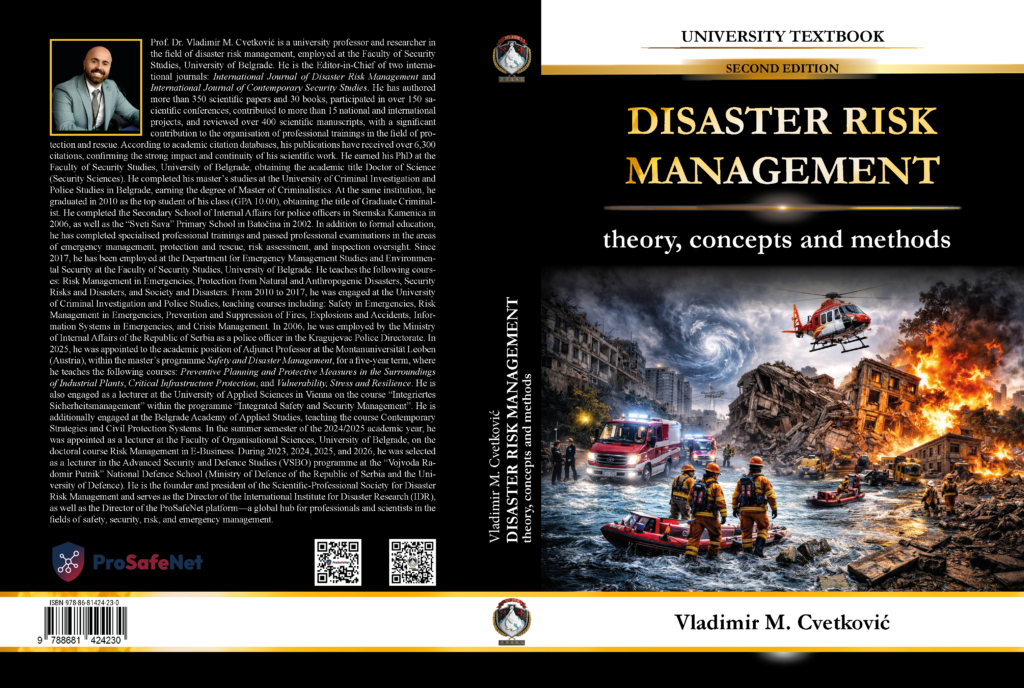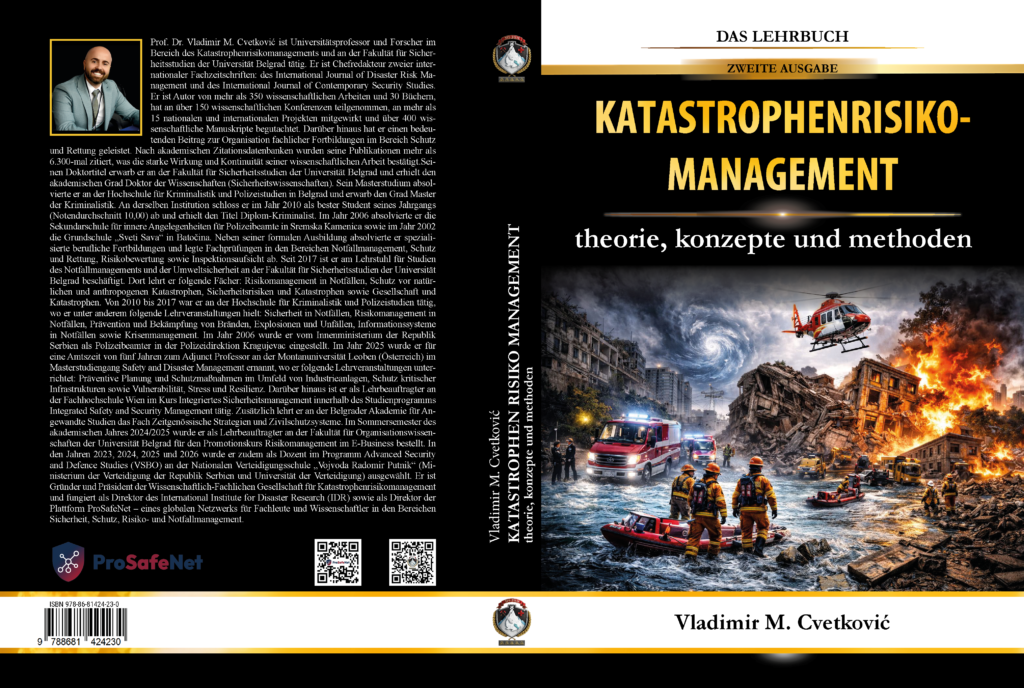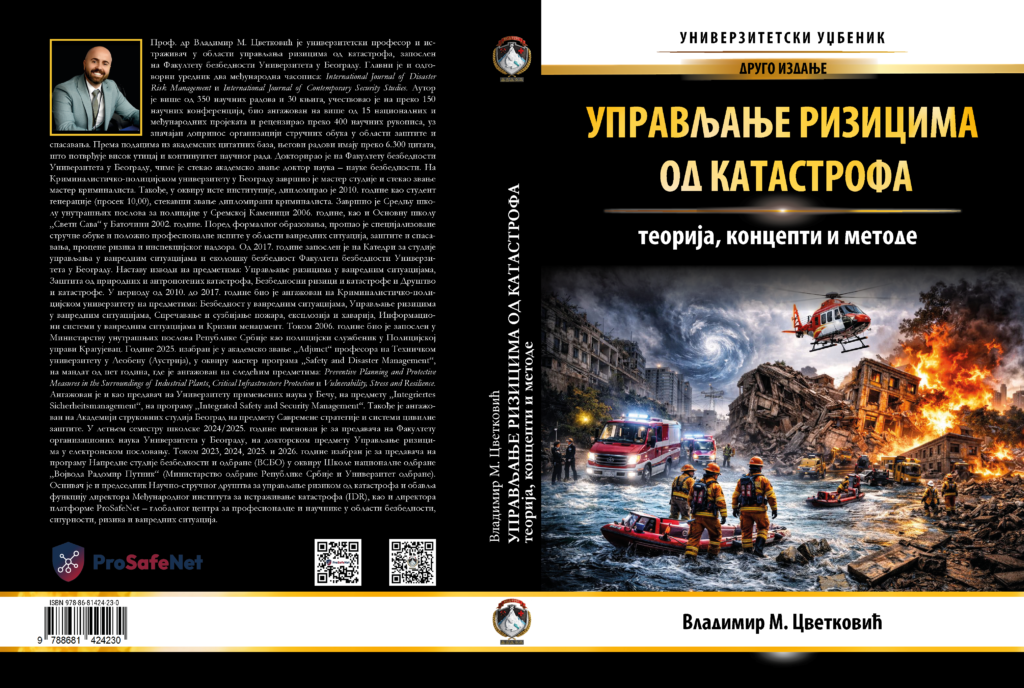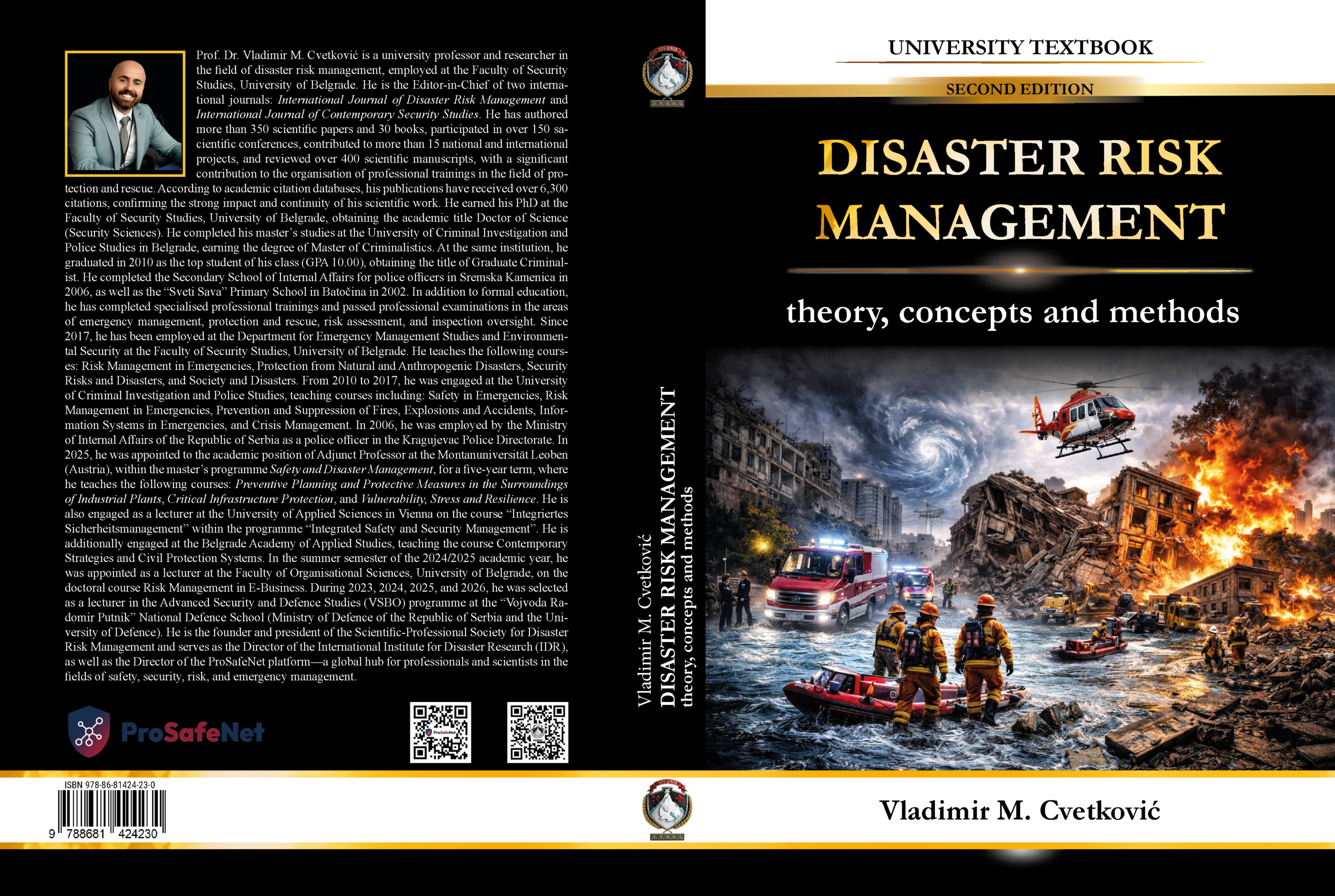
Six years after the publication of the first edition of the university textbook Disaster Risk Management (2020), it became clear that both the scientific discipline and the operational practice of risk management now exist in a significantly different and transformed security environment. Contemporary natural and technological risks have become increasingly complex, interdependent, and dynamic, while disasters more frequently take on a multi-hazard character and produce cascading effects that simultaneously affect critical infrastructure, public services, the economy, health, and security. At the same time, new theoretical frameworks have been developed, numerous studies have been conducted, more precise assessment methods, more advanced loss models, and decision-support systems have been created, as well as digital platforms that enable faster collection, processing, and exchange of data throughout the risk management cycle. For this reason, the second, revised and expanded edition was prepared as a thorough revision of the manuscript rather than a mere update. The title of the book has also been refined and now reads Disaster Risk Management — Theory, Concepts and Methods, thereby more clearly emphasizing its place within the framework of disaster studies and the integration of theoretical foundations with instruments for analysis, assessment, and decision-making. The textbook has been linguistically, conceptually, and structurally harmonized throughout, while a significant portion of the content has been revised and supplemented with new thematic units. The most extensive changes were made in the section dealing with methods, concepts, and models of risk management, where the corpus of risk assessment techniques has been expanded and systematized: from hazard identification methods, through cause-and-effect logical analyses (fault tree, event tree, bow-tie, barrier analysis, and root cause analysis), to quantitative and simulation approaches (Monte Carlo, Bayesian networks, Markov models, extreme value models, discrete-event simulation, and system dynamics), as well as scenario-based and consequence-oriented methods (stress tests, toxic cloud, fire and explosion analyses, domino effect, business impact, and continuity analysis). The spatial aspect of risk analysis has been particularly enhanced through mapping, with a more developed presentation of the preparation of risk maps and risk registers, as well as the role of indicators and index models in comparative assessment. The chapter on disaster response has also been substantially revised and given a more operational structure and clearer flow of activities: from system activation and response criteria, through command and coordination with headquarters and operational centers and resource management, to the development of situational awareness and information management, implementation of field measures (warning, evacuation, search and rescue, first aid, stabilization of living conditions), public health and sanitary activities, management of secondary risks, and communication with the public, media, and volunteers. In addition, the theoretical frameworks and paradigms in disaster studies have been expanded, the phenomenology of hazards and disasters has been deepened through a clearer distinction between hazard characteristics and consequences, and a systematized section relating to disaster risk and risk perception has been included. The units dealing with vulnerability and resilience have also been further improved, including assessment methods and indicators, as well as the sections devoted to risk reduction, international cooperation, legal frameworks, and the role of information and communication technologies and digital platforms in prevention, preparedness, and response. This edition has been enhanced and grounded in my previous scientific research work, including more than 350 published scientific papers and completed empirical studies in the field of disaster risk management. The content has also been additionally adapted to the teaching I conduct at the Faculty of Security Studies, University of Belgrade, as well as within my academic engagement at the Montanuniversität Leoben in Austria, with the intention that the textbook should remain at once scientifically grounded, methodologically precise, and pedagogically useful in different educational and professional contexts. In the meantime, the textbook has been translated into two world languages, English and German, which further confirms its relevance and usability in a broader academic and professional context. In the final stage of manuscript preparation, alongside conventional editing, tools based on artificial intelligence were also used as support in stylistic harmonization, linguistic refinement, and technical text editing; full responsibility for the scientific content, interpretations, and conclusions remains entirely with the author. Finally, I would like to express my special and sincere gratitude to the reviewers, Prof. Dr. Vladimir Jakovljević, Prof. Dr. Jasmina Gačić, Prof. Dr. Neda Nikolić, and Prof. Dr. Hatidža Beriša. Their careful review analysis, clearly articulated comments and suggestions, as well as their balanced recommendations for more precise conceptual differentiation, more logical structuring of individual sections, and stronger methodological consistency, made a significant contribution to the final form of the manuscript. I especially appreciate their dedication in reading the complex sections relating to risk assessment, the operationalization of management processes, as well as issues of preparedness, response, and recovery, because it was precisely in these segments that their comments helped make the text clearer, more transparent, and more applicable in teaching and practice. The book begins with an examination of the theoretical and conceptual foundations of disaster risk management, providing the reader with a clear insight into the development of this scientific discipline, its basic concepts, subject of study, the most important theoretical approaches, and the methodological foundations of research. Special attention is devoted to the place of risk management within the broader framework of disaster studies, as well as to understanding the contemporary challenges posed by complex, interconnected, and dynamic risks. The following sections address the phenomenology of hazards and disasters, with a focus on distinguishing natural, technological, and anthropogenic hazards, their causes, characteristics, intensity, spatial and temporal dimensions, as well as the ways in which they develop into disasters. The reader is introduced to an understanding of the relationship between hazards, exposure, vulnerability, and capacities, thereby establishing the foundation for a comprehensive understanding of disaster risk. A significant part of the book is devoted to the very concept of disaster risk, its components, and contemporary approaches to risk assessment. It explains how risk is identified, analyzed, and evaluated, while presenting numerous qualitative, quantitative, scenario-based, and simulation methods. Particular attention is given to hazard identification techniques, logical-causal analyses, models for assessing probability and consequences, as well as tools that enable more objective decision-making under conditions of uncertainty. The book then examines in detail vulnerability and resilience as two key dimensions of contemporary risk management. It explains why individuals, communities, institutions, and systems experience the consequences of disasters differently, as well as how resilience can be built and measured. In this context, indicators, models, and approaches are presented that support the assessment of social, economic, institutional, and infrastructural resilience. An important place is also given to chapters devoted to risk mapping, risk registers, spatial analysis, and the use of indicators and index models. The reader is shown how risks can be spatially represented, compared, and systematized for the purpose of better planning preventive and protective measures. In this way, the book goes beyond an exclusively theoretical framework and enters the practical sphere of planning, management, and decision support. A particularly extensive and operationally oriented chapter is devoted to disaster response. It examines system activation, response criteria, command and coordination, the work of headquarters and operational centers, resource management, the development of situational awareness, and information management. In addition, it addresses in detail field measures, including warning, evacuation, search and rescue, first aid, stabilization of living conditions, public health and sanitary activities, as well as the management of secondary risks. One of the book’s important values is that it does not stop at operational response, but also addresses the broader framework of disaster risk reduction, including prevention, mitigation, preparedness, and the long-term strengthening of community safety and security. In this sense, it discusses institutional and legal frameworks, international cooperation, the role of public policies, as well as the importance of intersectoral coordination in contemporary protection and rescue systems. Finally, the book highlights the growing importance of information and communication technologies, digital platforms, and modern decision-support systems in disaster risk management. In this way, it offers the reader a contemporary and integrated view of the field, in which theory, empirical research, and operational practice are connected into a coherent whole. For precisely this reason, this book represents a valuable source of knowledge not only for students and teachers, but also for experts, practitioners, and decision-makers who seek to improve their understanding and management of risks in the contemporary security environment.