Close Menu
Scientific-Professional Society for Disasaster Risk ManagementScientific-Professional Society for Disasaster Risk Management
    Facebook X (Twitter) Instagram
    Facebook X (Twitter) Instagram YouTube LinkedIn TikTok
    Scientific-Professional Society for Disasaster Risk ManagementScientific-Professional Society for Disasaster Risk Management
    Contact
    • About
      • History
      • President
      • Members
      • Secretary
      • Documentation
        • Statute
        • Communication Strategy
        • Work Information Booklet
        • Seminar Programs
        • Training Programs
        • Regulations on Identification Cards, Badges, and Uniforms
        • Cooperation Agreements
        • Organization Flyer
        • Membership Application Form
      • Membership
      • Contact SPS-DRM
    • Publication
      • Books
      • Collection of papers
      • Scientific papers
      • Broschure
      • Flyers and Posters
      • International journal (IJDRM)
    • IJDRM
    • ProSafeNet
    • Science
      • International Institute
      • Research Projects
      • Research Collaboration
      • International conference
    • Education
      • Training
      • Seminars
    • Information
      • Gallery / Training Photo Archive
      • Announcements
      • Media
      • Donations and Sponsorships
    • Posts
    Scientific-Professional Society for Disasaster Risk ManagementScientific-Professional Society for Disasaster Risk Management
    Home»News»Declination of the Strategic Compass: Transatlantic Elites, German Leadership, and the Future of European Security
    News

    Declination of the Strategic Compass: Transatlantic Elites, German Leadership, and the Future of European Security

    EditorBy EditorAugust 9, 2026No Comments2 Mins Read
    Facebook Twitter LinkedIn Telegram Pinterest Tumblr Reddit WhatsApp Email
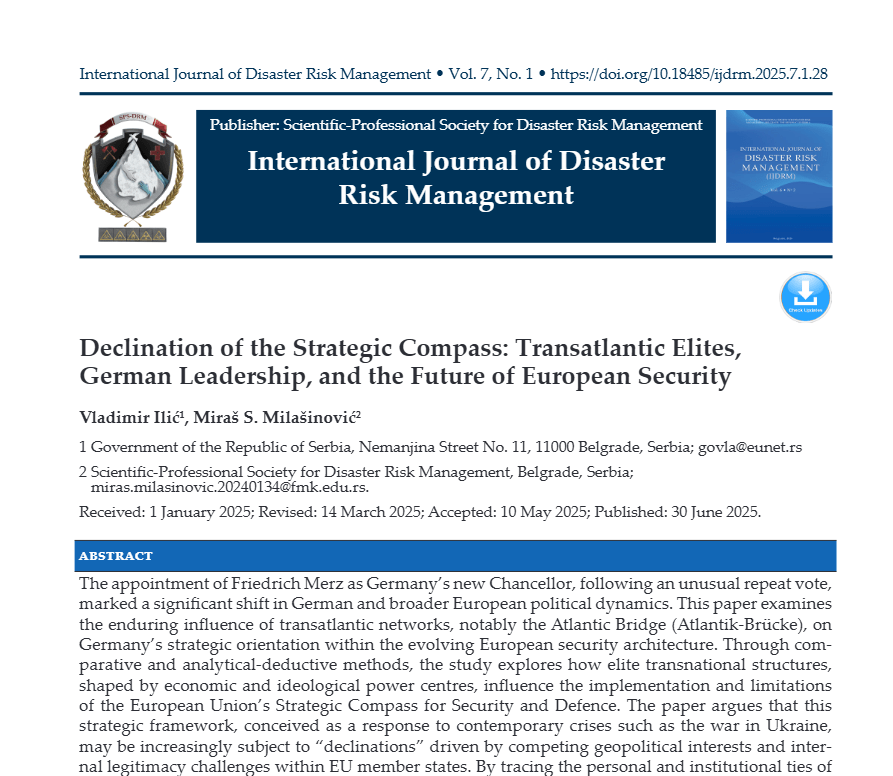
    Screenshot 2026 08 09 131034 Declination of the Strategic Compass: Transatlantic Elites, German Leadership, and the Future of European Security
    Share
    Facebook Twitter LinkedIn Pinterest Email

    The appointment of Friedrich Merz as Germany’s new Chancellor, following an unusual repeat vote, marked a significant shift in German and broader European political dynamics. This paper examines the enduring influence of transatlantic networks, notably the Atlantic Bridge (Atlantik-Brücke), on Germany’s strategic orientation within the evolving European security architecture. Through comparative and analytical-deductive methods, the study explores how elite transnational structures, shaped by economic and ideological power centres, influence the implementation and limitations of the European Union’s Strategic Compass for Security and Defence. The paper argues that this strategic framework, conceived as a response to contemporary crises such as the war in Ukraine, may be increasingly subject to “declinations” driven by competing geopolitical interests and internal legitimacy challenges within EU member states. By tracing the personal and institutional ties of key actors, including Chancellor Merz, the paper sheds light on the deeper geopolitical alignments that underpin NATO-EU cooperation and transatlantic risk governance. The findings highlight the urgent need for a more balanced and citizen-oriented security strategy if lasting peace and stability are to be achieved in Europe.

    Authors

    • Vladimir IlićGovernment of the Republic of Serbia, Nemanjina Street No. 11, 11000 Belgrade, SerbiaAuthor
    • Miraš MilašinovićScientific-Professional Society for Disaster Risk Management, Belgrade, SerbiaAuthor

    DOI:

    https://doi.org/10.18485/ijdrm.2025.7.1.28

    Keywords:

    security, emergency, Friedrich Merz, Atlantic Bridge, Strategic Compass, European Security, NATO, Transatlantic Elites,

    Risk Governance, Ukraine, Germany, EU Foreign Policy

    https://internationaljournalofdisasterriskmanagement.com/index.php/Vol1/article/view/92


    Share. Facebook Twitter Pinterest LinkedIn Tumblr Telegram Email
    Previous ArticleTeachers’ Perception Towards Responses of COVID-19 Pandemic Management in Gandaki Province of Nepal: A Cross-Sectional Survey
    Next Article Evaluating Puntland’s Disaster Risk Management Policy: Institutional Preparedness, Community Engagement and Implementation Challenges
    Editor
    • Website

    Prof. Dr. Vladimir M. Cvetković is recognized as a leading expert in Disaster Risk Management, with a focus on Risk Reduction, Preparedness, Response, and Recovery. He has authored over 300 scientific papers published in domestic and international journals and proceedings, as well as 30 books.

    Related Posts

    Disaster Risk Assessment and Management Challenges Faced by University Libraries: A Case Study of Disaster-Prone Region Hazara, Pakistan

    August 10, 2026

    Disaster and Dignity: Palliative Care Action Plan for Flooding in Garo Hills, Meghalaya

    August 10, 2026

    Digital Platform for Ecological Education of Students – Advancing the United Nations Sustainable Development Goals and the European Green Deal: The Case of ProSafeNet (Global Hub)

    August 10, 2026
    Add A Comment
    Leave A Reply

    You must be logged in to post a comment.

    Scientific-Professional Society for Disaster Risk Management (SPS-DRM) President’s Office: president@spsdrm.org Administrative Office: secretary@spsdrm.org Belgrade, Serbia | www.spsdrm.org
    Scientific-Professional Society for Disaster Risk Management, Belgrade, Serbia.

    The Association “Scientific-Professional Society for Disaster Risk Management”  (www.spsdr.com) is a non-governmental and non-profit association, established for an indefinite period, for the purpose of achieving objectives related to the advancement of scientific and professional knowledge and practice in the field of disaster risk management, emergencies, security, protection and community resilience, through the implementation of quantitative and/or qualitative research, publishing activities (journals, books and other publications), organizing national and international events, conducting formal and non-formal forms of education and professional development, preparing expert analyses, risk assessments and planning documents, developing digital platforms and knowledge bases, as well as other activities in accordance with the law and this Statute.

    International Journal of Disaster Risk Management

    The International Journal of Disaster Risk Management (IJDRM) is a double-blind peer-reviewed, open-access international scientific journal, published twice a year, dedicated to advancing interdisciplinary research, policy, and professional practice in the fields of disaster risk management, disaster risk reduction, hazards, emergencies, and resilience. The journal provides an international platform for researchers, academics, practitioners, policymakers, emergency managers, and other professionals to exchange knowledge, research findings, and innovative approaches to disaster prevention and management. IJDRM publishes theoretical, empirical, methodological, and applied contributions covering the entire disaster risk management cycle—prevention, mitigation, preparedness, response, recovery, reconstruction, and resilience-building.   www.ijdrm.com

    Scientific-Professional Society for Disaster Risk Management (SPS-DRM)

    Type above and press Enter to search. Press Esc to cancel.