Close Menu
Scientific-Professional Society for Disasaster Risk ManagementScientific-Professional Society for Disasaster Risk Management
    Facebook X (Twitter) Instagram
    Facebook X (Twitter) Instagram YouTube LinkedIn TikTok
    Scientific-Professional Society for Disasaster Risk ManagementScientific-Professional Society for Disasaster Risk Management
    Contact
    • About
      • History
      • President
      • Members
      • Secretary
      • Documentation
        • Statute
        • Communication Strategy
        • Work Information Booklet
        • Seminar Programs
        • Training Programs
        • Regulations on Identification Cards, Badges, and Uniforms
        • Cooperation Agreements
        • Organization Flyer
        • Membership Application Form
      • Membership
      • Contact SPS-DRM
    • Publication
      • Books
      • Collection of papers
      • Scientific papers
      • Broschure
      • Flyers and Posters
      • International journal (IJDRM)
    • IJDRM
      • Volume 8, Number 1
      • Volume 7, Number 2
      • Volume 7, Number 1
      • Volume 6, Number 2
      • Volume 6, Number 1
      • Volume 5, Number 2
      • Volume 5, Number 1
      • Volume 4, Number 2
      • Volume 4, Number 1
      • Volume 3, Number 2
      • Volume 3, Number 1
      • Volume 2, Number 2
      • Volume 2, Number 1
      • Volume 1, Number 2
      • Volume 1, Number 1
    • ProSafeNet
    • Science
      • International Institute
      • Research Projects
      • Research Collaboration
      • International Conference
    • Education
      • Training
      • Seminars
    • Information
      • Gallery / Training Photo Archive
      • Announcements
      • Media
      • Donations and Sponsorships
    • Posts
    Scientific-Professional Society for Disasaster Risk ManagementScientific-Professional Society for Disasaster Risk Management
    Home»Published papers»Assessing Local Disaster Governance in Coastal Bangladesh: Comparing Institutional and Community Perspectives on Disaster Management Committees
    Published papers

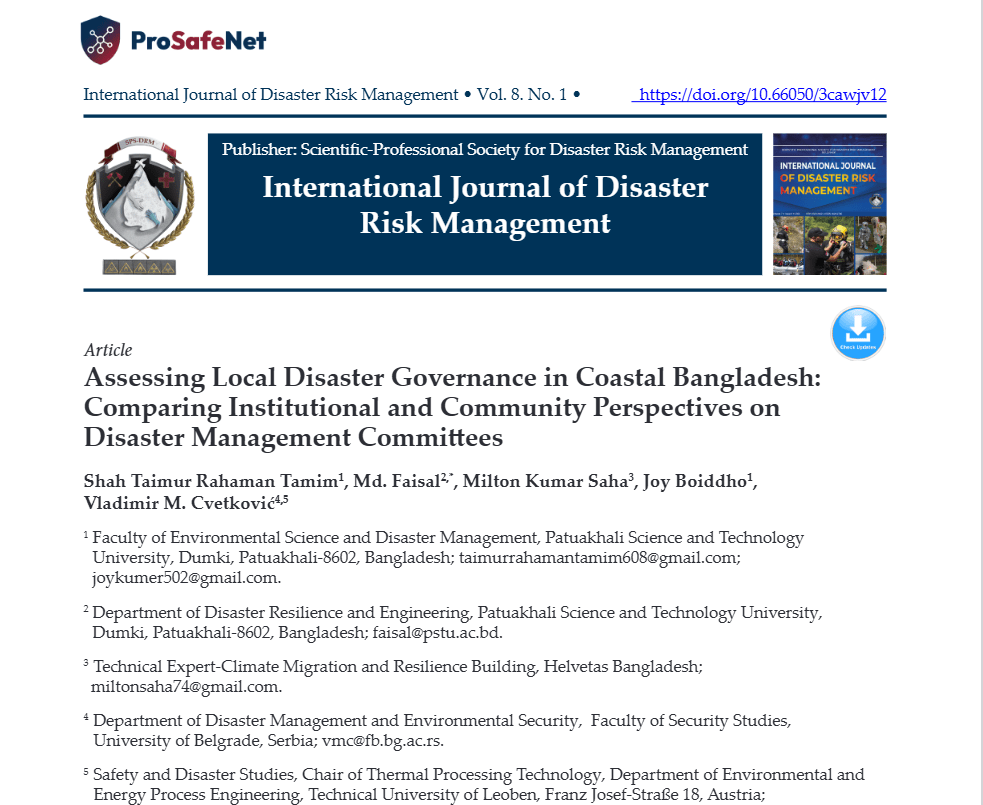
    Assessing Local Disaster Governance in Coastal Bangladesh: Comparing Institutional and Community Perspectives on Disaster Management Committees

    EditorBy EditorAugust 14, 2026No Comments3 Mins Read
    Facebook Twitter LinkedIn Telegram Pinterest Tumblr Reddit WhatsApp Email
    Assessing Local Disaster Governance in Coastal Bangladesh
    Assessing Local Disaster Governance in Coastal Bangladesh
    Share
    Facebook Twitter LinkedIn Pinterest Email

    Despite substantial investments in decentralized disaster governance, Bangladesh’s coastal regions remain highly vulnerable to climate-induced hazards. Disaster Management Committees (DMCs) were established to enhance local preparedness, response, and recovery through participatory governance. However, empirical evidence on their effectiveness at the community level remains limited. This study examines the institutional capacity, operational effectiveness, and governance legitimacy of DMCs in two disaster-prone coastal upazilas: Dumki and Kalapara of Patuakhali District. A mixed-methods approach was adopted, combining a community survey (N = 100) with key informant interviews (N = 30). Quantitative data were analyzed using descriptive and inferential statistics, and four composite indices were constructed: Community Awareness Index (CAI), Community Satisfaction Index (CSI), Institutional Capacity Index (ICI), and Operational Effectiveness Index (OEI). Qualitative data were analyzed thematically to contextualize institutional practices and explain the gap between institutional claims and community experience. The findings reveal a pronounced disconnect between institutional self-assessment and community-level perceptions. Community awareness of DMCs was very low (CAI = 0.07), and community satisfaction with DMC performance was also very low (CSI = 0.04), indicating limited public engagement and weak service visibility. In contrast, DMC members reported very high institutional capacity (ICI = 0.95) and ceiling-level operational effectiveness (OEI = 1.00), suggesting a substantial mismatch between institutional perceptions and community realities. Union-wise differences in awareness and satisfaction were limited and not statistically significant. Firth penalized logistic regression likewise did not identify any statistically significant predictor of community satisfaction, indicating that dissatisfaction was broad-based rather than confined to specific respondent groups or locations. Overall, the results suggest that decentralization alone is insufficient to ensure participatory and effective disaster governance without accountability, transparency, and sustained community engagement. The study highlights the importance of community-validated performance measures and stronger accountability mechanisms for improving local disaster risk governance in climate-vulnerable settings.

    Authors
    Shah Taimur Rahaman Tamim
    Faculty of Environmental Science and Disaster Management, Patuakhali Science and Technology University, Dumki, Patuakhali-8602, Bangladesh
    Author
    https://orcid.org/0009-0002-2228-5740
    Md. Faisal
    Department of Disaster Resilience and Engineering, Patuakhali Science and Technology University, Dumki, Patuakhali-8602, Bangladesh
    Author
    https://orcid.org/0000-0002-1705-8861
    Milton Kumar Saha
    Technical Expert-Climate Migration and Resilience Building, Helvetas Bangladesh
    Author
    https://orcid.org/0000-0002-2206-8204
    Joy Boiddho
    Faculty of Environmental Science and Disaster Management, Patuakhali Science and Technology University, Dumki, Patuakhali-8602, Bangladesh
    Author
    https://orcid.org/0009-0002-8287-3608
    Vladimir M. Cvetković
    Department of Disaster Management and Environmental Security, Faculty of Security Studies, University of Belgrade, Serbia , Safety and Disaster Studies, Chair of Thermal Processing Technology, Department of Environmental and Energy Process Engineering, Technical University of Leoben, Franz Josef-Straße 18, Austria
    Author
    https://orcid.org/0000-0002-3450-0658
    DOI: https://doi.org/10.66050/3cawjv12
    Keywords: local disaster governance, disaster management committees, coastal Bangladesh, institutional self-assessment, community perception, community satisfaction, accountability

    https://internationaljournalofdisasterriskmanagement.com/index.php/Vol1/article/view/230

    Assessing Local Disaster Governance in Coastal Bangladesh
    Share. Facebook Twitter Pinterest LinkedIn Tumblr Telegram Email
    Previous ArticleInsurance as a Model for Protecting the Economic System from Natural Disasters
    Next Article Administrative Risks and Logistics Supply Challenges in Gaza Shelter Centers During the 2023–2026 Conflict
    Editor
    • Website

    Prof. Dr. Vladimir M. Cvetković is recognized as a leading expert in Disaster Risk Management, with a focus on Risk Reduction, Preparedness, Response, and Recovery. He has authored over 300 scientific papers published in domestic and international journals and proceedings, as well as 30 books.

    Related Posts

    Beyond Platform Type: Effects of Vegetation Density, Sensor Modality, and Search Strategy on Aerial Search and Rescue Performance

    August 14, 2026

    Administrative Risks and Logistics Supply Challenges in Gaza Shelter Centers During the 2023–2026 Conflict

    August 14, 2026

    Insurance as a Model for Protecting the Economic System from Natural Disasters

    August 14, 2026
    Add A Comment
    Leave A Reply

    You must be logged in to post a comment.

    Scientific-Professional Society for Disaster Risk Management (SPS-DRM) President’s Office: president@spsdrm.org Administrative Office: secretary@spsdrm.org Belgrade, Serbia | www.spsdrm.org
    Scientific-Professional Society for Disaster Risk Management, Belgrade, Serbia.

    The Association “Scientific-Professional Society for Disaster Risk Management”  (www.spsdr.com) is a non-governmental and non-profit association, established for an indefinite period, for the purpose of achieving objectives related to the advancement of scientific and professional knowledge and practice in the field of disaster risk management, emergencies, security, protection and community resilience, through the implementation of quantitative and/or qualitative research, publishing activities (journals, books and other publications), organizing national and international events, conducting formal and non-formal forms of education and professional development, preparing expert analyses, risk assessments and planning documents, developing digital platforms and knowledge bases, as well as other activities in accordance with the law and this Statute.

    International Journal of Disaster Risk Management

    The International Journal of Disaster Risk Management (IJDRM) is a double-blind peer-reviewed, open-access international scientific journal, published twice a year, dedicated to advancing interdisciplinary research, policy, and professional practice in the fields of disaster risk management, disaster risk reduction, hazards, emergencies, and resilience. The journal provides an international platform for researchers, academics, practitioners, policymakers, emergency managers, and other professionals to exchange knowledge, research findings, and innovative approaches to disaster prevention and management. IJDRM publishes theoretical, empirical, methodological, and applied contributions covering the entire disaster risk management cycle—prevention, mitigation, preparedness, response, recovery, reconstruction, and resilience-building.   www.ijdrm.com

    Scientific-Professional Society for Disaster Risk Management (SPS-DRM)

    Type above and press Enter to search. Press Esc to cancel.