Close Menu
Scientific-Professional Society for Disasaster Risk ManagementScientific-Professional Society for Disasaster Risk Management
    Facebook X (Twitter) Instagram
    Facebook X (Twitter) Instagram YouTube LinkedIn TikTok
    Scientific-Professional Society for Disasaster Risk ManagementScientific-Professional Society for Disasaster Risk Management
    Contact
    • About
      • History
      • President
      • Members
      • Secretary
      • Documentation
        • Statute
        • Communication Strategy
        • Work Information Booklet
        • Seminar Programs
        • Training Programs
        • Regulations on Identification Cards, Badges, and Uniforms
        • Cooperation Agreements
        • Organization Flyer
        • Membership Application Form
      • Membership
      • Contact SPS-DRM
    • Publication
      • Books
      • Collection of papers
      • Scientific papers
      • Broschure
      • Flyers and Posters
      • International journal (IJDRM)
    • IJDRM
    • ProSafeNet
    • Science
      • International Institute
      • Research Projects
      • Research Collaboration
      • International conference
    • Education
      • Training
      • Seminars
    • Information
      • Gallery / Training Photo Archive
      • Announcements
      • Media
      • Donations and Sponsorships
    • Posts
    Scientific-Professional Society for Disasaster Risk ManagementScientific-Professional Society for Disasaster Risk Management
    Home»News»Climate Smart Disaster Risk Reduction: Indigenous Knowledge Practiced for Agriculture Sector in Coastal Bangladesh
    News

    Climate Smart Disaster Risk Reduction: Indigenous Knowledge Practiced for Agriculture Sector in Coastal Bangladesh

    EditorBy EditorAugust 10, 2026No Comments2 Mins Read
    Facebook Twitter LinkedIn Telegram Pinterest Tumblr Reddit WhatsApp Email
    Screenshot 2026 08 10 125802 Climate Smart Disaster Risk Reduction: Indigenous Knowledge Practiced for Agriculture Sector in Coastal Bangladesh
    Share
    Facebook Twitter LinkedIn Pinterest Email

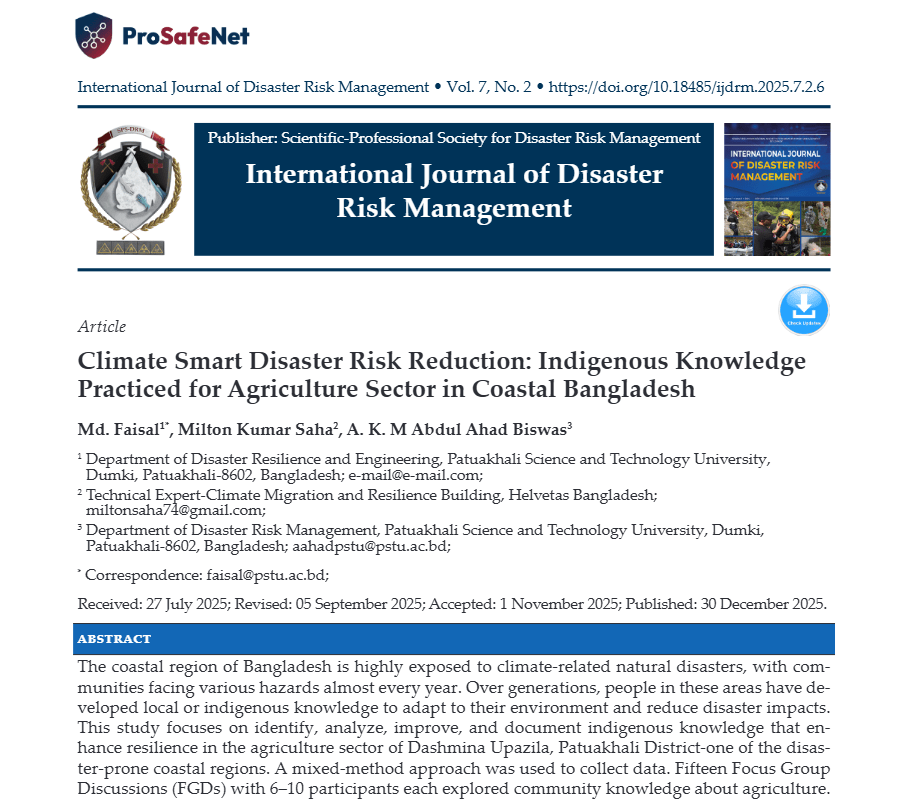
    The coastal region of Bangladesh is highly exposed to climate-related natural disasters, with communities facing various hazards almost every year. Over generations, people in these areas have developed local or indigenous knowledge to adapt to their environment and reduce disaster impacts. This study focuses on identify, analyze, improve, and document indigenous knowledge that enhance resilience in the agriculture sector of Dashmina Upazila, Patuakhali District-one of the disaster-prone coastal regions. A mixed-method approach was used to collect data. Fifteen Focus Group Discussions (FGDs) with 6–10 participants each explored community knowledge about agriculture. These were followed by 20 Key Informant Interviews (KIIs) with individuals such as social leaders, NGO workers, and community representatives to validate and expand on the FGDs’ findings. Additional data were gathered through direct observations using transect walks, five detailed case studies, and a review of secondary sources such as reports, articles, and research papers. Data were analyzed using Microsoft Excel 2010 for creating tables and summarizing information, while qualitative insights were described narratively. A SWOT (Strengths, Weaknesses, Opportunities, Threats) analysis was used to evaluate the indigenous practices. The study identified several effective traditional practices, including crop selection based on weather observation, raised farming land, planting fruit trees on house plinths, arum cultivation in lowlands, ridge-furrow farming for hydrophobic plants, seed preservation in mud pitchers, and livestock management strategies like using raised platforms (Killa) and jute sack covers. These practices offer low-cost, practical solutions that improve agricultural resilience. The study recommends integrating such knowledge into disaster risk reduction and development planning.

    Authors

    • Md. FaisalDepartment of Disaster Resilience and Engineering, Patuakhali Science and Technology University, Dumki, Patuakhali-8602, BangladeshAuthor
    • Milton Kumar SahaTechnical Expert-Climate Migration and Resilience Building, Helvetas BangladeshAuthor
    • A. K. M Abdul Ahad BiswasDepartment of Disaster Risk Management, Patuakhali Science and Technology University, Dumki, Patuakhali-8602, BangladeshAuthor

    DOI:

    https://doi.org/10.18485/ijdrm.2025.7.2.6

    Keywords:

    coastal area, disaster risk reduction, indigenous knowledge, agriculture

    https://internationaljournalofdisasterriskmanagement.com/index.php/Vol1/article/view/149

    Share. Facebook Twitter Pinterest LinkedIn Tumblr Telegram Email
    Previous ArticleBridging Defense Studies and Disaster Risk Reduction: Comparative Perspectives from the Former Yugoslavia
    Next Article Community-Based Disaster Risk Reduction: Overcoming Barriers to Build Stronger Communities
    Editor
    • Website

    Prof. Dr. Vladimir M. Cvetković is recognized as a leading expert in Disaster Risk Management, with a focus on Risk Reduction, Preparedness, Response, and Recovery. He has authored over 300 scientific papers published in domestic and international journals and proceedings, as well as 30 books.

    Related Posts

    Community-Based Disaster Risk Reduction: Overcoming Barriers to Build Stronger Communities

    August 10, 2026

    Bridging Defense Studies and Disaster Risk Reduction: Comparative Perspectives from the Former Yugoslavia

    August 10, 2026

    Beyond Tokenism: Exploring the Experiences and Barriers of Persons with Disabilities in Disability-inclusive Disaster Risk Management in Mwanza City Council, Tanzania

    August 10, 2026
    Add A Comment
    Leave A Reply

    You must be logged in to post a comment.

    Scientific-Professional Society for Disaster Risk Management (SPS-DRM) President’s Office: president@spsdrm.org Administrative Office: secretary@spsdrm.org Belgrade, Serbia | www.spsdrm.org
    Scientific-Professional Society for Disaster Risk Management, Belgrade, Serbia.

    The Association “Scientific-Professional Society for Disaster Risk Management”  (www.spsdr.com) is a non-governmental and non-profit association, established for an indefinite period, for the purpose of achieving objectives related to the advancement of scientific and professional knowledge and practice in the field of disaster risk management, emergencies, security, protection and community resilience, through the implementation of quantitative and/or qualitative research, publishing activities (journals, books and other publications), organizing national and international events, conducting formal and non-formal forms of education and professional development, preparing expert analyses, risk assessments and planning documents, developing digital platforms and knowledge bases, as well as other activities in accordance with the law and this Statute.

    International Journal of Disaster Risk Management

    The International Journal of Disaster Risk Management (IJDRM) is a double-blind peer-reviewed, open-access international scientific journal, published twice a year, dedicated to advancing interdisciplinary research, policy, and professional practice in the fields of disaster risk management, disaster risk reduction, hazards, emergencies, and resilience. The journal provides an international platform for researchers, academics, practitioners, policymakers, emergency managers, and other professionals to exchange knowledge, research findings, and innovative approaches to disaster prevention and management. IJDRM publishes theoretical, empirical, methodological, and applied contributions covering the entire disaster risk management cycle—prevention, mitigation, preparedness, response, recovery, reconstruction, and resilience-building.   www.ijdrm.com

    Scientific-Professional Society for Disaster Risk Management (SPS-DRM)

    Type above and press Enter to search. Press Esc to cancel.