Close Menu
Scientific-Professional Society for Disasaster Risk ManagementScientific-Professional Society for Disasaster Risk Management
    Facebook X (Twitter) Instagram
    Facebook X (Twitter) Instagram YouTube LinkedIn TikTok
    Scientific-Professional Society for Disasaster Risk ManagementScientific-Professional Society for Disasaster Risk Management
    Contact
    • About
      • History
      • President
      • Members
      • Secretary
      • Documentation
        • Statute
        • Communication Strategy
        • Work Information Booklet
        • Seminar Programs
        • Training Programs
        • Regulations on Identification Cards, Badges, and Uniforms
        • Cooperation Agreements
        • Organization Flyer
        • Membership Application Form
      • Membership
      • Contact SPS-DRM
    • Publication
      • Books
      • Collection of papers
      • Scientific papers
      • Broschure
      • Flyers and Posters
      • International journal (IJDRM)
    • IJDRM
    • ProSafeNet
    • Science
      • International Institute
      • Research Projects
      • Research Collaboration
      • International conference
    • Education
      • Training
      • Seminars
    • Information
      • Gallery / Training Photo Archive
      • Announcements
      • Media
      • Donations and Sponsorships
    • Posts
    Scientific-Professional Society for Disasaster Risk ManagementScientific-Professional Society for Disasaster Risk Management
    Home»News»Disaster and Dignity: Palliative Care Action Plan for Flooding in Garo Hills, Meghalaya
    News

    Disaster and Dignity: Palliative Care Action Plan for Flooding in Garo Hills, Meghalaya

    EditorBy EditorAugust 10, 2026No Comments2 Mins Read
    Facebook Twitter LinkedIn Telegram Pinterest Tumblr Reddit WhatsApp Email
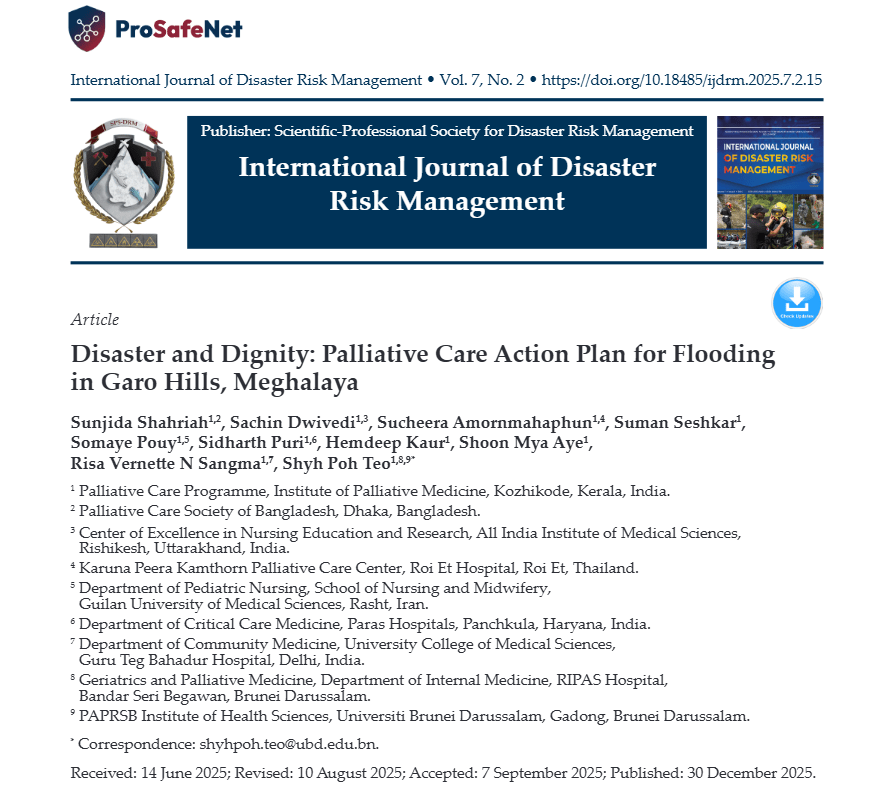
    Screenshot 2026 08 10 132328 Disaster and Dignity: Palliative Care Action Plan for Flooding in Garo Hills, Meghalaya
    Share
    Facebook Twitter LinkedIn Pinterest Email

    Palliative care is an essential component of healthcare systems, which aims to improve the quality of life for people facing life-threatening illnesses and their families through symptom control, psychosocial support, and dignity in care. In disaster situations where health systems are often overwhelmed and resources are strained, the integration of palliative care becomes crucial to address the needs of vulnerable populations. The Garo Hills region of Meghalaya, Northeast India, is geographically remote, vulnerable to annual flooding, and has limited access to health services. This paper explores the theoretical development of a palliative care action plan for the flood-prone region of Garo Hills, Meghalaya, conceptualized as a group exercise for the Fellowship of Palliative Care 2022 to address palliative care needs in a neglected setting. Strategies to obtain buy-in for a palliative care intervention are described based on three target groups: national and international support, neighboring regions, and the Garo community. Given the region’s vulnerability to climate-related disasters, the action plan emphasises community-based preparedness and the integration of palliative care into humanitarian response efforts. This conceptual framework is intended as a guide for managers, humanitarian actors, and policymakers, with potential adaptation to other disaster-prone regions, where palliative care is necessary. No disaster response is complete without attention to those who may not survive.

    Authors

    • Sunjida ShahriahFellowship in Palliative Care Programme, Institute of Palliative Medicine, Kozhikode, Kerala, IndiaAuthor
    • Risa Vernette N. SangmaDepartment of Community Medicine, University College of Medical Sciences, Guru Teg Bahadur Hospital, Delhi, IndiaAuthor
    • Shoon Mya AyeFellowship in Palliative Care Programme, Institute of Palliative Medicine, Kozhikode, Kerala, IndiaAuthor
    • Hemdeep KaurDepartment of Community Medicine, University College of Medical Sciences, Guru Teg Bahadur Hospital, Delhi, IndiaAuthor
    • Sidharth PuriDepartment of Critical Care Medicine, Paras Hospitals, Panchkula, Haryana, IndiaAuthor
    • Somaye PouyDepartment of Pediatric Nursing, School of Nursing and Midwifery, Guilan University of Medical Sciences, Rasht, IranAuthor
    • Suman SeshkarFellowship in Palliative Care Programme, Institute of Palliative Medicine, Kozhikode, Kerala, IndiaAuthor
    • Sucheera AmornmahaphunKaruna Peera Kamthorn Palliative Care Center, Roi Et Hospital, Roi Et, ThailandAuthor
    • Sachin DwivediFellowship in Palliative Care Programme, Institute of Palliative Medicine, Kozhikode, Kerala, IndiaAuthor
    • Shyh Poh TeoGeriatrics and Palliative Medicine, Department of Internal Medicine, RIPAS Hospital, Bandar Seri Begawan, Brunei DarussalamAuthor

    DOI:

    https://doi.org/10.18485/ijdrm.2025.7.2.15

    Keywords:

    community health, disaster planning, health services accessibility, natural disasters, palliative care

    https://internationaljournalofdisasterriskmanagement.com/index.php/Vol1/article/view/153

    Share. Facebook Twitter Pinterest LinkedIn Tumblr Telegram Email
    Previous ArticleDigital Platform for Ecological Education of Students – Advancing the United Nations Sustainable Development Goals and the European Green Deal: The Case of ProSafeNet (Global Hub)
    Next Article Disaster Risk Assessment and Management Challenges Faced by University Libraries: A Case Study of Disaster-Prone Region Hazara, Pakistan
    Editor
    • Website

    Prof. Dr. Vladimir M. Cvetković is recognized as a leading expert in Disaster Risk Management, with a focus on Risk Reduction, Preparedness, Response, and Recovery. He has authored over 300 scientific papers published in domestic and international journals and proceedings, as well as 30 books.

    Related Posts

    Disaster Risk Assessment and Management Challenges Faced by University Libraries: A Case Study of Disaster-Prone Region Hazara, Pakistan

    August 10, 2026

    Digital Platform for Ecological Education of Students – Advancing the United Nations Sustainable Development Goals and the European Green Deal: The Case of ProSafeNet (Global Hub)

    August 10, 2026

    Digital Literacy and Educational Empowerment Among Rural Women in Bangladesh: Bridging the Technology Access Gap

    August 10, 2026
    Add A Comment
    Leave A Reply

    You must be logged in to post a comment.

    Scientific-Professional Society for Disaster Risk Management (SPS-DRM) President’s Office: president@spsdrm.org Administrative Office: secretary@spsdrm.org Belgrade, Serbia | www.spsdrm.org
    Scientific-Professional Society for Disaster Risk Management, Belgrade, Serbia.

    The Association “Scientific-Professional Society for Disaster Risk Management”  (www.spsdr.com) is a non-governmental and non-profit association, established for an indefinite period, for the purpose of achieving objectives related to the advancement of scientific and professional knowledge and practice in the field of disaster risk management, emergencies, security, protection and community resilience, through the implementation of quantitative and/or qualitative research, publishing activities (journals, books and other publications), organizing national and international events, conducting formal and non-formal forms of education and professional development, preparing expert analyses, risk assessments and planning documents, developing digital platforms and knowledge bases, as well as other activities in accordance with the law and this Statute.

    International Journal of Disaster Risk Management

    The International Journal of Disaster Risk Management (IJDRM) is a double-blind peer-reviewed, open-access international scientific journal, published twice a year, dedicated to advancing interdisciplinary research, policy, and professional practice in the fields of disaster risk management, disaster risk reduction, hazards, emergencies, and resilience. The journal provides an international platform for researchers, academics, practitioners, policymakers, emergency managers, and other professionals to exchange knowledge, research findings, and innovative approaches to disaster prevention and management. IJDRM publishes theoretical, empirical, methodological, and applied contributions covering the entire disaster risk management cycle—prevention, mitigation, preparedness, response, recovery, reconstruction, and resilience-building.   www.ijdrm.com

    Scientific-Professional Society for Disaster Risk Management (SPS-DRM)

    Type above and press Enter to search. Press Esc to cancel.