Close Menu
Scientific-Professional Society for Disasaster Risk ManagementScientific-Professional Society for Disasaster Risk Management
    Facebook X (Twitter) Instagram
    Facebook X (Twitter) Instagram YouTube LinkedIn TikTok
    Scientific-Professional Society for Disasaster Risk ManagementScientific-Professional Society for Disasaster Risk Management
    Contact
    • About
      • History
      • President
      • Members
      • Secretary
      • Documentation
        • Statute
        • Communication Strategy
        • Work Information Booklet
        • Seminar Programs
        • Training Programs
        • Regulations on Identification Cards, Badges, and Uniforms
        • Cooperation Agreements
        • Organization Flyer
        • Membership Application Form
      • Membership
      • Contact SPS-DRM
    • Publication
      • Books
      • Collection of papers
      • Scientific papers
      • Broschure
      • Flyers and Posters
      • International journal (IJDRM)
    • IJDRM
      • Volume 8, Number 1
      • Volume 7, Number 2
      • Volume 7, Number 1
      • Volume 6, Number 2
      • Volume 6, Number 1
      • Volume 5, Number 2
      • Volume 5, Number 1
      • Volume 4, Number 2
      • Volume 4, Number 1
      • Volume 3, Number 2
      • Volume 3, Number 1
      • Volume 2, Number 2
      • Volume 2, Number 1
      • Volume 1, Number 2
      • Volume 1, Number 1
    • ProSafeNet
    • Science
      • International Institute
      • Research Projects
      • Research Collaboration
      • International Conference
    • Education
      • Training
      • Seminars
    • Information
      • Gallery / Training Photo Archive
      • Announcements
      • Media
      • Donations and Sponsorships
    • Posts
    Scientific-Professional Society for Disasaster Risk ManagementScientific-Professional Society for Disasaster Risk Management
    Home»Published papers»Strategic Risks of AI-Enabled Automation: Implications for Crisis Management and Systemic Resilience
    Published papers

    Strategic Risks of AI-Enabled Automation: Implications for Crisis Management and Systemic Resilience

    EditorBy EditorAugust 14, 2026No Comments2 Mins Read
    Facebook Twitter LinkedIn Telegram Pinterest Tumblr Reddit WhatsApp Email
    Strategic Risks of AI-Enabled Automation: Implications for Crisis Management and Systemic Resilience
    Strategic Risks of AI-Enabled Automation: Implications for Crisis Management and Systemic Resilience
    Share
    Facebook Twitter LinkedIn Pinterest Email

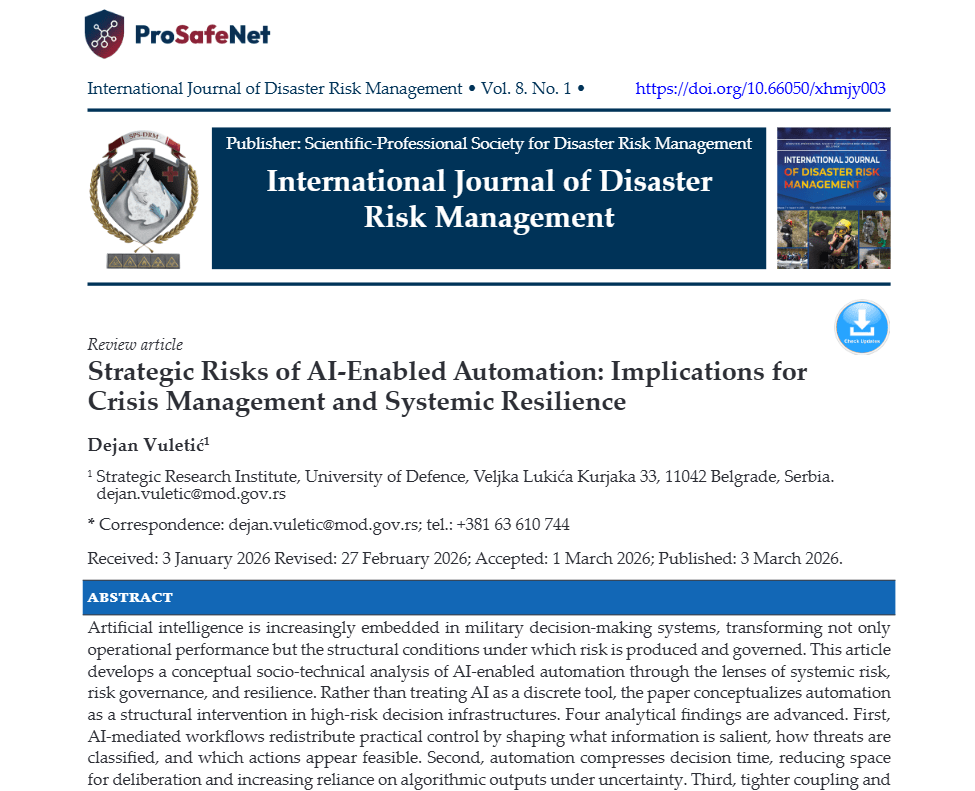
    Artificial intelligence is increasingly embedded in military decision-making systems, transforming not only operational performance but the structural conditions under which risk is produced and governed. This article develops a conceptual socio-technical analysis of AI-enabled automation through the lenses of systemic risk, risk governance, and resilience. Rather than treating AI as a discrete tool, the paper conceptualizes automation as a structural intervention in high-risk decision infrastructures. Four analytical findings are advanced. First, AI-mediated workflows redistribute practical control by shaping what information is salient, how threats are classified, and which actions appear feasible. Second, automation compresses decision time, reducing space for deliberation and increasing reliance on algorithmic outputs under uncertainty. Third, tighter coupling and accelerated interaction across domains enable localized errors or manipulations to propagate into broader escalation dynamics. Fourth, distributed human–machine architectures contribute to responsibility diffusion, weakening the alignment between accountability and effective decision influence. The article argues that prevailing “human-in-the-loop” safeguards are insufficient when control is reduced to technical override rather than institutional capacity for judgment and accountability. Effective integration of AI in high-risk environments requires governance arrangements that preserve human judgment as a strategic resource for crisis management and systemic resilience.

    Authors
    Dejan Vuletić
    Strategic Research Institute, University of Defence, Veljka Lukića Kurjaka 33, 11042 Belgrade, Serbia
    Author
    https://orcid.org/0000-0001-9496-2259
    DOI: https://doi.org/10.66050/xhmjy003
    Keywords: artificial intelligence, military decision-making, risk governance, socio-technical systems, escalation risk

    https://internationaljournalofdisasterriskmanagement.com/index.php/Vol1/article/view/198

    Strategic Risks of AI-Enabled Automation: Implications for Crisis Management and Systemic Resilience
    Share. Facebook Twitter Pinterest LinkedIn Tumblr Telegram Email
    Previous ArticleSite Suitability of Evacuation Centers in Zamboanga City, Philippines using GIS: Assessing Safety and Accessibility in Hazard-Prone Areas
    Next Article Regulating Emerging Technologies in Disaster Management: A Comparative Analysis of Security Governance and Legal Liability in India and Serbia
    Editor
    • Website

    Prof. Dr. Vladimir M. Cvetković is recognized as a leading expert in Disaster Risk Management, with a focus on Risk Reduction, Preparedness, Response, and Recovery. He has authored over 300 scientific papers published in domestic and international journals and proceedings, as well as 30 books.

    Related Posts

    Beyond Platform Type: Effects of Vegetation Density, Sensor Modality, and Search Strategy on Aerial Search and Rescue Performance

    August 14, 2026

    Administrative Risks and Logistics Supply Challenges in Gaza Shelter Centers During the 2023–2026 Conflict

    August 14, 2026

    Assessing Local Disaster Governance in Coastal Bangladesh: Comparing Institutional and Community Perspectives on Disaster Management Committees

    August 14, 2026
    Add A Comment
    Leave A Reply

    You must be logged in to post a comment.

    Scientific-Professional Society for Disaster Risk Management (SPS-DRM) President’s Office: president@spsdrm.org Administrative Office: secretary@spsdrm.org Belgrade, Serbia | www.spsdrm.org
    Scientific-Professional Society for Disaster Risk Management, Belgrade, Serbia.

    The Association “Scientific-Professional Society for Disaster Risk Management”  (www.spsdr.com) is a non-governmental and non-profit association, established for an indefinite period, for the purpose of achieving objectives related to the advancement of scientific and professional knowledge and practice in the field of disaster risk management, emergencies, security, protection and community resilience, through the implementation of quantitative and/or qualitative research, publishing activities (journals, books and other publications), organizing national and international events, conducting formal and non-formal forms of education and professional development, preparing expert analyses, risk assessments and planning documents, developing digital platforms and knowledge bases, as well as other activities in accordance with the law and this Statute.

    International Journal of Disaster Risk Management

    The International Journal of Disaster Risk Management (IJDRM) is a double-blind peer-reviewed, open-access international scientific journal, published twice a year, dedicated to advancing interdisciplinary research, policy, and professional practice in the fields of disaster risk management, disaster risk reduction, hazards, emergencies, and resilience. The journal provides an international platform for researchers, academics, practitioners, policymakers, emergency managers, and other professionals to exchange knowledge, research findings, and innovative approaches to disaster prevention and management. IJDRM publishes theoretical, empirical, methodological, and applied contributions covering the entire disaster risk management cycle—prevention, mitigation, preparedness, response, recovery, reconstruction, and resilience-building.   www.ijdrm.com

    Scientific-Professional Society for Disaster Risk Management (SPS-DRM)

    Type above and press Enter to search. Press Esc to cancel.