Close Menu
Scientific-Professional Society for Disasaster Risk ManagementScientific-Professional Society for Disasaster Risk Management
    Facebook X (Twitter) Instagram
    Facebook X (Twitter) Instagram YouTube LinkedIn TikTok
    Scientific-Professional Society for Disasaster Risk ManagementScientific-Professional Society for Disasaster Risk Management
    Contact
    • About
      • History
      • President
      • Members
      • Secretary
      • Documentation
        • Statute
        • Communication Strategy
        • Work Information Booklet
        • Seminar Programs
        • Training Programs
        • Regulations on Identification Cards, Badges, and Uniforms
        • Cooperation Agreements
        • Organization Flyer
        • Membership Application Form
      • Membership
      • Contact SPS-DRM
    • Publication
      • Books
      • Collection of papers
      • Scientific papers
      • Broschure
      • Flyers and Posters
      • International journal (IJDRM)
    • IJDRM
      • Volume 8, Number 1
      • Volume 7, Number 2
      • Volume 7, Number 1
      • Volume 6, Number 2
      • Volume 6, Number 1
      • Volume 5, Number 2
      • Volume 5, Number 1
      • Volume 4, Number 2
      • Volume 4, Number 1
      • Volume 3, Number 2
      • Volume 3, Number 1
      • Volume 2, Number 2
      • Volume 2, Number 1
      • Volume 1, Number 2
      • Volume 1, Number 1
    • ProSafeNet
    • Science
      • International Institute
      • Research Projects
      • Research Collaboration
      • International Conference
    • Education
      • Training
      • Seminars
    • Media
      • Gallery / Training Photo Archive
      • Donations and Sponsorships
    • Posts
      • Announcements
    Scientific-Professional Society for Disasaster Risk ManagementScientific-Professional Society for Disasaster Risk Management
    Home»Published papers»Risk Intensity and Exposure-Weighted Burden of Multiple Hazards in Serbia: A Nationwide Secondary Analysis of Public Health Emergency Assessments
    Published papers

    Risk Intensity and Exposure-Weighted Burden of Multiple Hazards in Serbia: A Nationwide Secondary Analysis of Public Health Emergency Assessments

    EditorBy EditorNovember 4, 2026No Comments2 Mins Read
    Facebook Twitter LinkedIn Telegram Pinterest Tumblr Reddit WhatsApp Email
    Cvetković, V. M., Ivanović, D., Lalić, V., Sabljić, L., Bašić, J., Cvetković, V. D., & Lukić, T. (2026). Risk Intensity and Exposure-Weighted Burden of Multiple Hazards in Serbia: A Nationwide Secondary Analysis of Public Health Emergency Assessments. Safety, 12(6), 145. https://doi.org/10.3390/safety12060145
    Cvetković, V. M., Ivanović, D., Lalić, V., Sabljić, L., Bašić, J., Cvetković, V. D., & Lukić, T. (2026). Risk Intensity and Exposure-Weighted Burden of Multiple Hazards in Serbia: A Nationwide Secondary Analysis of Public Health Emergency Assessments. Safety, 12(6), 145. https://doi.org/10.3390/safety12060145
    Share
    Facebook Twitter LinkedIn Pinterest Email

    Can communities classified as facing moderate disaster risk still experience a substantial cumulative burden from multiple hazards?

    I am pleased to share our newly published open-access research article in Safety:
    “Risk Intensity and Exposure-Weighted Burden of Multiple Hazards in Serbia: A Nationwide Secondary Analysis of Public Health Emergency Assessments”

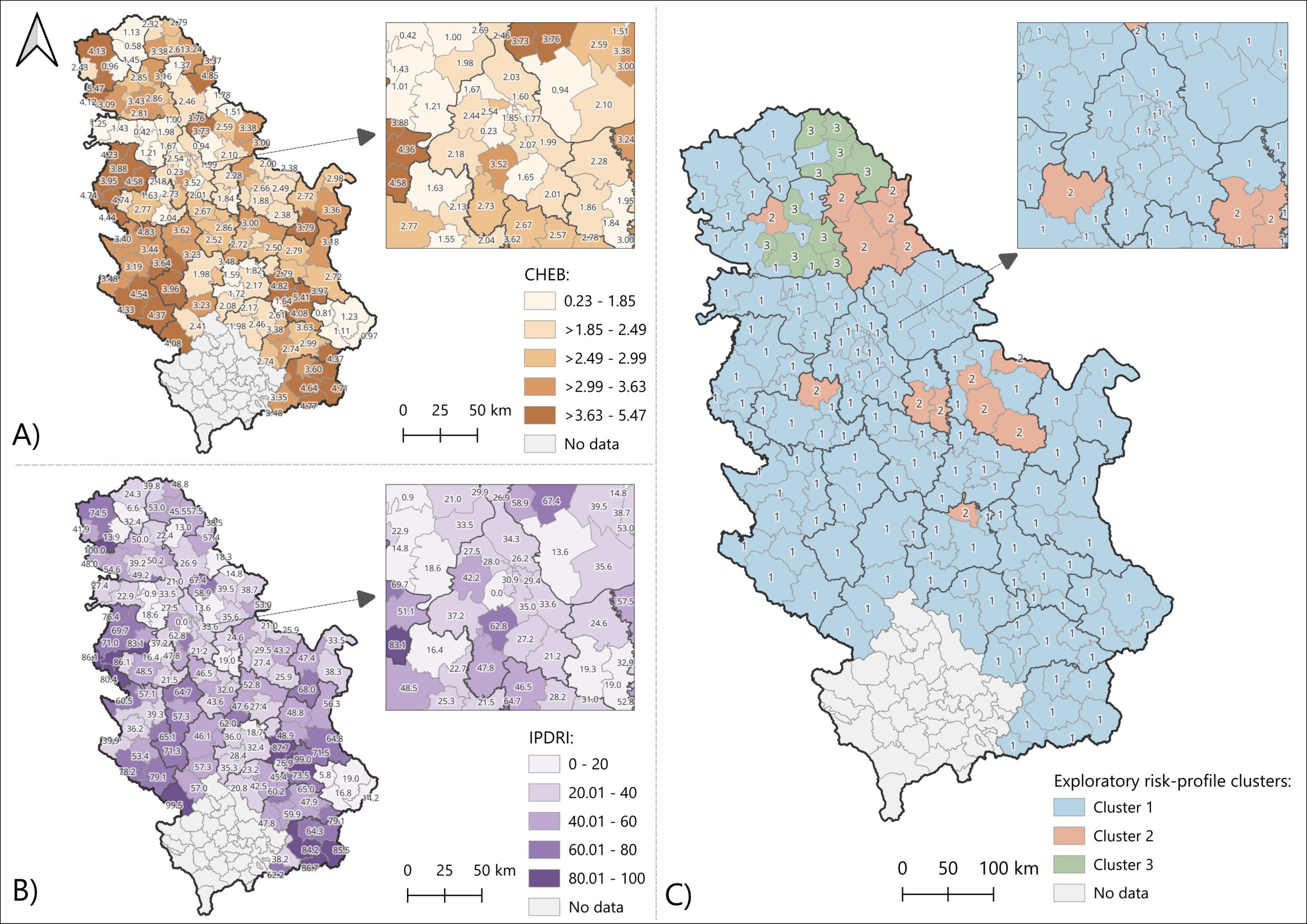
    Our nationwide study examines 161 local administrative units across Serbia, using data from the World Health Organization’s Strategic Toolkit for Assessing Risks (WHO STAR), advanced statistical analyses, and Geographic Information Systems (GIS).

    Key research findings:
    – 83.2% of local units were classified as moderate risk, compared with 11.2% low risk and 5.6% high risk.
    – We developed complementary analytical measures: the Probability–Impact Product (PIP), Cumulative Hazard–Exposure Burden (CHEB), Exposure-Weighted PIP, Portfolio Risk Burden (PRB = PIP × CHEB), and a sample-relative 0–100 Integrated Portfolio Disaster Risk Index (IPDRI).
    – National mean values were PIP = 8.18, CHEB = 2.78, exposure-weighted PIP = 2.08, PRB = 22.64, and IPDRI = 43.64.
    – The IPDRI showed only a weak, non-significant relationship with the official WHO STAR risk category (Spearman’s ρ = 0.104, p = 0.187), indicating limited correspondence between categorical risk intensity and the constructed cumulative portfolio-burden measure.
    – Significant regional differences were observed. Average IPDRI values were 48.31 in Central Serbia, 37.75 in Vojvodina, and 32.00 in Belgrade.
    – Applying risk-matrix thresholds to aggregate probability–impact scores reproduced the supplied STAR categories in only 75.8% of local units, highlighting important aggregation-related methodological challenges.
    – Exploratory cluster analysis identified three local assessment profiles, further illustrating the diversity of multi-hazard conditions.
    – One particularly important finding: Odžaci and Niš had among the highest exposure-weighted portfolio-burden scores in the analysed sample, despite being classified as moderate risk under the supplied STAR assessment.

    These findings demonstrate why disaster risk assessment should consider both the intensity of individual hazards and the cumulative exposure burden of multiple hazards.

    The newly developed indicators are intended as transparent, exploratory analytical complements to WHO STAR, not as replacements for its official classifications or independently validated predictions of disaster losses.

    The broader scientific message is clear: A single categorical risk score may not fully capture the complexity of multi-hazard exposure and preparedness needs.

    I sincerely thank my co-authors Dejan Ivanović, Velibor Lalić, Luka Sabljic, Jasmina Bašić, Vanja D. Cvetković, and Tin Lukić for their valuable contributions to this interdisciplinary research.

    Read the full open-access article:
    https://lnkd.in/dvAsfE4f
    Safety (2026), 12(6), 145.

    & Lukić 12(6) 145. https://doi.org/10.3390/safety12060145 Bašić Cvetković D. Ivanović J. L. Lalić Sabljić T. (2026). Risk Intensity and Exposure-Weighted Burden of Multiple Hazards in Serbia: A Nationwide Secondary Analysis of Public Health Emergency Assessments. Safety V. V. D. V. M.
    Share. Facebook Twitter Pinterest LinkedIn Tumblr Telegram Email
    Previous ArticleKatastrophenrisikomanagement: Theorie, Konzepte und Methoden
    Editor
    • Website

    Prof. Dr. Vladimir M. Cvetković is recognized as a leading expert in Disaster Risk Management, with a focus on Risk Reduction, Preparedness, Response, and Recovery. He has authored over 300 scientific papers published in domestic and international journals and proceedings, as well as 30 books.

    Related Posts

    Katastrophenrisikomanagement: Theorie, Konzepte und Methoden

    October 17, 2026

    A Little Guide to Disaster Safety for Children

    October 11, 2026

    Indigenous Flood Early Warning Systems for Hydropower-Dam-Induced Flood Risk: A Case Study of the Dassenech Community in the Lower Omo Valley, Ethiopia

    August 21, 2026
    Add A Comment
    Leave A Reply

    You must be logged in to post a comment.

    Scientific-Professional Society for Disaster Risk Management (SPS-DRM) President’s Office: president@spsdrm.org Administrative Office: secretary@spsdrm.org Belgrade, Serbia | www.spsdrm.org
    Scientific-Professional Society for Disaster Risk Management, Belgrade, Serbia.

    The Association “Scientific-Professional Society for Disaster Risk Management”  (www.spsdr.com) is a non-governmental and non-profit association, established for an indefinite period, for the purpose of achieving objectives related to the advancement of scientific and professional knowledge and practice in the field of disaster risk management, emergencies, security, protection and community resilience, through the implementation of quantitative and/or qualitative research, publishing activities (journals, books and other publications), organizing national and international events, conducting formal and non-formal forms of education and professional development, preparing expert analyses, risk assessments and planning documents, developing digital platforms and knowledge bases, as well as other activities in accordance with the law and this Statute.

    International Journal of Disaster Risk Management

    The International Journal of Disaster Risk Management (IJDRM) is a double-blind peer-reviewed, open-access international scientific journal, published twice a year, dedicated to advancing interdisciplinary research, policy, and professional practice in the fields of disaster risk management, disaster risk reduction, hazards, emergencies, and resilience. The journal provides an international platform for researchers, academics, practitioners, policymakers, emergency managers, and other professionals to exchange knowledge, research findings, and innovative approaches to disaster prevention and management. IJDRM publishes theoretical, empirical, methodological, and applied contributions covering the entire disaster risk management cycle—prevention, mitigation, preparedness, response, recovery, reconstruction, and resilience-building.   www.ijdrm.com

    Scientific-Professional Society for Disaster Risk Management (SPS-DRM)

    Type above and press Enter to search. Press Esc to cancel.