Close Menu
Scientific-Professional Society for Disasaster Risk ManagementScientific-Professional Society for Disasaster Risk Management
    Facebook X (Twitter) Instagram
    Facebook X (Twitter) Instagram YouTube LinkedIn TikTok
    Scientific-Professional Society for Disasaster Risk ManagementScientific-Professional Society for Disasaster Risk Management
    Contact
    • About
      • History
      • President
      • Members
      • Secretary
      • Documentation
        • Statute
        • Communication Strategy
        • Work Information Booklet
        • Seminar Programs
        • Training Programs
        • Regulations on Identification Cards, Badges, and Uniforms
        • Cooperation Agreements
        • Organization Flyer
        • Membership Application Form
      • Membership
      • Contact SPS-DRM
    • Publication
      • Books
      • Collection of papers
      • Scientific papers
      • Broschure
      • Flyers and Posters
      • International journal (IJDRM)
    • IJDRM
      • Volume 8, Number 1
      • Volume 7, Number 2
      • Volume 7, Number 1
      • Volume 6, Number 2
      • Volume 6, Number 1
      • Volume 5, Number 2
      • Volume 5, Number 1
      • Volume 4, Number 2
      • Volume 4, Number 1
      • Volume 3, Number 2
      • Volume 3, Number 1
      • Volume 2, Number 2
      • Volume 2, Number 1
      • Volume 1, Number 2
      • Volume 1, Number 1
    • ProSafeNet
    • Science
      • International Institute
      • Research Projects
      • Research Collaboration
      • International Conference
    • Education
      • Training
      • Seminars
    • Media
      • Gallery / Training Photo Archive
      • Donations and Sponsorships
    • Posts
      • Announcements
    Scientific-Professional Society for Disasaster Risk ManagementScientific-Professional Society for Disasaster Risk Management
    Home»News»The Impacts of Upstream Damming of the Omo River on Flood-Retreat Agriculture and Food Security Among Dassanech Agro-pastoralists, Lower Omo Valley, Ethiopia
    News

    The Impacts of Upstream Damming of the Omo River on Flood-Retreat Agriculture and Food Security Among Dassanech Agro-pastoralists, Lower Omo Valley, Ethiopia

    EditorBy EditorAugust 10, 2026No Comments2 Mins Read
    Facebook Twitter LinkedIn Telegram Pinterest Tumblr Reddit WhatsApp Email
    Screenshot 2026 08 10 184114 The Impacts of Upstream Damming of the Omo River on Flood-Retreat Agriculture and Food Security Among Dassanech Agro-pastoralists, Lower Omo Valley, Ethiopia
    Share
    Facebook Twitter LinkedIn Pinterest Email

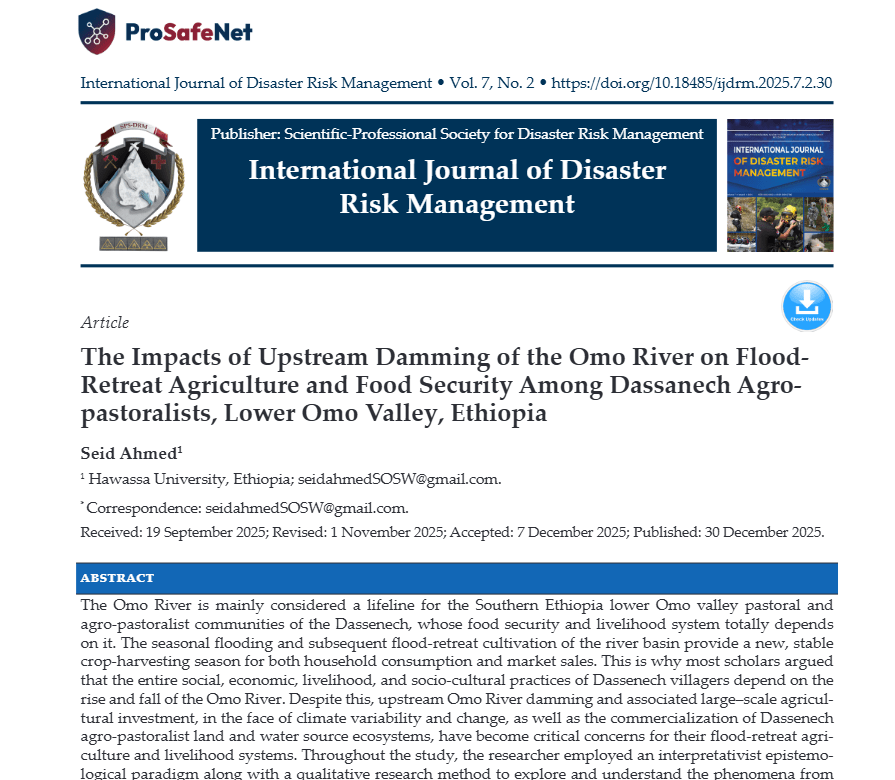
    The Omo River is mainly considered a lifeline for the Southern Ethiopia lower Omo valley pastoral and agro-pastoralist communities of the Dassenech, whose food security and livelihood system totally depends on it. The seasonal flooding and subsequent flood-retreat cultivation of the river basin provide a new, stable crop-harvesting season for both household consumption and market sales. This is why most scholars argued that the entire social, economic, livelihood, and socio-cultural practices of Dassenech villagers depend on the rise and fall of the Omo River. Despite this, upstream Omo River damming and associated large–scale agricultural investment, in the face of climate variability and change, as well as the commercialization of Dassenech agro-pastoralist land and water source ecosystems, have become critical concerns for their flood-retreat agriculture and livelihood systems. Throughout the study, the researcher employed an interpretativist epistemological paradigm along with a qualitative research method to explore and understand the phenomena from the study participants’ or actors’ own perspective, and to examine the world they experienced via key informant interviews, in-depth interviews, focus group discussions, and a case study with nearly 68 participants. So, this article aims to assess and analyze the impacts of upstream damming of the Omo River on flood retreat agriculture and food security among the Dassenech agro-pastoralists of the Lower Omo Valley in detail, and how it affects local agro-pastoralists’ survival systems in the face of harsh agro-ecology and climate change. However, the study findings reveal that the destruction of Dassenech pastoral and agro-pastoral communities, flood retreat agriculture swiftly produces and intensifies major humanitarian disasters, including drought, and recurrent occurrences of flooding disasters in the area, with widespread conditions of starvation, disease, and spiraling interethnic armed conflict between the tri-nation border region of the lower Omo valley region. This increased their vulnerability to the effects of food insecurity, due to the loss of their seasonal sources of grain products – flood retreat crop cultivation, as well as livestock grazing areas. Therefore, to ensure the well-being of human development in the area, maintaining the sustainability of local ecosystem functions is vital for local communities’ survival and resilience-building.

    Authors

    • Seid AhmedHawassa University, EthiopiaAuthor

    DOI:

    https://doi.org/10.18485/ijdrm.2025.7.2.30

    Keywords:

    lower Omo Valley, agro-pastoralist, food security, flood-retreat Agriculture

    https://internationaljournalofdisasterriskmanagement.com/index.php/Vol1/article/view/134


    Share. Facebook Twitter Pinterest LinkedIn Tumblr Telegram Email
    Previous ArticleThe Impact of Political Variables on the Quality of Health Services in Governmental Hospitals – Case Study: Al-Shifa Medical Complex
    Next Article Transforming Landscapes, Shaping Risk: Land Cover Change and Disaster Vulnerability in Parshuram Municipality (2005–2025)
    Editor
    • Website

    Prof. Dr. Vladimir M. Cvetković is recognized as a leading expert in Disaster Risk Management, with a focus on Risk Reduction, Preparedness, Response, and Recovery. He has authored over 300 scientific papers published in domestic and international journals and proceedings, as well as 30 books.

    Related Posts

    Strategic Cooperation Agreement Signed between ProSafeNet and the Faculty of Security Studies, University of Belgrade

    September 9, 2026

    Adaptive Governance of Disaster and Systemic Risks in Critical Energy Infrastructure: A Complex Adaptive Systems Perspective

    August 21, 2026

    Disaster Victim Identification in India: Forensic Challenges and the Need for a Comprehensive Legal–Policy Framework

    August 21, 2026
    Add A Comment
    Leave A Reply

    You must be logged in to post a comment.

    Scientific-Professional Society for Disaster Risk Management (SPS-DRM) President’s Office: president@spsdrm.org Administrative Office: secretary@spsdrm.org Belgrade, Serbia | www.spsdrm.org
    Scientific-Professional Society for Disaster Risk Management, Belgrade, Serbia.

    The Association “Scientific-Professional Society for Disaster Risk Management”  (www.spsdr.com) is a non-governmental and non-profit association, established for an indefinite period, for the purpose of achieving objectives related to the advancement of scientific and professional knowledge and practice in the field of disaster risk management, emergencies, security, protection and community resilience, through the implementation of quantitative and/or qualitative research, publishing activities (journals, books and other publications), organizing national and international events, conducting formal and non-formal forms of education and professional development, preparing expert analyses, risk assessments and planning documents, developing digital platforms and knowledge bases, as well as other activities in accordance with the law and this Statute.

    International Journal of Disaster Risk Management

    The International Journal of Disaster Risk Management (IJDRM) is a double-blind peer-reviewed, open-access international scientific journal, published twice a year, dedicated to advancing interdisciplinary research, policy, and professional practice in the fields of disaster risk management, disaster risk reduction, hazards, emergencies, and resilience. The journal provides an international platform for researchers, academics, practitioners, policymakers, emergency managers, and other professionals to exchange knowledge, research findings, and innovative approaches to disaster prevention and management. IJDRM publishes theoretical, empirical, methodological, and applied contributions covering the entire disaster risk management cycle—prevention, mitigation, preparedness, response, recovery, reconstruction, and resilience-building.   www.ijdrm.com

    Scientific-Professional Society for Disaster Risk Management (SPS-DRM)

    Type above and press Enter to search. Press Esc to cancel.