

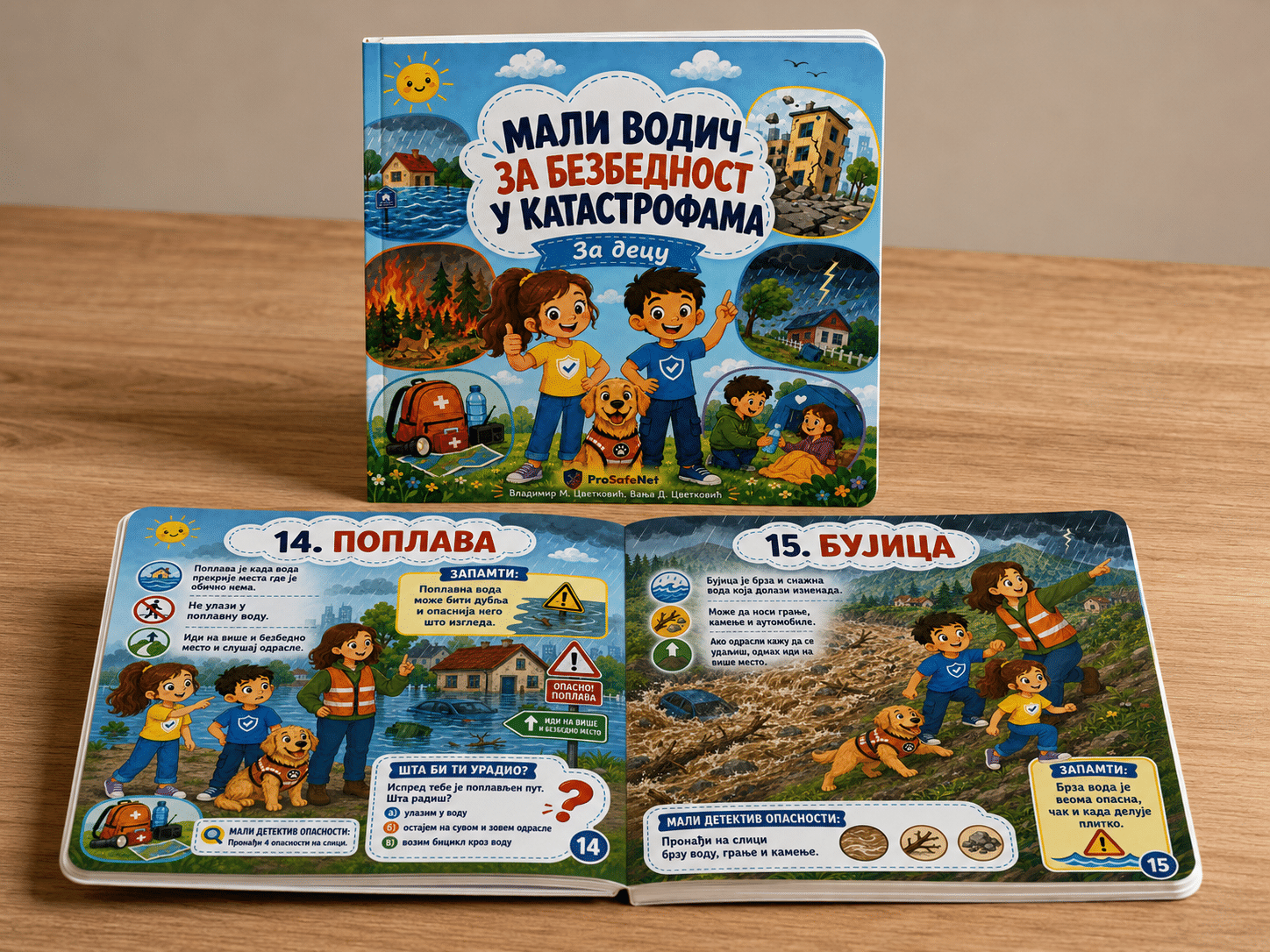
Authors: Prof. Dr. Vladimir M. Cvetković and Vanja D. Cvetković
Publisher: Scientific-Professional Society for Disaster Risk Management (SPS-DRM), Belgrade, Serbia
Year of Publication: 2026
ISBN: 978-86-81424-25-4
About the Publication
A Little Guide to Disaster Safety for Children is a modern, richly illustrated, and interactive educational publication designed to develop children’s knowledge, awareness, practical skills, and appropriate behaviour in situations involving natural and technological hazards. The guide aims to make complex scientific and professional knowledge in the fields of Disaster Risk Management (DRM) and Disaster Risk Reduction (DRR) accessible to young readers through clear explanations, engaging illustrations, and age-appropriate educational activities.
Recognising education as one of the fundamental prerequisites for developing a culture of safety and strengthening societal resilience, the authors place particular emphasis on connecting theoretical knowledge with practical situations that children may encounter in their everyday lives.
The publication addresses a broad spectrum of natural hazards, including earthquakes, floods, flash floods, landslides, rockfalls, volcanic eruptions, tsunamis, storms, thunderstorms, hail, heavy precipitation, severe winter weather, heatwaves, cold waves, droughts, and other extreme natural events. It also covers biological and technological hazards, including epidemics and pandemics, animal and plant diseases, industrial accidents, hazardous materials, explosions, fires, traffic accidents, and disruptions to critical infrastructure systems.
A dedicated section focuses on the fundamentals of individual and family disaster preparedness, including emergency telephone numbers, developing family emergency plans, preparing emergency supply kits, identifying safe locations, and understanding appropriate protective actions during different hazardous events.
Innovative and Interactive Educational Approach
One of the publication’s distinguishing features is its visual and interactive approach to learning. Through engaging illustrations, educational scenarios, accessible explanations, and specially designed activities, children are encouraged to participate actively in acquiring essential safety knowledge.
Interactive sections such as Remember, Little Hazard Detective, and What Would You Do? help children recognise different hazards, understand basic safety rules, and consider appropriate actions in potentially dangerous situations.
This educational approach supports the development of observation skills, independent reasoning, age-appropriate decision-making, and responsible behaviour, while emphasising the importance of following guidance from parents, teachers, and other responsible adults.
Scientific, Educational, and Societal Significance
The publication contributes to the dissemination of scientific knowledge in disaster risk management and its integration into children’s safety education. Its particular significance lies in promoting risk awareness, preventive behaviour, and essential emergency preparedness competencies from an early age.
The guide is intended for children, parents, teachers, preschool educators, educational institutions, civil society organisations, and professionals involved in disaster prevention and educational initiatives.
It can serve as supplementary educational material in schools and preschools, as well as in workshops, awareness campaigns, local disaster risk reduction programmes, and activities aimed at improving children’s safety.
The long-term value of this approach lies in its potential to help children gradually develop knowledge, practical skills, and behavioural habits that contribute to their personal safety, the safety of their families, and the resilience of local communities.
The publication also supports broader international efforts to strengthen disaster risk reduction education, promote preventive approaches to disaster management, and integrate resilience-building principles into early learning.
At its core, the guide conveys a fundamental message: safety begins with knowledge, preparedness helps reduce disaster risks, and a culture of prevention and responsible behaviour should be fostered from early childhood.
How to Order the Publication
Parents, teachers, preschool educators, schools, educational institutions, civil society organisations, and other interested individuals or institutions may order A Little Guide to Disaster Safety for Children by contacting:
Email: secretary@spsdrm.org
For further information regarding availability, pricing, and ordering arrangements, please contact us at the email address above.
Safety begins with knowledge, and investing in children’s disaster education means investing in a safer and more resilient future.
Keywords
Disaster Risk Management; Disaster Risk Reduction; Children’s Safety; Disaster Education; Natural Hazards; Technological Hazards; Risk Awareness; Preventive Behaviour; Emergency Preparedness; Family Preparedness; Safety Culture; Community Resilience; Emergency Response; School Safety.
