Close Menu
Scientific-Professional Society for Disasaster Risk ManagementScientific-Professional Society for Disasaster Risk Management
    Facebook X (Twitter) Instagram
    Facebook X (Twitter) Instagram YouTube LinkedIn TikTok
    Scientific-Professional Society for Disasaster Risk ManagementScientific-Professional Society for Disasaster Risk Management
    Contact
    • About
      • History
      • President
      • Members
      • Secretary
      • Documentation
        • Statute
        • Communication Strategy
        • Work Information Booklet
        • Seminar Programs
        • Training Programs
        • Regulations on Identification Cards, Badges, and Uniforms
        • Cooperation Agreements
        • Organization Flyer
        • Membership Application Form
      • Membership
      • Contact SPS-DRM
    • Publication
      • Books
      • Collection of papers
      • Scientific papers
      • Broschure
      • Flyers and Posters
      • International journal (IJDRM)
    • IJDRM
    • ProSafeNet
    • Science
      • International Institute
      • Research Projects
      • Research Collaboration
      • International conference
    • Education
      • Training
      • Seminars
    • Information
      • Gallery / Training Photo Archive
      • Announcements
      • Media
      • Donations and Sponsorships
    • Posts
    Scientific-Professional Society for Disasaster Risk ManagementScientific-Professional Society for Disasaster Risk Management
    Home»News»Ensuring Disaster Management Practices in Academic Libraries of Ghana: The Issues at Hand
    News

    Ensuring Disaster Management Practices in Academic Libraries of Ghana: The Issues at Hand

    EditorBy EditorAugust 9, 2026No Comments2 Mins Read
    Facebook Twitter LinkedIn Telegram Pinterest Tumblr Reddit WhatsApp Email
    Screenshot 2026 08 09 125516 Ensuring Disaster Management Practices in Academic Libraries of Ghana: The Issues at Hand
    Share
    Facebook Twitter LinkedIn Pinterest Email

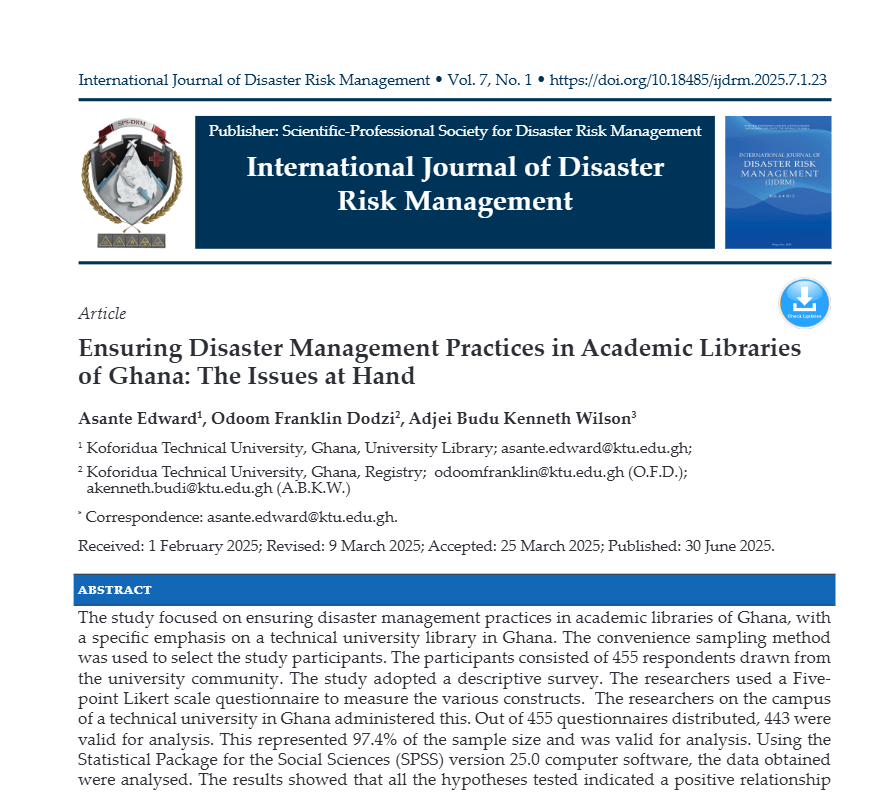
    The study focused on ensuring disaster management practices in academic libraries of Ghana, with a specific emphasis on a technical university library in Ghana. The convenience sampling method was used to select the study participants. The participants consisted of 455 respondents drawn from the university community. The study adopted a descriptive survey. The researchers used a Five-point Likert scale questionnaire to measure the various constructs.  The researchers on the campus of a technical university in Ghana administered this. Out of 455 questionnaires distributed, 443 were valid for analysis. This represented 97.4% of the sample size and was valid for analysis. Using the Statistical Package for the Social Sciences (SPSS) version 25.0 computer software, the data obtained were analysed. The results showed that all the hypotheses tested indicated a positive relationship between the independent variables (Causes of Disaster, Technological Approaches, Challenges of Disaster Management, and Disaster Management Policy) and the dependent variable (Disaster Management Practices), except for the relationship between Challenges of Effective Management and the dependent variable. This suggests that the management of academic libraries in ensuring practical disaster management issues of the causes of disasters such as flooding, power fluctuations, power surges, fire outbreaks, roof leakages, earthquakes, mutilation, hacking of the library computers, plumbing defects as well as activities of pests (termites, cockroaches, rodents) among others should be given attention. The study recommends implementing technological approaches, such as fire detectors, fire extinguishers, smoke detectors, fire alarms, and CCT cameras, among others, to mitigate the occurrence of natural disasters. The study further recommends that academic libraries, in their pursuit of achieving effective disaster management, should develop a disaster recovery plan and policy to guide implementation. The policy should outline timelines for staff training, periodic inspections, security upgrades, repair of leakages and assembly points, and creation of awareness about disasters and emergency response lines, among others, as they form the core elements of ensuring disaster management practices in an emergency.

    Authors

    • Asante EdwardKoforidua Technical University, Ghana, University LibraryAuthor
    • Odoom Franklin DodziKoforidua Technical University, Ghana, RegistryAuthor
    • Adjei Budu Kenneth WilsonKoforidua Technical University, Ghana, RegistryAuthor

    DOI:

    https://doi.org/10.18485/ijdrm.2025.7.1.23

    Keywords:

    causes of disaster, technological approaches, challenges of disaster management, disaster management policy, disaster management practices, disaster recovery plan

    https://internationaljournalofdisasterriskmanagement.com/index.php/Vol1/article/view/93


    Share. Facebook Twitter Pinterest LinkedIn Tumblr Telegram Email
    Previous ArticleLarge-Area Emergency Lockdowns with Automated Driving Systems
    Next Article University Students’ Perception, Knowledge, and Preparedness of Flood Disaster Risk Management in Assam (India)
    Editor
    • Website

    Prof. Dr. Vladimir M. Cvetković is recognized as a leading expert in Disaster Risk Management, with a focus on Risk Reduction, Preparedness, Response, and Recovery. He has authored over 300 scientific papers published in domestic and international journals and proceedings, as well as 30 books.

    Related Posts

    From Vulnerability to Resilience: A Systematic Review of Odisha’s Integrated Approach to Disaster Risk Reduction

    August 9, 2026

    Evaluating Puntland’s Disaster Risk Management Policy: Institutional Preparedness, Community Engagement and Implementation Challenges

    August 9, 2026

    Declination of the Strategic Compass: Transatlantic Elites, German Leadership, and the Future of European Security

    August 9, 2026
    Add A Comment
    Leave A Reply

    You must be logged in to post a comment.

    Scientific-Professional Society for Disaster Risk Management (SPS-DRM) President’s Office: president@spsdrm.org Administrative Office: secretary@spsdrm.org Belgrade, Serbia | www.spsdrm.org
    Scientific-Professional Society for Disaster Risk Management, Belgrade, Serbia.

    The Association “Scientific-Professional Society for Disaster Risk Management”  (www.spsdr.com) is a non-governmental and non-profit association, established for an indefinite period, for the purpose of achieving objectives related to the advancement of scientific and professional knowledge and practice in the field of disaster risk management, emergencies, security, protection and community resilience, through the implementation of quantitative and/or qualitative research, publishing activities (journals, books and other publications), organizing national and international events, conducting formal and non-formal forms of education and professional development, preparing expert analyses, risk assessments and planning documents, developing digital platforms and knowledge bases, as well as other activities in accordance with the law and this Statute.

    International Journal of Disaster Risk Management

    The International Journal of Disaster Risk Management (IJDRM) is a double-blind peer-reviewed, open-access international scientific journal, published twice a year, dedicated to advancing interdisciplinary research, policy, and professional practice in the fields of disaster risk management, disaster risk reduction, hazards, emergencies, and resilience. The journal provides an international platform for researchers, academics, practitioners, policymakers, emergency managers, and other professionals to exchange knowledge, research findings, and innovative approaches to disaster prevention and management. IJDRM publishes theoretical, empirical, methodological, and applied contributions covering the entire disaster risk management cycle—prevention, mitigation, preparedness, response, recovery, reconstruction, and resilience-building.   www.ijdrm.com

    Scientific-Professional Society for Disaster Risk Management (SPS-DRM)

    Type above and press Enter to search. Press Esc to cancel.