Close Menu
Scientific-Professional Society for Disasaster Risk ManagementScientific-Professional Society for Disasaster Risk Management
    Facebook X (Twitter) Instagram
    Facebook X (Twitter) Instagram YouTube LinkedIn TikTok
    Scientific-Professional Society for Disasaster Risk ManagementScientific-Professional Society for Disasaster Risk Management
    Contact
    • About
      • History
      • President
      • Members
      • Secretary
      • Documentation
        • Statute
        • Communication Strategy
        • Work Information Booklet
        • Seminar Programs
        • Training Programs
        • Regulations on Identification Cards, Badges, and Uniforms
        • Cooperation Agreements
        • Organization Flyer
        • Membership Application Form
      • Membership
      • Contact SPS-DRM
    • Publication
      • Books
      • Collection of papers
      • Scientific papers
      • Broschure
      • Flyers and Posters
      • International journal (IJDRM)
    • IJDRM
      • Volume 8, Number 1
      • Volume 7, Number 2
      • Volume 7, Number 1
      • Volume 6, Number 2
      • Volume 6, Number 1
      • Volume 5, Number 2
      • Volume 5, Number 1
      • Volume 4, Number 2
      • Volume 4, Number 1
      • Volume 3, Number 2
      • Volume 3, Number 1
      • Volume 2, Number 2
      • Volume 2, Number 1
      • Volume 1, Number 2
      • Volume 1, Number 1
    • ProSafeNet
    • Science
      • International Institute
      • Research Projects
      • Research Collaboration
      • International Conference
    • Education
      • Training
      • Seminars
    • Media
      • Gallery / Training Photo Archive
      • Donations and Sponsorships
    • Posts
      • Announcements
    Scientific-Professional Society for Disasaster Risk ManagementScientific-Professional Society for Disasaster Risk Management
    Home»News»Examining the Challenges in Implementing Occupational Health and Safety in the Selected Construction Companies Across Nigerian Coastal Cities
    News

    Examining the Challenges in Implementing Occupational Health and Safety in the Selected Construction Companies Across Nigerian Coastal Cities

    EditorBy EditorAugust 10, 2026No Comments2 Mins Read
    Facebook Twitter LinkedIn Telegram Pinterest Tumblr Reddit WhatsApp Email
    Screenshot 2026 08 10 181711 Examining the Challenges in Implementing Occupational Health and Safety in the Selected Construction Companies Across Nigerian Coastal Cities
    Share
    Facebook Twitter LinkedIn Pinterest Email

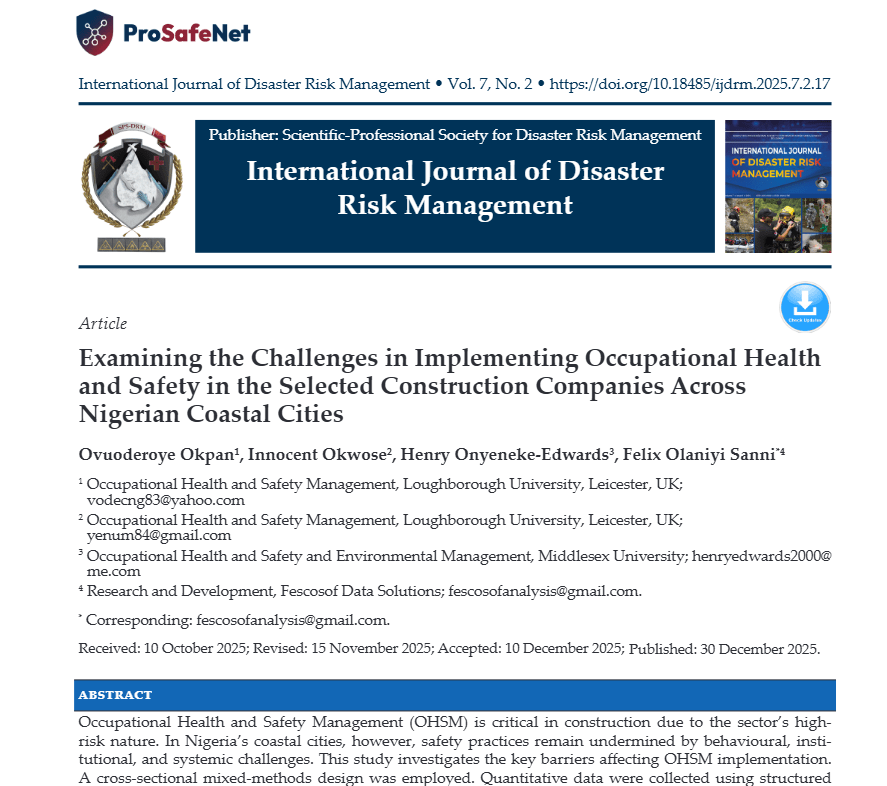
    Occupational Health and Safety Management (OHSM) is critical in construction due to the sector’s high-risk nature. In Nigeria’s coastal cities, however, safety practices remain undermined by behavioural, institutional, and systemic challenges. This study investigates the key barriers affecting OHSM implementation. A cross-sectional mixed-methods design was employed. Quantitative data were collected using structured questionnaires administered to 1,400 construction workers across Lagos, Rivers, Delta, and Cross River States. Quantitative analyses were conducted with SPSS 28 using descriptive statistics, mean ranking, and Chi-square tests. Qualitative data were obtained through 35 key informant interviews with senior site managers and were analysed thematically with QDA Miner. Workers’ resistance emerged as the most significant challenge (mean = 3.98), followed by corruption and bribery (mean = 3.41), poor health and safety culture (mean = 3.39), and political influence (mean = 3.38). Overall, 58.5% of respondents reported moderate OHSM challenges, while 40.4% reported low challenges. Significant differences were observed between indigenous and international companies (χ² = 65.210, p < 0.001) and across states (χ² = 217.92, p < 0.001). Qualitative findings corroborated the quantitative results, highlighting worker non-compliance, budgetary constraints, logistical delays in PPE supply, low educational levels, and systemic governance challenges. The study highlights that behavioural non-compliance and systemic governance weaknesses, rather than resource constraints, are the primary drivers of OHSM outcomes. interventions should prioritize continuous worker sensitization, stricter safety enforcement, effective resource planning, and enhanced government commitment to improve health and safety outcomes.

    Authors

    • Ovuoderoye OkpanOccupational Health and Safety Management, Loughborough University, Leicester, UKAuthor
    • Innocent OkwoseOccupational Health and Safety Management, Loughborough University, Leicester, UKAuthor
    • Henry Onyeneke-Edwards EdwardsOccupational Health and Safety and Environmental Management, Middlesex UniversityAuthor
    • Felix SanniFescosof Data SolutionAuthor

    DOI:

    https://doi.org/10.18485/ijdrm.2025.7.2.17

    Keywords:

    OHSM, construction industry, coastal cities, worker resistance, management challenges, Nigeria

    https://internationaljournalofdisasterriskmanagement.com/index.php/Vol1/article/view/125


    Share. Facebook Twitter Pinterest LinkedIn Tumblr Telegram Email
    Previous ArticleDisaster Risk Assessment and Management Challenges Faced by University Libraries: A Case Study of Disaster-Prone Region Hazara, Pakistan
    Next Article Exploring Flood-Induced Livelihood Vulnerabilities in Bangladesh: Insights from Teota, Manikganj and the Bangladesh Delta Plan 2100
    Editor
    • Website

    Prof. Dr. Vladimir M. Cvetković is recognized as a leading expert in Disaster Risk Management, with a focus on Risk Reduction, Preparedness, Response, and Recovery. He has authored over 300 scientific papers published in domestic and international journals and proceedings, as well as 30 books.

    Related Posts

    Strategic Cooperation Agreement Signed between ProSafeNet and the Faculty of Security Studies, University of Belgrade

    September 9, 2026

    Adaptive Governance of Disaster and Systemic Risks in Critical Energy Infrastructure: A Complex Adaptive Systems Perspective

    August 21, 2026

    Disaster Victim Identification in India: Forensic Challenges and the Need for a Comprehensive Legal–Policy Framework

    August 21, 2026
    Add A Comment
    Leave A Reply

    You must be logged in to post a comment.

    Scientific-Professional Society for Disaster Risk Management (SPS-DRM) President’s Office: president@spsdrm.org Administrative Office: secretary@spsdrm.org Belgrade, Serbia | www.spsdrm.org
    Scientific-Professional Society for Disaster Risk Management, Belgrade, Serbia.

    The Association “Scientific-Professional Society for Disaster Risk Management”  (www.spsdr.com) is a non-governmental and non-profit association, established for an indefinite period, for the purpose of achieving objectives related to the advancement of scientific and professional knowledge and practice in the field of disaster risk management, emergencies, security, protection and community resilience, through the implementation of quantitative and/or qualitative research, publishing activities (journals, books and other publications), organizing national and international events, conducting formal and non-formal forms of education and professional development, preparing expert analyses, risk assessments and planning documents, developing digital platforms and knowledge bases, as well as other activities in accordance with the law and this Statute.

    International Journal of Disaster Risk Management

    The International Journal of Disaster Risk Management (IJDRM) is a double-blind peer-reviewed, open-access international scientific journal, published twice a year, dedicated to advancing interdisciplinary research, policy, and professional practice in the fields of disaster risk management, disaster risk reduction, hazards, emergencies, and resilience. The journal provides an international platform for researchers, academics, practitioners, policymakers, emergency managers, and other professionals to exchange knowledge, research findings, and innovative approaches to disaster prevention and management. IJDRM publishes theoretical, empirical, methodological, and applied contributions covering the entire disaster risk management cycle—prevention, mitigation, preparedness, response, recovery, reconstruction, and resilience-building.   www.ijdrm.com

    Scientific-Professional Society for Disaster Risk Management (SPS-DRM)

    Type above and press Enter to search. Press Esc to cancel.