Close Menu
Scientific-Professional Society for Disasaster Risk ManagementScientific-Professional Society for Disasaster Risk Management
    Facebook X (Twitter) Instagram
    Facebook X (Twitter) Instagram YouTube LinkedIn TikTok
    Scientific-Professional Society for Disasaster Risk ManagementScientific-Professional Society for Disasaster Risk Management
    Contact
    • About
      • History
      • President
      • Members
      • Secretary
      • Documentation
        • Statute
        • Communication Strategy
        • Work Information Booklet
        • Seminar Programs
        • Training Programs
        • Regulations on Identification Cards, Badges, and Uniforms
        • Cooperation Agreements
        • Organization Flyer
        • Membership Application Form
      • Membership
      • Contact SPS-DRM
    • Publication
      • Books
      • Collection of papers
      • Scientific papers
      • Broschure
      • Flyers and Posters
      • International journal (IJDRM)
    • IJDRM
      • Volume 8, Number 1
      • Volume 7, Number 2
      • Volume 7, Number 1
      • Volume 6, Number 2
      • Volume 6, Number 1
      • Volume 5, Number 2
      • Volume 5, Number 1
      • Volume 4, Number 2
      • Volume 4, Number 1
      • Volume 3, Number 2
      • Volume 3, Number 1
      • Volume 2, Number 2
      • Volume 2, Number 1
      • Volume 1, Number 2
      • Volume 1, Number 1
    • ProSafeNet
    • Science
      • International Institute
      • Research Projects
      • Research Collaboration
      • International Conference
    • Education
      • Training
      • Seminars
    • Media
      • Gallery / Training Photo Archive
      • Donations and Sponsorships
    • Posts
      • Announcements
    Scientific-Professional Society for Disasaster Risk ManagementScientific-Professional Society for Disasaster Risk Management
    Home»News»First responders in the Western Balkans: Strengthening Capacities and Preparedness for a Resilient Future
    News

    First responders in the Western Balkans: Strengthening Capacities and Preparedness for a Resilient Future

    EditorBy EditorAugust 10, 2026No Comments3 Mins Read
    Facebook Twitter LinkedIn Telegram Pinterest Tumblr Reddit WhatsApp Email
    Screenshot 2026 08 10 182002 First responders in the Western Balkans: Strengthening Capacities and Preparedness for a Resilient Future
    Share
    Facebook Twitter LinkedIn Pinterest Email

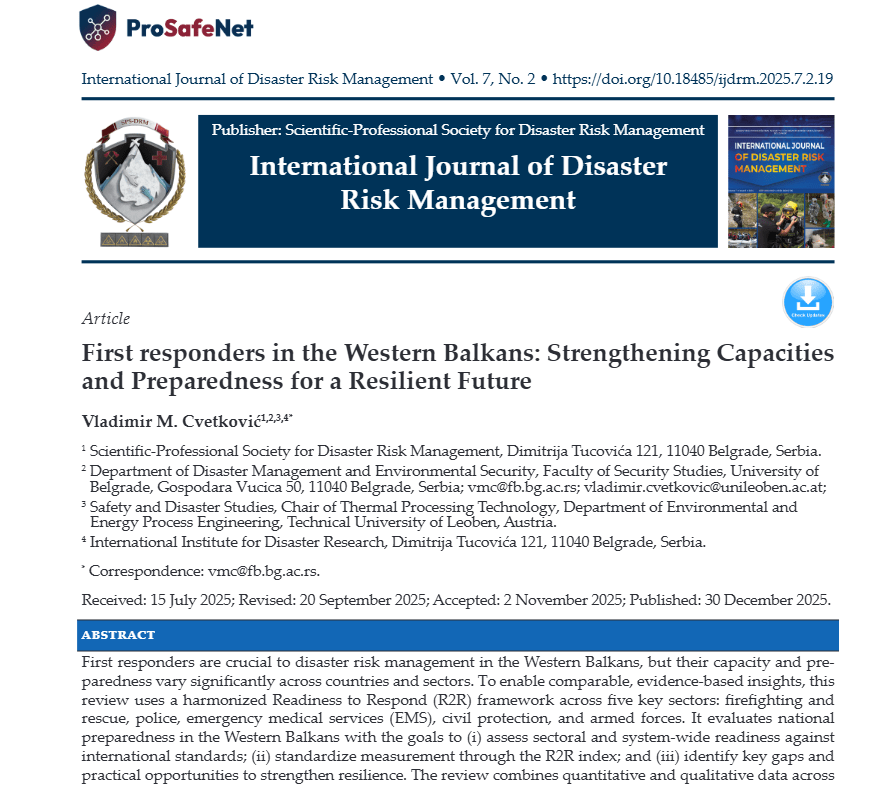
    First responders are crucial to disaster risk management in the Western Balkans, but their capacity and preparedness vary significantly across countries and sectors. To enable comparable, evidence-based insights, this review uses a harmonized Readiness to Respond (R2R) framework across five key sectors: firefighting and rescue, police, emergency medical services (EMS), civil protection, and armed forces. It evaluates national preparedness in the Western Balkans with the goals to (i) assess sectoral and system-wide readiness against international standards; (ii) standardize measurement through the R2R index; and (iii) identify key gaps and practical opportunities to strengthen resilience. The review combines quantitative and qualitative data across six dimensions: Staffing, Equipment & Infrastructure, Training & Education, Legislation & Strategies, Coordination & Governance, and Main Challenges. Sector scores range from 0 to 60, with an overall or system score from 0 to 360, normalized across tiers. Data sources include official documents, international reports, and secondary literature, supplemented by expert judgment when data are missing or inconsistent. No country reaches high readiness (≥281/360); Serbia (275/360) and Montenegro (270/360) score highest but still fall within the medium readiness category. Furthermore, Albania (243/360) is moderate, while North Macedonia (220/360) and Bosnia and Herzegovina (205/360) lag. Police and armed forces generally outperform EMS and civil protection, which face staffing shortages, aging equipment, uneven training, and fragmented governance. Firefighting capacity varies greatly, with Montenegro excelling while others demonstrate modest capability. Montenegro exhibits the most balanced overall profile, whereas Bosnia and Herzegovina ranks lowest due to structural fragmentation, with Serbia and Albania in the middle, and North Macedonia trailing slightly. Four main regional constraints are identified: outdated equipment and infrastructure, persistent human resource shortages (notably in EMS and specialized rescue), weak multi-level coordination, and reliance on external aid for modernization and training. Moving from moderate to high readiness requires lifecycle-based fleet renewal, expanding accredited training and retention programs, harmonizing SOPs and metrics, establishing integrated asset and incident registries, and defining volunteer roles. Countries need to shift from donation-based procurement to multi-year, standards-driven capability development, co-financed through EU/NATO/UN mechanisms. Given shared risks and limited scale, cross-border cooperation—such as mutual aid, pooled aerial firefighting and CBRN assets, and joint exercises—offers the most cost-effective way to build interoperable, resilient first responder systems across the Western Balkans.

    Authors

    • Vladimir M. CvetkovićThe University of Belgrade, Faculty of Security Studies, Gospodara Vučića 50, Belgrade, Serbia. Technical University of Leoben, Austria.Author http://orcid.org/0000-0002-3450-0658 (unauthenticated)

    DOI:

    https://doi.org/10.18485/ijdrm.2025.7.2.19

    Keywords:

    first responders, Western Balkans, disaster risk management, capacity building, community resilience, cross-border cooperation, emergency preparedness

    https://internationaljournalofdisasterriskmanagement.com/index.php/Vol1/article/view/130


    Share. Facebook Twitter Pinterest LinkedIn Tumblr Telegram Email
    Previous ArticleExploring Flood-Induced Livelihood Vulnerabilities in Bangladesh: Insights from Teota, Manikganj and the Bangladesh Delta Plan 2100
    Next Article Geospatial Analysis of COVID-19 Spread in Constantine, Algeria: Epidemiological Insights and Policy Recommendations
    Editor
    • Website

    Prof. Dr. Vladimir M. Cvetković is recognized as a leading expert in Disaster Risk Management, with a focus on Risk Reduction, Preparedness, Response, and Recovery. He has authored over 300 scientific papers published in domestic and international journals and proceedings, as well as 30 books.

    Related Posts

    Strategic Cooperation Agreement Signed between ProSafeNet and the Faculty of Security Studies, University of Belgrade

    September 9, 2026

    Adaptive Governance of Disaster and Systemic Risks in Critical Energy Infrastructure: A Complex Adaptive Systems Perspective

    August 21, 2026

    Disaster Victim Identification in India: Forensic Challenges and the Need for a Comprehensive Legal–Policy Framework

    August 21, 2026
    Add A Comment
    Leave A Reply

    You must be logged in to post a comment.

    Scientific-Professional Society for Disaster Risk Management (SPS-DRM) President’s Office: president@spsdrm.org Administrative Office: secretary@spsdrm.org Belgrade, Serbia | www.spsdrm.org
    Scientific-Professional Society for Disaster Risk Management, Belgrade, Serbia.

    The Association “Scientific-Professional Society for Disaster Risk Management”  (www.spsdr.com) is a non-governmental and non-profit association, established for an indefinite period, for the purpose of achieving objectives related to the advancement of scientific and professional knowledge and practice in the field of disaster risk management, emergencies, security, protection and community resilience, through the implementation of quantitative and/or qualitative research, publishing activities (journals, books and other publications), organizing national and international events, conducting formal and non-formal forms of education and professional development, preparing expert analyses, risk assessments and planning documents, developing digital platforms and knowledge bases, as well as other activities in accordance with the law and this Statute.

    International Journal of Disaster Risk Management

    The International Journal of Disaster Risk Management (IJDRM) is a double-blind peer-reviewed, open-access international scientific journal, published twice a year, dedicated to advancing interdisciplinary research, policy, and professional practice in the fields of disaster risk management, disaster risk reduction, hazards, emergencies, and resilience. The journal provides an international platform for researchers, academics, practitioners, policymakers, emergency managers, and other professionals to exchange knowledge, research findings, and innovative approaches to disaster prevention and management. IJDRM publishes theoretical, empirical, methodological, and applied contributions covering the entire disaster risk management cycle—prevention, mitigation, preparedness, response, recovery, reconstruction, and resilience-building.   www.ijdrm.com

    Scientific-Professional Society for Disaster Risk Management (SPS-DRM)

    Type above and press Enter to search. Press Esc to cancel.