Close Menu
Scientific-Professional Society for Disasaster Risk ManagementScientific-Professional Society for Disasaster Risk Management
    Facebook X (Twitter) Instagram
    Facebook X (Twitter) Instagram YouTube LinkedIn TikTok
    Scientific-Professional Society for Disasaster Risk ManagementScientific-Professional Society for Disasaster Risk Management
    Contact
    • About
      • History
      • President
      • Members
      • Secretary
      • Documentation
        • Statute
        • Communication Strategy
        • Work Information Booklet
        • Seminar Programs
        • Training Programs
        • Regulations on Identification Cards, Badges, and Uniforms
        • Cooperation Agreements
        • Organization Flyer
        • Membership Application Form
      • Membership
      • Contact SPS-DRM
    • Publication
      • Books
      • Collection of papers
      • Scientific papers
      • Broschure
      • Flyers and Posters
      • International journal (IJDRM)
    • IJDRM
      • Volume 8, Number 1
      • Volume 7, Number 2
      • Volume 7, Number 1
      • Volume 6, Number 2
      • Volume 6, Number 1
      • Volume 5, Number 2
      • Volume 5, Number 1
      • Volume 4, Number 2
      • Volume 4, Number 1
      • Volume 3, Number 2
      • Volume 3, Number 1
      • Volume 2, Number 2
      • Volume 2, Number 1
      • Volume 1, Number 2
      • Volume 1, Number 1
    • ProSafeNet
    • Science
      • International Institute
      • Research Projects
      • Research Collaboration
      • International Conference
    • Education
      • Training
      • Seminars
    • Media
      • Gallery / Training Photo Archive
      • Donations and Sponsorships
    • Posts
      • Announcements
    Scientific-Professional Society for Disasaster Risk ManagementScientific-Professional Society for Disasaster Risk Management
    Home»News»Putting People First: Why Pooled Funds Belong to Communities
    News

    Putting People First: Why Pooled Funds Belong to Communities

    EditorBy EditorAugust 10, 2026No Comments2 Mins Read
    Facebook Twitter LinkedIn Telegram Pinterest Tumblr Reddit WhatsApp Email
    Screenshot 2026 08 10 182819 Putting People First: Why Pooled Funds Belong to Communities
    Share
    Facebook Twitter LinkedIn Pinterest Email

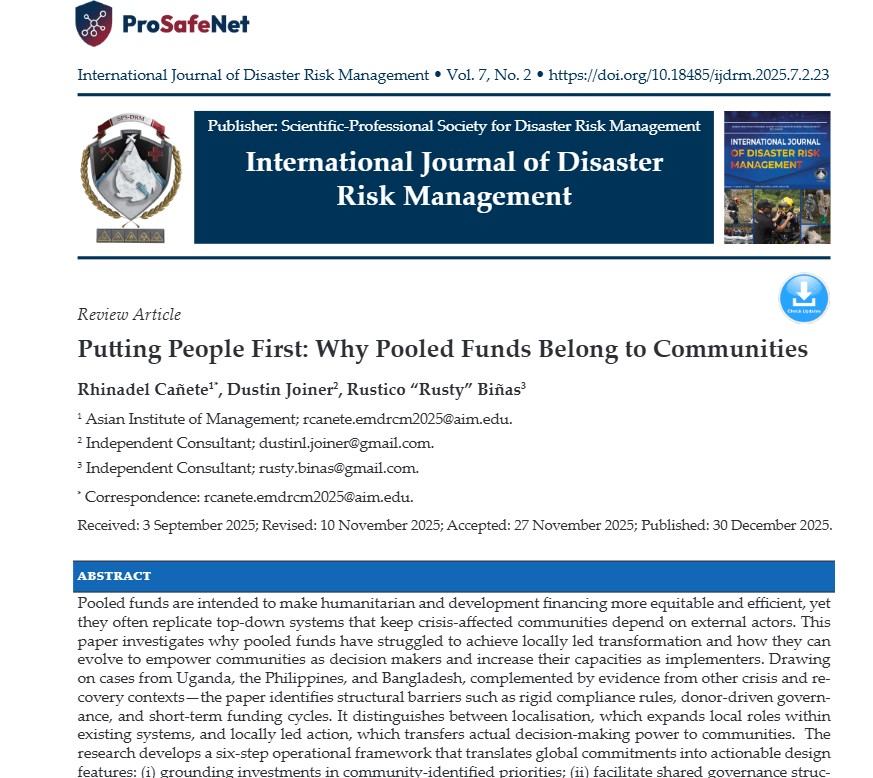
    Pooled funds are intended to make humanitarian and development financing more equitable and efficient, yet they often replicate top-down systems that keep crisis-affected communities depend on external actors. This paper investigates why pooled funds have struggled to achieve locally led transformation and how they can evolve to empower communities as decision makers and increase their capacities as implementers. Drawing on cases from Uganda, the Philippines, and Bangladesh, complemented by evidence from other crisis and recovery contexts—the paper identifies structural barriers such as rigid compliance rules, donor-driven governance, and short-term funding cycles. It distinguishes between localisation, which expands local roles within existing systems, and locally led action, which transfers actual decision-making power to communities.  The research develops a six-step operational framework that translates global commitments into actionable design features: (i) grounding investments in community-identified priorities; (ii) facilitate shared governance structures; (iii) Facilitate Fit-for-Scale Trustworthiness; (iv) enabling multi-year and flexible funding; (v) investing in transformation not just outputs; and (vi) measuring resilience transformation alongside facilitating. The findings show that community-driven pooled funding is both feasible and compatible with donor accountability requirements. The study contributes to humanitarian financing debates by proposing practical pathways for donors and fund managers to reorient pooled funds from sustaining survival toward enabling self-determination, dignity, and resilience.

    Authors

    • Rhinadel CaneteAsian Institute of ManagementAuthor
    • Dustin JoinerIndependent Consultant, United StatesAuthor
    • Rusty BinasIndependent Consultant, PhilippinesAuthor

    DOI:

    https://doi.org/10.18485/ijdrm.2025.7.2.23

    Keywords:

    pooled funding, localisation, locally led action, humanitarian finance, development finance, community-led recovery, donor policy, funding governance, participatory decision-making, resilience building

    https://internationaljournalofdisasterriskmanagement.com/index.php/Vol1/article/view/140

    Share. Facebook Twitter Pinterest LinkedIn Tumblr Telegram Email
    Previous ArticlePolicing Law for Disaster Risk Response in Ethiopia: The case of COVID-19
    Next Article Resilience of Higher Education Institutions to Security Risks – Analysis of the Current State and the Need for Cooperation
    Editor
    • Website

    Prof. Dr. Vladimir M. Cvetković is recognized as a leading expert in Disaster Risk Management, with a focus on Risk Reduction, Preparedness, Response, and Recovery. He has authored over 300 scientific papers published in domestic and international journals and proceedings, as well as 30 books.

    Related Posts

    Strategic Cooperation Agreement Signed between ProSafeNet and the Faculty of Security Studies, University of Belgrade

    September 9, 2026

    Adaptive Governance of Disaster and Systemic Risks in Critical Energy Infrastructure: A Complex Adaptive Systems Perspective

    August 21, 2026

    Disaster Victim Identification in India: Forensic Challenges and the Need for a Comprehensive Legal–Policy Framework

    August 21, 2026
    Add A Comment
    Leave A Reply

    You must be logged in to post a comment.

    Scientific-Professional Society for Disaster Risk Management (SPS-DRM) President’s Office: president@spsdrm.org Administrative Office: secretary@spsdrm.org Belgrade, Serbia | www.spsdrm.org
    Scientific-Professional Society for Disaster Risk Management, Belgrade, Serbia.

    The Association “Scientific-Professional Society for Disaster Risk Management”  (www.spsdr.com) is a non-governmental and non-profit association, established for an indefinite period, for the purpose of achieving objectives related to the advancement of scientific and professional knowledge and practice in the field of disaster risk management, emergencies, security, protection and community resilience, through the implementation of quantitative and/or qualitative research, publishing activities (journals, books and other publications), organizing national and international events, conducting formal and non-formal forms of education and professional development, preparing expert analyses, risk assessments and planning documents, developing digital platforms and knowledge bases, as well as other activities in accordance with the law and this Statute.

    International Journal of Disaster Risk Management

    The International Journal of Disaster Risk Management (IJDRM) is a double-blind peer-reviewed, open-access international scientific journal, published twice a year, dedicated to advancing interdisciplinary research, policy, and professional practice in the fields of disaster risk management, disaster risk reduction, hazards, emergencies, and resilience. The journal provides an international platform for researchers, academics, practitioners, policymakers, emergency managers, and other professionals to exchange knowledge, research findings, and innovative approaches to disaster prevention and management. IJDRM publishes theoretical, empirical, methodological, and applied contributions covering the entire disaster risk management cycle—prevention, mitigation, preparedness, response, recovery, reconstruction, and resilience-building.   www.ijdrm.com

    Scientific-Professional Society for Disaster Risk Management (SPS-DRM)

    Type above and press Enter to search. Press Esc to cancel.