Close Menu
Scientific-Professional Society for Disasaster Risk ManagementScientific-Professional Society for Disasaster Risk Management
    Facebook X (Twitter) Instagram
    Facebook X (Twitter) Instagram YouTube LinkedIn TikTok
    Scientific-Professional Society for Disasaster Risk ManagementScientific-Professional Society for Disasaster Risk Management
    Contact
    • About
      • History
      • President
      • Members
      • Secretary
      • Documentation
        • Statute
        • Communication Strategy
        • Work Information Booklet
        • Seminar Programs
        • Training Programs
        • Regulations on Identification Cards, Badges, and Uniforms
        • Cooperation Agreements
        • Organization Flyer
        • Membership Application Form
      • Membership
      • Contact SPS-DRM
    • Publication
      • Books
      • Collection of papers
      • Scientific papers
      • Broschure
      • Flyers and Posters
      • International journal (IJDRM)
    • IJDRM
    • ProSafeNet
    • Science
      • International Institute
      • Research Projects
      • Research Collaboration
      • International conference
    • Education
      • Training
      • Seminars
    • Information
      • Gallery / Training Photo Archive
      • Announcements
      • Media
      • Donations and Sponsorships
    • Posts
    Scientific-Professional Society for Disasaster Risk ManagementScientific-Professional Society for Disasaster Risk Management
    Home»News»Rethinking Disaster Resilience: Conceptual Framework, Core Dimensions, and Key Actors
    News

    Rethinking Disaster Resilience: Conceptual Framework, Core Dimensions, and Key Actors

    EditorBy EditorAugust 10, 2026No Comments2 Mins Read
    Facebook Twitter LinkedIn Telegram Pinterest Tumblr Reddit WhatsApp Email
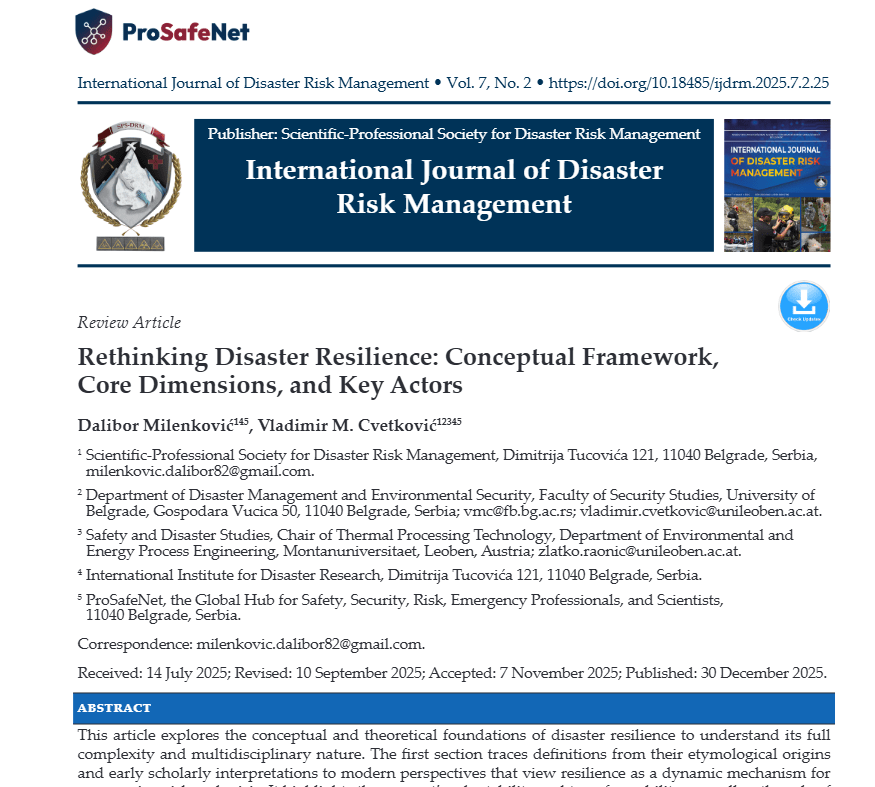
    Screenshot 2026 08 10 183222 Rethinking Disaster Resilience: Conceptual Framework, Core Dimensions, and Key Actors
    Share
    Facebook Twitter LinkedIn Pinterest Email

    This article explores the conceptual and theoretical foundations of disaster resilience to understand its full complexity and multidisciplinary nature. The first section traces definitions from their etymological origins and early scholarly interpretations to modern perspectives that view resilience as a dynamic mechanism for overcoming risk and crisis. It highlights the concept’s adaptability and transformability, as well as the role of learning in establishing stability—i.e., resilience. The second section organizes the conceptual framework of disaster resilience and its multiple dimensions. Resilience is seen as a combination of physical, social, institutional, and economic aspects, with particular focus on social cohesion and a culture of safety. The analysis emphasizes resilience as fundamental to sustainable development and societal strength. The third section examines different resilience dimensions, noting that there is no universal set; they vary by context and methodology. It considers biophysical, social, institutional, and local aspects, as well as the importance of prevention, education, infrastructure standards, and international cooperation in enhancing resilience. The fourth section discusses the leading actors in resilience—individuals, communities, and institutions—focusing on psychological skills at the individual level, social capital and solidarity at the community level, and the importance of institutional coordination and global initiatives that foster a culture of resilience. The discussion links these findings to existing research and points out the absence of universal indicators and standardized methods for measuring resilience. In conclusion, the article asserts that disaster resilience is an evolving process involving multiple dimensions and active participation from actors across all levels. A holistic approach, combined with new analytical tools, is crucial for accurate measurement and practical implementation in risk management, thereby establishing clear connections between local capacities, institutional policies, and international resilience efforts.

    Authors

    • Dalibor MilenkovićScientific-Professional Society for Disaster Risk Management, Dimitrija Tucovića 121, 11040 Belgrade, SerbiaAuthor
    • Vladimir M. CvetkovićThe University of Belgrade, Faculty of Security Studies, Gospodara Vučića 50, Belgrade, Serbia. Technical University of Leoben, Austria.Author http://orcid.org/0000-0002-3450-0658 (unauthenticated)

    DOI:

    https://doi.org/10.18485/ijdrm.2025.7.2.25

    Keywords:

    disaster resilience, resilience concept, resilience dimensions, social resilience, resilience actors, risk management

    https://internationaljournalofdisasterriskmanagement.com/index.php/Vol1/article/view/132


    Share. Facebook Twitter Pinterest LinkedIn Tumblr Telegram Email
    Previous ArticleResilience of Higher Education Institutions to Security Risks – Analysis of the Current State and the Need for Cooperation
    Next Article Shelter for people in extreme weather: Exploring the options in the coastal areas of Bangladesh
    Editor
    • Website

    Prof. Dr. Vladimir M. Cvetković is recognized as a leading expert in Disaster Risk Management, with a focus on Risk Reduction, Preparedness, Response, and Recovery. He has authored over 300 scientific papers published in domestic and international journals and proceedings, as well as 30 books.

    Related Posts

    Transforming Landscapes, Shaping Risk: Land Cover Change and Disaster Vulnerability in Parshuram Municipality (2005–2025)

    August 10, 2026

    The Impacts of Upstream Damming of the Omo River on Flood-Retreat Agriculture and Food Security Among Dassanech Agro-pastoralists, Lower Omo Valley, Ethiopia

    August 10, 2026

    The Impact of Political Variables on the Quality of Health Services in Governmental Hospitals – Case Study: Al-Shifa Medical Complex

    August 10, 2026
    Add A Comment
    Leave A Reply

    You must be logged in to post a comment.

    Scientific-Professional Society for Disaster Risk Management (SPS-DRM) President’s Office: president@spsdrm.org Administrative Office: secretary@spsdrm.org Belgrade, Serbia | www.spsdrm.org
    Scientific-Professional Society for Disaster Risk Management, Belgrade, Serbia.

    The Association “Scientific-Professional Society for Disaster Risk Management”  (www.spsdr.com) is a non-governmental and non-profit association, established for an indefinite period, for the purpose of achieving objectives related to the advancement of scientific and professional knowledge and practice in the field of disaster risk management, emergencies, security, protection and community resilience, through the implementation of quantitative and/or qualitative research, publishing activities (journals, books and other publications), organizing national and international events, conducting formal and non-formal forms of education and professional development, preparing expert analyses, risk assessments and planning documents, developing digital platforms and knowledge bases, as well as other activities in accordance with the law and this Statute.

    International Journal of Disaster Risk Management

    The International Journal of Disaster Risk Management (IJDRM) is a double-blind peer-reviewed, open-access international scientific journal, published twice a year, dedicated to advancing interdisciplinary research, policy, and professional practice in the fields of disaster risk management, disaster risk reduction, hazards, emergencies, and resilience. The journal provides an international platform for researchers, academics, practitioners, policymakers, emergency managers, and other professionals to exchange knowledge, research findings, and innovative approaches to disaster prevention and management. IJDRM publishes theoretical, empirical, methodological, and applied contributions covering the entire disaster risk management cycle—prevention, mitigation, preparedness, response, recovery, reconstruction, and resilience-building.   www.ijdrm.com

    Scientific-Professional Society for Disaster Risk Management (SPS-DRM)

    Type above and press Enter to search. Press Esc to cancel.