Close Menu
Scientific-Professional Society for Disasaster Risk ManagementScientific-Professional Society for Disasaster Risk Management
    Facebook X (Twitter) Instagram
    Facebook X (Twitter) Instagram YouTube LinkedIn TikTok
    Scientific-Professional Society for Disasaster Risk ManagementScientific-Professional Society for Disasaster Risk Management
    Contact
    • About
      • History
      • President
      • Members
      • Secretary
      • Documentation
        • Statute
        • Communication Strategy
        • Work Information Booklet
        • Seminar Programs
        • Training Programs
        • Regulations on Identification Cards, Badges, and Uniforms
        • Cooperation Agreements
        • Organization Flyer
        • Membership Application Form
      • Membership
      • Contact SPS-DRM
    • Publication
      • Books
        • Monographs
        • Practicums
      • Collection of papers
      • Scientific papers
      • Broschure
      • Flyers and Posters
      • International journal (IJDRM)
    • Journal
    • ProSafeNet
    • Science
      • IDR
      • Research results
        • National research
          • Academic papers
          • Reports and analysis
      • International research
        • Academic papers
        • Reports and analysis
      • Projects
        • International projects
        • National projects
    • Education
      • Training
        • Training Program
        • Completed training
        • Announced Trainings
      • Seminars
        • Seminar Programs and Agendas
        • Participant Registration
        • Speaker Registration
      • Conference
        • International conference
      • Disaster Management Courses
      • Disaster Database
        • International Disaster Database
        • National Disaster Database
      • Articles
      • Case Studies
      • Presentations
      • Disaster statistics
      • Blog about disaster
    • Information
      • Announcements
      • Video
      • Donations and Sponsorships
    • Posts
    Scientific-Professional Society for Disasaster Risk ManagementScientific-Professional Society for Disasaster Risk Management
    Home»News»Sustainable Recovery: the Link Between Development and Response to Disasters
    News

    Sustainable Recovery: the Link Between Development and Response to Disasters

    EditorBy EditorAugust 7, 2026No Comments2 Mins Read
    Facebook Twitter LinkedIn Telegram Pinterest Tumblr Reddit WhatsApp Email
    Screenshot 2026 08 07 191543 Sustainable Recovery: the Link Between Development and Response to Disasters
    Share
    Facebook Twitter LinkedIn Pinterest Email

    Authors

    • Ivica DjordjevićFaculty of Security Studies, University of Belgrade, Gospodara Vučića 50, 11040 Belgrade, SerbiaAuthor
    • Jasmina GačićFaculty of Security Studies, University of Belgrade, Gospodara Vučića 50, 11040 Belgrade, SerbiaAuthor

    DOI:

    https://doi.org/10.18485/ijdrm.2024.6.2.15

    Keywords:

    Sustainability, Vulnerability, Resilience, Development, Recovery

    Abstract

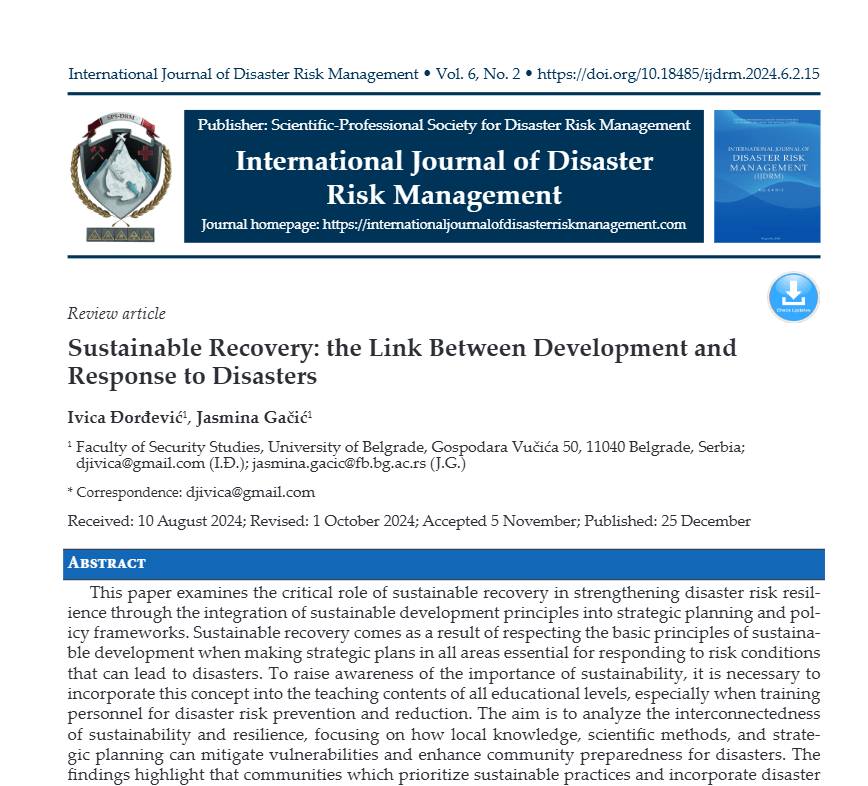
    This paper examines the critical role of sustainable recovery in strengthening disaster risk resilience through the integration of sustainable development principles into strategic planning and policy frameworks. Sustainable recovery comes as a result of respecting the basic principles of sustainable development when making strategic plans in all areas essential for responding to risk conditions that can lead to disasters. To raise awareness of the importance of sustainability, it is necessary to incorporate this concept into the teaching contents of all educational levels, especially when training personnel for disaster risk prevention and reduction. The aim is to analyze the interconnectedness of sustainability and resilience, focusing on how local knowledge, scientific methods, and strategic planning can mitigate vulnerabilities and enhance community preparedness for disasters. The findings highlight that communities which prioritize sustainable practices and incorporate disaster risk reduction measures into their development strategies demonstrate higher levels of resilience to hazards. Also, the practice has shown that the most resilient communities are those that base their development strategies on respect for local specificities and knowledge of scientific methods derived from previous experiences with numerous risks and their consequences. This study also identifies key factors contributing to vulnerability, emphasizing the importance of education, intersectoral collaboration, and policy reforms in fostering long-term resilience. Vulnerability comes as a result of many factors, the knowledge of which can contribute to raising the level of community resistance to hazards and risks to which the area is exposed. The phenomenon of sustainable development or sustainability as well as sustainable recovery is a major catalyst for change in government policies and legal frameworks, which has dramatically changed the role and behavior of nations. Politics, economy, ecology, geographical characteristics of the area and climatic conditions in combination with personnel potential can be part of the solution, but also the source of the problem. The results underscore the necessity for integrating sustainability principles at all levels of governance to achieve a holistic approach to disaster risk reduction and community resilience. Future research should focus on developing standardized indicators for measuring sustainable recovery and resilience across diverse socio-economic and geographical contexts.

    https://internationaljournalofdisasterriskmanagement.com/index.php/Vol1/article/view/81

    Share. Facebook Twitter Pinterest LinkedIn Tumblr Telegram Email
    Previous ArticleAn Assessment of Socio-Economic Impacts of Rainstorm Disaster on the Livelihood of the Residents of Ikole Local Government Area in Ekiti State, Nigeria
    Next Article Integrating Multi-Source Geospatial Data and AHP for Flood Susceptibility Mapping in Ain Smara, Constantine, Algeria
    Editor
    • Website

    Prof. Dr. Vladimir M. Cvetković is recognized as a leading expert in Disaster Risk Management, with a focus on Risk Reduction, Preparedness, Response, and Recovery. He has authored over 300 scientific papers published in domestic and international journals and proceedings, as well as 30 books.

    Related Posts

    Implications of Artificial Intelligence and Cyberspace on Risk Management Capabilities

    August 7, 2026

    Understanding Crowd Dynamics and Disaster Risks in Kerala Temple Festivals: Strategies for Effective Management

    August 7, 2026

    Integrating Multi-Source Geospatial Data and AHP for Flood Susceptibility Mapping in Ain Smara, Constantine, Algeria

    August 7, 2026
    Add A Comment
    Leave A Reply

    You must be logged in to post a comment.

    Scientific-Professional Society for Disaster Risk Management, Belgrade, Serbia.

    The Association “Scientific-Professional Society for Disaster Risk Management”  (www.spsdr.com) is a non-governmental and non-profit association, established for an indefinite period, for the purpose of achieving objectives related to the advancement of scientific and professional knowledge and practice in the field of disaster risk management, emergencies, security, protection and community resilience, through the implementation of quantitative and/or qualitative research, publishing activities (journals, books and other publications), organizing national and international events, conducting formal and non-formal forms of education and professional development, preparing expert analyses, risk assessments and planning documents, developing digital platforms and knowledge bases, as well as other activities in accordance with the law and this Statute.

    International Journal of Disaster Risk Management

    The International Journal of Disaster Risk Management (IJDRM) is a double-blind peer-reviewed, open-access international journal published twice a year, dedicated to advancing interdisciplinary research and practice in disaster and hazard studies, policy, and management. IJDRM publishes contributions across the full disaster risk management cycle—prevention, mitigation, preparedness, response, and recovery—covering natural hazards, technological/man-made hazards, complex emergencies, and global crises. www.ijdrm.com

    Scientific-Professional Society for Disaster Risk Management (SPS-DRM)

    Type above and press Enter to search. Press Esc to cancel.