Close Menu
Scientific-Professional Society for Disasaster Risk ManagementScientific-Professional Society for Disasaster Risk Management
    Facebook X (Twitter) Instagram
    Facebook X (Twitter) Instagram YouTube LinkedIn TikTok
    Scientific-Professional Society for Disasaster Risk ManagementScientific-Professional Society for Disasaster Risk Management
    Contact
    • About
      • History
      • President
      • Members
      • Secretary
      • Documentation
        • Statute
        • Communication Strategy
        • Work Information Booklet
        • Seminar Programs
        • Training Programs
        • Regulations on Identification Cards, Badges, and Uniforms
        • Cooperation Agreements
        • Organization Flyer
        • Membership Application Form
      • Membership
      • Contact SPS-DRM
    • Publication
      • Books
        • Monographs
        • Practicums
      • Collection of papers
      • Scientific papers
      • Broschure
      • Flyers and Posters
      • International journal (IJDRM)
    • Journal
    • ProSafeNet
    • Science
      • IDR
      • Research results
        • National research
          • Academic papers
          • Reports and analysis
      • International research
        • Academic papers
        • Reports and analysis
      • Projects
        • International projects
        • National projects
    • Education
      • Training
        • Training Program
        • Completed training
        • Announced Trainings
      • Seminars
        • Seminar Programs and Agendas
        • Participant Registration
        • Speaker Registration
      • Conference
        • International conference
      • Disaster Management Courses
      • Disaster Database
        • International Disaster Database
        • National Disaster Database
      • Articles
      • Case Studies
      • Presentations
      • Disaster statistics
      • Blog about disaster
    • Information
      • Announcements
      • Video
      • Donations and Sponsorships
    • Posts
    Scientific-Professional Society for Disasaster Risk ManagementScientific-Professional Society for Disasaster Risk Management
    Home»News»Understanding Crowd Dynamics and Disaster Risks in Kerala Temple Festivals: Strategies for Effective Management
    News

    Understanding Crowd Dynamics and Disaster Risks in Kerala Temple Festivals: Strategies for Effective Management

    EditorBy EditorAugust 8, 2026Updated:August 8, 2026No Comments2 Mins Read
    Facebook Twitter LinkedIn Telegram Pinterest Tumblr Reddit WhatsApp Email
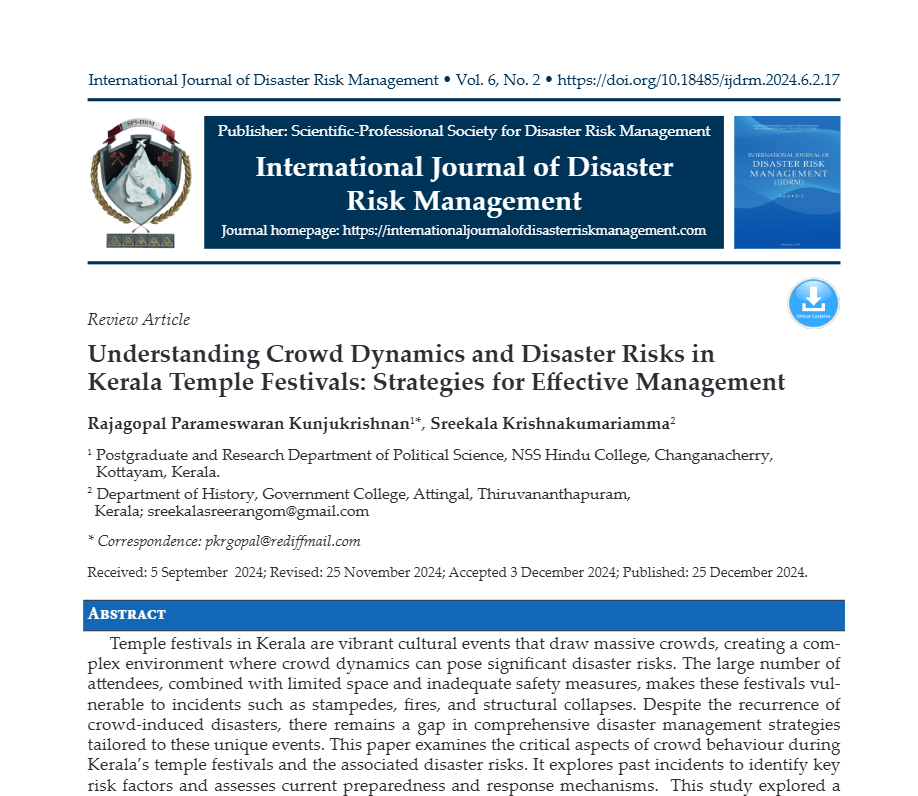
    Screenshot 2026 08 08 114142 Understanding Crowd Dynamics and Disaster Risks in Kerala Temple Festivals: Strategies for Effective Management
    Share
    Facebook Twitter LinkedIn Pinterest Email

    Authors

    • Rajagopal Parameswaran KunjukrishnanPostgraduate and Research Department of Political Science, NSS Hindu College, Changanacherry, Kottayam, Kerala.Author
    • Sreekala KrishnakumariammaDepartment of History, Government College, Attingal, Thiruvananthapuram, KeralaAuthor

    DOI:

    https://doi.org/10.18485/ijdrm.2024.6.2.17

    Keywords:

    crowd dymanics, crowd-induced disasters, temple festivals, stampedes, public safety

    Abstract

    Temple festivals in Kerala are vibrant cultural events that draw massive crowds, creating a complex environment where crowd dynamics can pose significant disaster risks. The large number of attendees, combined with limited space and inadequate safety measures, makes these festivals vulnerable to incidents such as stampedes, fires, and structural collapses. Despite the recurrence of crowd-induced disasters, there remains a gap in comprehensive disaster management strategies tailored to these unique events. This paper examines the critical aspects of crowd behaviour during Kerala’s temple festivals and the associated disaster risks. It explores past incidents to identify key risk factors and assesses current preparedness and response mechanisms.This study explored a mixed-methods approach to examine crowd dynamics and disaster risks in Kerala temple festivals. Primary data were collected through field observations and semi-structured interviews with festival organizers, local authorities, and participants. Secondary data included incident reports and archival records of past festivals. The findings were synthesized to propose evidence-based management strategies. The analysis revealed critical risk factors associated with crowd dynamics during Kerala temple festivals, including overcrowding in confined spaces, inadequate evacuation routes, and lack of real-time communication systems. GIS-based spatial mapping highlighted congestion hotspots and high-risk zones. Interviews with stakeholders identified gaps in preparedness and coordination among organizers and emergency services. The proposed management strategies demonstrated the potential to mitigate risks, enhance crowd safety, and ensure efficient emergency response. Effective crowd management at temple festivals requires a multidisciplinary approach that involves spatial analysis, stakeholder collaboration, and robust catastrophe preparedness. The study highlights the significance of conducting preventive risk assessments and dynamic crowd monitoring techniques to avoid disasters. Implementing the proposed measures can considerably improve public safety, serve as a model for comparable cultural events, and help to shape legislation for disaster risk reduction in large crowds.

    https://internationaljournalofdisasterriskmanagement.com/index.php/Vol1/article/view/79

    Share. Facebook Twitter Pinterest LinkedIn Tumblr Telegram Email
    Previous ArticleIntegrating Multi-Source Geospatial Data and AHP for Flood Susceptibility Mapping in Ain Smara, Constantine, Algeria
    Next Article Implications of Artificial Intelligence and Cyberspace on Risk Management Capabilities
    Editor
    • Website

    Prof. Dr. Vladimir M. Cvetković is recognized as a leading expert in Disaster Risk Management, with a focus on Risk Reduction, Preparedness, Response, and Recovery. He has authored over 300 scientific papers published in domestic and international journals and proceedings, as well as 30 books.

    Related Posts

    Factors of Vulnerability and Resilience of Persons with Disabilities During Disasters: Challenges and Strategies for Inclusive Risk Reduction

    August 8, 2026

    Stray Dogs in Urban Bangladesh: A Zoonotic Disaster Risk and Policy Challenge

    August 8, 2026

    Rescue Light Communication System (RLCS): Enhancing Emergency Signaling in Crisis Situations

    August 8, 2026
    Add A Comment
    Leave A Reply

    You must be logged in to post a comment.

    Scientific-Professional Society for Disaster Risk Management (SPS-DRM) President’s Office: president@spsdrm.org Administrative Office: secretary@spsdrm.org Belgrade, Serbia | www.spsdrm.org
    Scientific-Professional Society for Disaster Risk Management, Belgrade, Serbia.

    The Association “Scientific-Professional Society for Disaster Risk Management”  (www.spsdr.com) is a non-governmental and non-profit association, established for an indefinite period, for the purpose of achieving objectives related to the advancement of scientific and professional knowledge and practice in the field of disaster risk management, emergencies, security, protection and community resilience, through the implementation of quantitative and/or qualitative research, publishing activities (journals, books and other publications), organizing national and international events, conducting formal and non-formal forms of education and professional development, preparing expert analyses, risk assessments and planning documents, developing digital platforms and knowledge bases, as well as other activities in accordance with the law and this Statute.

    International Journal of Disaster Risk Management

    The International Journal of Disaster Risk Management (IJDRM) is a double-blind peer-reviewed, open-access international scientific journal, published twice a year, dedicated to advancing interdisciplinary research, policy, and professional practice in the fields of disaster risk management, disaster risk reduction, hazards, emergencies, and resilience. The journal provides an international platform for researchers, academics, practitioners, policymakers, emergency managers, and other professionals to exchange knowledge, research findings, and innovative approaches to disaster prevention and management. IJDRM publishes theoretical, empirical, methodological, and applied contributions covering the entire disaster risk management cycle—prevention, mitigation, preparedness, response, recovery, reconstruction, and resilience-building.   www.ijdrm.com

    Scientific-Professional Society for Disaster Risk Management (SPS-DRM)

    Type above and press Enter to search. Press Esc to cancel.