Close Menu
Scientific-Professional Society for Disasaster Risk ManagementScientific-Professional Society for Disasaster Risk Management
    Facebook X (Twitter) Instagram
    Facebook X (Twitter) Instagram YouTube LinkedIn TikTok
    Scientific-Professional Society for Disasaster Risk ManagementScientific-Professional Society for Disasaster Risk Management
    Contact
    • About
      • History
      • President
      • Members
      • Secretary
      • Documentation
        • Statute
        • Communication Strategy
        • Work Information Booklet
        • Seminar Programs
        • Training Programs
        • Regulations on Identification Cards, Badges, and Uniforms
        • Cooperation Agreements
        • Organization Flyer
        • Membership Application Form
      • Membership
      • Contact SPS-DRM
    • Publication
      • Books
      • Collection of papers
      • Scientific papers
      • Broschure
      • Flyers and Posters
      • International journal (IJDRM)
    • IJDRM
      • Volume 8, Number 1
      • Volume 7, Number 2
      • Volume 7, Number 1
      • Volume 6, Number 2
      • Volume 6, Number 1
      • Volume 5, Number 2
      • Volume 5, Number 1
      • Volume 4, Number 2
      • Volume 4, Number 1
      • Volume 3, Number 2
      • Volume 3, Number 1
      • Volume 2, Number 2
      • Volume 2, Number 1
      • Volume 1, Number 2
      • Volume 1, Number 1
    • ProSafeNet
    • Science
      • International Institute
      • Research Projects
      • Research Collaboration
      • International Conference
    • Education
      • Training
      • Seminars
    • Media
      • Gallery / Training Photo Archive
      • Donations and Sponsorships
    • Posts
      • Announcements
    Scientific-Professional Society for Disasaster Risk ManagementScientific-Professional Society for Disasaster Risk Management
    Home»News»Resilience of Higher Education Institutions to Security Risks – Analysis of the Current State and the Need for Cooperation
    News

    Resilience of Higher Education Institutions to Security Risks – Analysis of the Current State and the Need for Cooperation

    EditorBy EditorAugust 10, 2026No Comments2 Mins Read
    Facebook Twitter LinkedIn Telegram Pinterest Tumblr Reddit WhatsApp Email
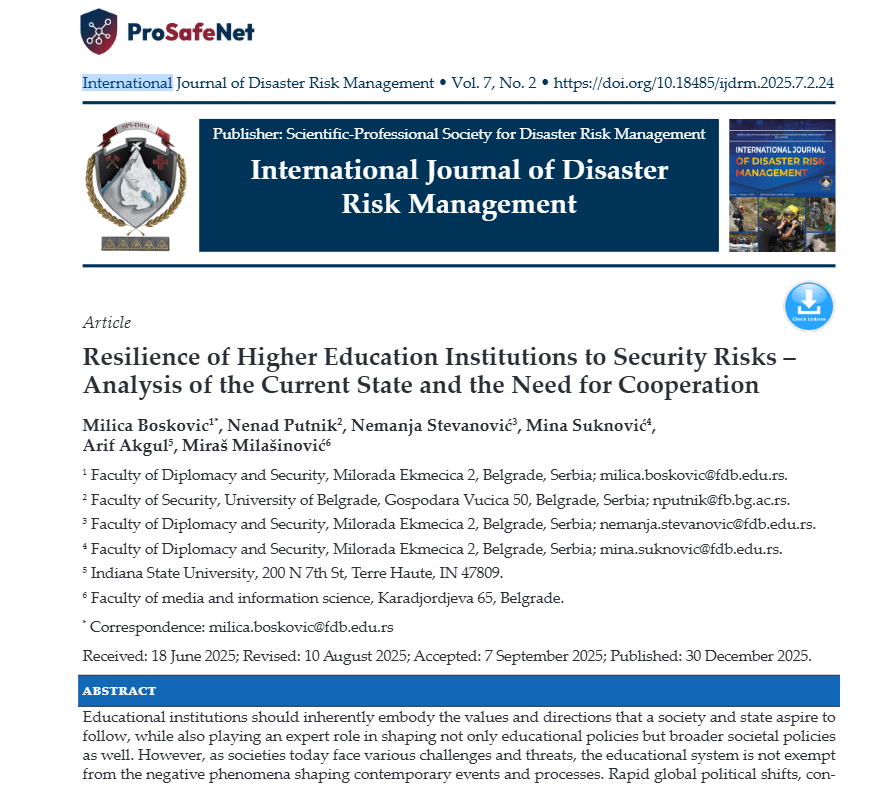
    Screenshot 2026 08 10 183036 Resilience of Higher Education Institutions to Security Risks – Analysis of the Current State and the Need for Cooperation
    Share
    Facebook Twitter LinkedIn Pinterest Email

    Educational institutions should inherently embody the values and directions that a society and state aspire to follow, while also playing an expert role in shaping not only educational policies but broader societal policies as well. However, as societies today face various challenges and threats, the educational system is not exempt from the negative phenomena shaping contemporary events and processes. Rapid global political shifts, conflicts, internal social violence, cyber threats, and other risks necessitate that the education system, through both formal and informal educational content, equips students, pupils, and even adults with the necessary knowledge to respond adequately to crises. A literature review on risk management in higher education yields limited results (Raanan, 2009), with most studies focusing on teaching risk management to students or practitioners, such as those by Menoni (2006) and Gabel (2008). To assess the preparedness of higher education institutions (HEIs) and their employees for various security risks, we conducted a study as part of the project activity  “Enhancing the Capacities of Higher Education Institutions for Various Security Risks”, under the Erasmus CBHE programme.

    Authors

    • Milica BoškovićFaculty of Diplomacy and Security, Milorada Ekmecica 2, Belgrade, SerbiaAuthor
    • Nenad PutnikFaculty of Security, University of Belgrade, Gospodara Vucica 50, Belgrade, SerbiaAuthor
    • Nemanja StevanovićFaculty of Diplomacy and Security, Milorada Ekmecica 2, Belgrade, SerbiaAuthor
    • Mina SuknovicFaculty of Diplomacy and Security, Milorada Ekmecica 2, Belgrade, SerbiaAuthor
    • Arif AkgulIndiana State University, 200 N 7th St, Terre Haute, IN 47809, United StatesAuthor
    • Miraš MilašinovićFaculty of media and information science, Karadjordjeva 65, BelgradeAuthor

    DOI:

    https://doi.org/10.18485/ijdrm.2025.7.2.24

    Keywords:

    HEI, risk, knowledge, cooperation, resilience, analysis, management

    https://internationaljournalofdisasterriskmanagement.com/index.php/Vol1/article/view/152


    Share. Facebook Twitter Pinterest LinkedIn Tumblr Telegram Email
    Previous ArticlePutting People First: Why Pooled Funds Belong to Communities
    Next Article Rethinking Disaster Resilience: Conceptual Framework, Core Dimensions, and Key Actors
    Editor
    • Website

    Prof. Dr. Vladimir M. Cvetković is recognized as a leading expert in Disaster Risk Management, with a focus on Risk Reduction, Preparedness, Response, and Recovery. He has authored over 300 scientific papers published in domestic and international journals and proceedings, as well as 30 books.

    Related Posts

    Strategic Cooperation Agreement Signed between ProSafeNet and the Faculty of Security Studies, University of Belgrade

    September 9, 2026

    Adaptive Governance of Disaster and Systemic Risks in Critical Energy Infrastructure: A Complex Adaptive Systems Perspective

    August 21, 2026

    Disaster Victim Identification in India: Forensic Challenges and the Need for a Comprehensive Legal–Policy Framework

    August 21, 2026
    Add A Comment
    Leave A Reply

    You must be logged in to post a comment.

    Scientific-Professional Society for Disaster Risk Management (SPS-DRM) President’s Office: president@spsdrm.org Administrative Office: secretary@spsdrm.org Belgrade, Serbia | www.spsdrm.org
    Scientific-Professional Society for Disaster Risk Management, Belgrade, Serbia.

    The Association “Scientific-Professional Society for Disaster Risk Management”  (www.spsdr.com) is a non-governmental and non-profit association, established for an indefinite period, for the purpose of achieving objectives related to the advancement of scientific and professional knowledge and practice in the field of disaster risk management, emergencies, security, protection and community resilience, through the implementation of quantitative and/or qualitative research, publishing activities (journals, books and other publications), organizing national and international events, conducting formal and non-formal forms of education and professional development, preparing expert analyses, risk assessments and planning documents, developing digital platforms and knowledge bases, as well as other activities in accordance with the law and this Statute.

    International Journal of Disaster Risk Management

    The International Journal of Disaster Risk Management (IJDRM) is a double-blind peer-reviewed, open-access international scientific journal, published twice a year, dedicated to advancing interdisciplinary research, policy, and professional practice in the fields of disaster risk management, disaster risk reduction, hazards, emergencies, and resilience. The journal provides an international platform for researchers, academics, practitioners, policymakers, emergency managers, and other professionals to exchange knowledge, research findings, and innovative approaches to disaster prevention and management. IJDRM publishes theoretical, empirical, methodological, and applied contributions covering the entire disaster risk management cycle—prevention, mitigation, preparedness, response, recovery, reconstruction, and resilience-building.   www.ijdrm.com

    Scientific-Professional Society for Disaster Risk Management (SPS-DRM)

    Type above and press Enter to search. Press Esc to cancel.