Close Menu
Scientific-Professional Society for Disasaster Risk ManagementScientific-Professional Society for Disasaster Risk Management
    Facebook X (Twitter) Instagram
    Facebook X (Twitter) Instagram YouTube LinkedIn TikTok
    Scientific-Professional Society for Disasaster Risk ManagementScientific-Professional Society for Disasaster Risk Management
    Contact
    • About
      • History
      • President
      • Members
      • Secretary
      • Documentation
        • Statute
        • Communication Strategy
        • Work Information Booklet
        • Seminar Programs
        • Training Programs
        • Regulations on Identification Cards, Badges, and Uniforms
        • Cooperation Agreements
        • Organization Flyer
        • Membership Application Form
      • Membership
      • Contact SPS-DRM
    • Publication
      • Books
      • Collection of papers
      • Scientific papers
      • Broschure
      • Flyers and Posters
      • International journal (IJDRM)
    • IJDRM
    • ProSafeNet
    • Science
      • International Institute
      • Research Projects
      • Research Collaboration
      • International conference
    • Education
      • Training
      • Seminars
    • Information
      • Gallery / Training Photo Archive
      • Announcements
      • Media
      • Donations and Sponsorships
    • Posts
    Scientific-Professional Society for Disasaster Risk ManagementScientific-Professional Society for Disasaster Risk Management
    Home»News»Crisis Communication in Times of Disasters: Public Perceptions on the Timeliness and Clarity of Safety Announcements: A Systematic Literature Review
    News

    Crisis Communication in Times of Disasters: Public Perceptions on the Timeliness and Clarity of Safety Announcements: A Systematic Literature Review

    EditorBy EditorAugust 10, 2026Updated:August 10, 2026No Comments2 Mins Read
    Facebook Twitter LinkedIn Telegram Pinterest Tumblr Reddit WhatsApp Email
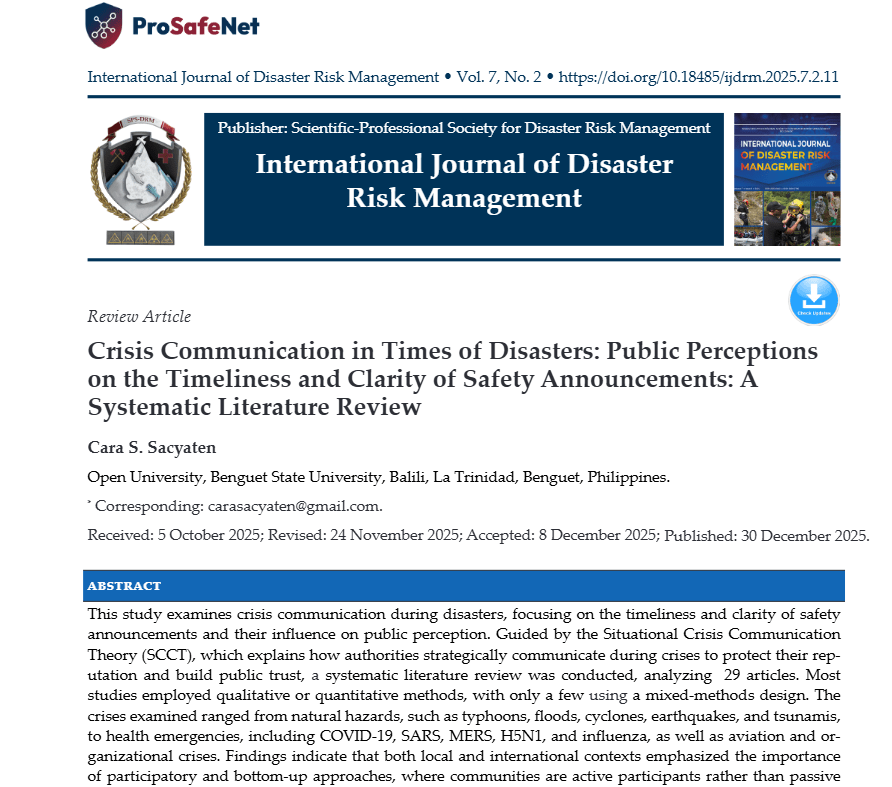
    Screenshot 2026 08 10 130921 1 Crisis Communication in Times of Disasters: Public Perceptions on the Timeliness and Clarity of Safety Announcements: A Systematic Literature Review
    Share
    Facebook Twitter LinkedIn Pinterest Email

    This study examines crisis communication during disasters, focusing on the timeliness and clarity of safety announcements and their influence on public perception. Guided by the Situational Crisis Communication Theory (SCCT), which explains how authorities strategically communicate during crises to protect their reputation and build public trust, a systematic literature review was conducted, analyzing  29 articles. Most studies employed qualitative or quantitative methods, with only a few using a mixed-methods design. The crises examined ranged from natural hazards, such as typhoons, floods, cyclones, earthquakes, and tsunamis, to health emergencies, including COVID-19, SARS, MERS, H5N1, and influenza, as well as aviation and organizational crises. Findings indicate that both local and international contexts emphasized the importance of participatory and bottom-up approaches, where communities are active participants rather than passive recipients. Effective strategies also rely on the use of dominant languages, interpersonal communication, clarity, and timeliness. Communities and organizations often trust community radio and social media platforms, such as Twitter, as sources of information that help at-risk residents make appropriate and necessary preparations. Delays caused by inconsistent or overshadowed information, unpreparedness, and slow responses decrease public trust, create confusion, and undermine public compliance. Based on these findings, the study recommends that authorities responsible for crisis communication employ multidimensional crisis communication strategies, enhance message clarity and comprehensibility, prioritize timely and accurate information, adopt participatory approaches, leverage diverse communication channels strategically, foster public trust through transparency, consistency, accountability, and empathy, implement proactive misinformation mitigation strategies, and continuously refine communication strategies based community or organization needs to improve future emergency responses.

    Authors

    • Cara S. SacyatenOpen University, Benguet State University, Balili, La Trinidad, Benguet, PhilippinesAuthor

    DOI:

    https://doi.org/10.18485/ijdrm.2025.7.2.11

    Keywords:

    crisis communication, disaster, perceptions, clarity, timeliness

    https://internationaljournalofdisasterriskmanagement.com/index.php/Vol1/article/view/124


    Share. Facebook Twitter Pinterest LinkedIn Tumblr Telegram Email
    Previous ArticleCOSI-SAFE: A GIS-Based Multi-Criteria Framework for Evaluating Urban Open Space Suitability for Post-Earthquake Emergency Sheltering
    Next Article Differential Risk and the Elements of Resilience: A Framework for Advancing Disaster Risk Reduction
    Editor
    • Website

    Prof. Dr. Vladimir M. Cvetković is recognized as a leading expert in Disaster Risk Management, with a focus on Risk Reduction, Preparedness, Response, and Recovery. He has authored over 300 scientific papers published in domestic and international journals and proceedings, as well as 30 books.

    Related Posts

    Digital Literacy and Educational Empowerment Among Rural Women in Bangladesh: Bridging the Technology Access Gap

    August 10, 2026

    Differential Risk and the Elements of Resilience: A Framework for Advancing Disaster Risk Reduction

    August 10, 2026

    COSI-SAFE: A GIS-Based Multi-Criteria Framework for Evaluating Urban Open Space Suitability for Post-Earthquake Emergency Sheltering

    August 10, 2026
    Add A Comment
    Leave A Reply

    You must be logged in to post a comment.

    Scientific-Professional Society for Disaster Risk Management (SPS-DRM) President’s Office: president@spsdrm.org Administrative Office: secretary@spsdrm.org Belgrade, Serbia | www.spsdrm.org
    Scientific-Professional Society for Disaster Risk Management, Belgrade, Serbia.

    The Association “Scientific-Professional Society for Disaster Risk Management”  (www.spsdr.com) is a non-governmental and non-profit association, established for an indefinite period, for the purpose of achieving objectives related to the advancement of scientific and professional knowledge and practice in the field of disaster risk management, emergencies, security, protection and community resilience, through the implementation of quantitative and/or qualitative research, publishing activities (journals, books and other publications), organizing national and international events, conducting formal and non-formal forms of education and professional development, preparing expert analyses, risk assessments and planning documents, developing digital platforms and knowledge bases, as well as other activities in accordance with the law and this Statute.

    International Journal of Disaster Risk Management

    The International Journal of Disaster Risk Management (IJDRM) is a double-blind peer-reviewed, open-access international scientific journal, published twice a year, dedicated to advancing interdisciplinary research, policy, and professional practice in the fields of disaster risk management, disaster risk reduction, hazards, emergencies, and resilience. The journal provides an international platform for researchers, academics, practitioners, policymakers, emergency managers, and other professionals to exchange knowledge, research findings, and innovative approaches to disaster prevention and management. IJDRM publishes theoretical, empirical, methodological, and applied contributions covering the entire disaster risk management cycle—prevention, mitigation, preparedness, response, recovery, reconstruction, and resilience-building.   www.ijdrm.com

    Scientific-Professional Society for Disaster Risk Management (SPS-DRM)

    Type above and press Enter to search. Press Esc to cancel.