Close Menu
Scientific-Professional Society for Disasaster Risk ManagementScientific-Professional Society for Disasaster Risk Management
    Facebook X (Twitter) Instagram
    Facebook X (Twitter) Instagram YouTube LinkedIn TikTok
    Scientific-Professional Society for Disasaster Risk ManagementScientific-Professional Society for Disasaster Risk Management
    Contact
    • About
      • History
      • President
      • Members
      • Secretary
      • Documentation
        • Statute
        • Communication Strategy
        • Work Information Booklet
        • Seminar Programs
        • Training Programs
        • Regulations on Identification Cards, Badges, and Uniforms
        • Cooperation Agreements
        • Organization Flyer
        • Membership Application Form
      • Membership
      • Contact SPS-DRM
    • Publication
      • Books
      • Collection of papers
      • Scientific papers
      • Broschure
      • Flyers and Posters
      • International journal (IJDRM)
    • IJDRM
    • ProSafeNet
    • Science
      • International Institute
      • Research Projects
      • Research Collaboration
      • International conference
    • Education
      • Training
      • Seminars
    • Information
      • Gallery / Training Photo Archive
      • Announcements
      • Media
      • Donations and Sponsorships
    • Posts
    Scientific-Professional Society for Disasaster Risk ManagementScientific-Professional Society for Disasaster Risk Management
    Home»News»Differential Risk and the Elements of Resilience: A Framework for Advancing Disaster Risk Reduction
    News

    Differential Risk and the Elements of Resilience: A Framework for Advancing Disaster Risk Reduction

    EditorBy EditorAugust 10, 2026No Comments1 Min Read
    Facebook Twitter LinkedIn Telegram Pinterest Tumblr Reddit WhatsApp Email
    Screenshot 2026 08 10 131218 1 Differential Risk and the Elements of Resilience: A Framework for Advancing Disaster Risk Reduction
    Share
    Facebook Twitter LinkedIn Pinterest Email

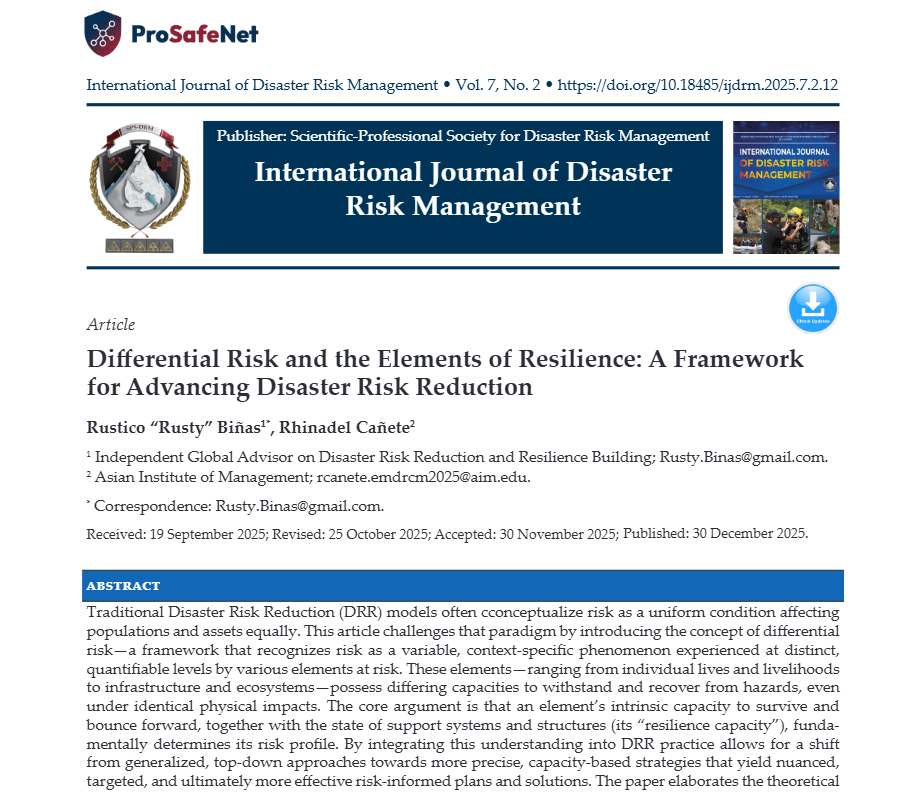
    Traditional Disaster Risk Reduction (DRR) models often cconceptualize risk as a uniform condition affecting populations and assets equally. This article challenges that paradigm by introducing the concept of differential risk—a framework that recognizes risk as a variable, context-specific phenomenon experienced at distinct, quantifiable levels by various elements at risk. These elements—ranging from individual lives and livelihoods to infrastructure and ecosystems—possess differing capacities to withstand and recover from hazards, even under identical physical impacts. The core argument is that an element’s intrinsic capacity to survive and bounce forward, together with the state of support systems and structures (its “resilience capacity”), fundamentally determines its risk profile. By integrating this understanding into DRR practice allows for a shift from generalized, top-down approaches towards more precise, capacity-based strategies that yield nuanced, targeted, and ultimately more effective risk-informed plans and solutions. The paper elaborates the theoretical foundations of differential risk and presents a practical framework for its application in DRR policy, planning, and implementation.

    Authors

    • Rhinadel CaneteAsian Institute of ManagementAuthor https://orcid.org/0009-0002-8865-3809 (unauthenticated)
    • Rustico “Rusty” BiñasAsian Institute of ManagementAuthor

    DOI:

    https://doi.org/10.18485/ijdrm.2025.7.2.12

    Keywords:

    differential risk, vulnerability, capacity, disaster risk reduction, resilience, climate change , adaptation, hazard, preparedness

    https://internationaljournalofdisasterriskmanagement.com/index.php/Vol1/article/view/135


    Share. Facebook Twitter Pinterest LinkedIn Tumblr Telegram Email
    Previous ArticleCrisis Communication in Times of Disasters: Public Perceptions on the Timeliness and Clarity of Safety Announcements: A Systematic Literature Review
    Next Article Digital Literacy and Educational Empowerment Among Rural Women in Bangladesh: Bridging the Technology Access Gap
    Editor
    • Website

    Prof. Dr. Vladimir M. Cvetković is recognized as a leading expert in Disaster Risk Management, with a focus on Risk Reduction, Preparedness, Response, and Recovery. He has authored over 300 scientific papers published in domestic and international journals and proceedings, as well as 30 books.

    Related Posts

    Digital Literacy and Educational Empowerment Among Rural Women in Bangladesh: Bridging the Technology Access Gap

    August 10, 2026

    Crisis Communication in Times of Disasters: Public Perceptions on the Timeliness and Clarity of Safety Announcements: A Systematic Literature Review

    August 10, 2026

    COSI-SAFE: A GIS-Based Multi-Criteria Framework for Evaluating Urban Open Space Suitability for Post-Earthquake Emergency Sheltering

    August 10, 2026
    Add A Comment
    Leave A Reply

    You must be logged in to post a comment.

    Scientific-Professional Society for Disaster Risk Management (SPS-DRM) President’s Office: president@spsdrm.org Administrative Office: secretary@spsdrm.org Belgrade, Serbia | www.spsdrm.org
    Scientific-Professional Society for Disaster Risk Management, Belgrade, Serbia.

    The Association “Scientific-Professional Society for Disaster Risk Management”  (www.spsdr.com) is a non-governmental and non-profit association, established for an indefinite period, for the purpose of achieving objectives related to the advancement of scientific and professional knowledge and practice in the field of disaster risk management, emergencies, security, protection and community resilience, through the implementation of quantitative and/or qualitative research, publishing activities (journals, books and other publications), organizing national and international events, conducting formal and non-formal forms of education and professional development, preparing expert analyses, risk assessments and planning documents, developing digital platforms and knowledge bases, as well as other activities in accordance with the law and this Statute.

    International Journal of Disaster Risk Management

    The International Journal of Disaster Risk Management (IJDRM) is a double-blind peer-reviewed, open-access international scientific journal, published twice a year, dedicated to advancing interdisciplinary research, policy, and professional practice in the fields of disaster risk management, disaster risk reduction, hazards, emergencies, and resilience. The journal provides an international platform for researchers, academics, practitioners, policymakers, emergency managers, and other professionals to exchange knowledge, research findings, and innovative approaches to disaster prevention and management. IJDRM publishes theoretical, empirical, methodological, and applied contributions covering the entire disaster risk management cycle—prevention, mitigation, preparedness, response, recovery, reconstruction, and resilience-building.   www.ijdrm.com

    Scientific-Professional Society for Disaster Risk Management (SPS-DRM)

    Type above and press Enter to search. Press Esc to cancel.