Close Menu
Scientific-Professional Society for Disasaster Risk ManagementScientific-Professional Society for Disasaster Risk Management
    Facebook X (Twitter) Instagram
    Facebook X (Twitter) Instagram YouTube LinkedIn TikTok
    Scientific-Professional Society for Disasaster Risk ManagementScientific-Professional Society for Disasaster Risk Management
    Contact
    • About
      • History
      • President
      • Members
      • Secretary
      • Documentation
        • Statute
        • Communication Strategy
        • Work Information Booklet
        • Seminar Programs
        • Training Programs
        • Regulations on Identification Cards, Badges, and Uniforms
        • Cooperation Agreements
        • Organization Flyer
        • Membership Application Form
      • Membership
      • Contact SPS-DRM
    • Publication
      • Books
      • Collection of papers
      • Scientific papers
      • Broschure
      • Flyers and Posters
      • International journal (IJDRM)
    • IJDRM
    • ProSafeNet
    • Science
      • International Institute
      • Research Projects
      • Research Collaboration
      • International conference
    • Education
      • Training
      • Seminars
    • Information
      • Gallery / Training Photo Archive
      • Announcements
      • Media
      • Donations and Sponsorships
    • Posts
    Scientific-Professional Society for Disasaster Risk ManagementScientific-Professional Society for Disasaster Risk Management
    Home»News»Guardians of Safety: Assessing Awareness and Preparedness of Teachers along with School Initiatives for Disaster Risk Reduction
    News

    Guardians of Safety: Assessing Awareness and Preparedness of Teachers along with School Initiatives for Disaster Risk Reduction

    EditorBy EditorAugust 9, 2026No Comments2 Mins Read
    Facebook Twitter LinkedIn Telegram Pinterest Tumblr Reddit WhatsApp Email
    Screenshot 2026 08 09 124041 Guardians of Safety: Assessing Awareness and Preparedness of Teachers along with School Initiatives for Disaster Risk Reduction
    Share
    Facebook Twitter LinkedIn Pinterest Email

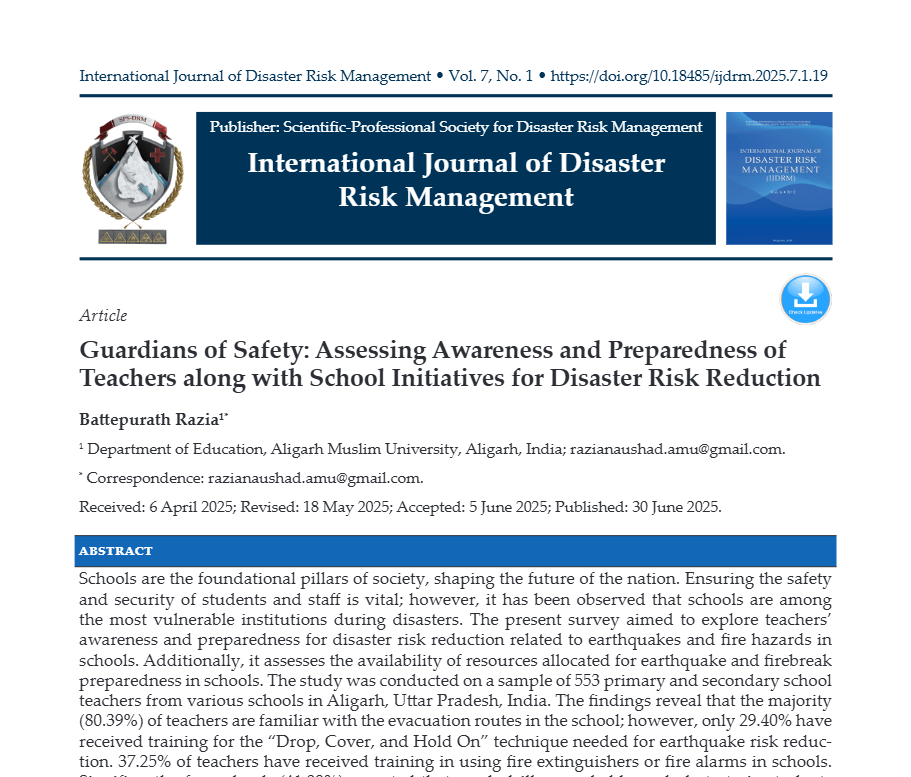
    Schools are the foundational pillars of society, shaping the future of the nation. Ensuring the safety and security of students and staff is vital; however, it has been observed that schools are among the most vulnerable institutions during disasters. The present survey aimed to explore teachers’ awareness and preparedness for disaster risk reduction related to earthquakes and fire hazards in schools. Additionally, it assesses the availability of resources allocated for earthquake and firebreak preparedness in schools. The study was conducted on a sample of 553 primary and secondary school teachers from various schools in Aligarh, Uttar Pradesh, India. The findings reveal that the majority (80.39%) of teachers are familiar with the evacuation routes in the school; however, only 29.40% have received training for the “Drop, Cover, and Hold On” technique needed for earthquake risk reduction. 37.25% of teachers have received training in using fire extinguishers or fire alarms in schools. Significantly, few schools (41.09%) reported that mock drills were held regularly to train students in emergencies. A concerning gap prevailed in the training of teachers and students regarding disaster risk reduction in schools. Key findings indicate an urgent need for comprehensive, hands-on training programs for teachers at both pre-service and in-service levels. In conclusion, the survey emphasises the critical need to prioritise DRR activities in schools and teacher education institutions while also investing swiftly in the preparedness of teachers. By providing the necessary skills and resources, schools can significantly enhance teachers’ capacity to protect the lives and well-being of students during unforeseen circumstances.

    Authors

    • Battepurath RaziaDepartment of Education, Aligarh Muslim University, Aligarh, IndiaAuthor

    DOI:

    https://doi.org/10.18485/ijdrm.2025.7.1.19

    Keywords:

    disaster risk reduction, awareness, disaster preparedness, earthquake, fire hazard

    https://internationaljournalofdisasterriskmanagement.com/index.php/Vol1/article/view/102


    Share. Facebook Twitter Pinterest LinkedIn Tumblr Telegram Email
    Previous ArticleFemale Gender Empowerment, Individualism, Collectivism, and Resilience: A Comparative Study in the Context of Disaster Risk Management
    Next Article Project DINGGIN: Empowering Communities through Risk‐Based and Inclusive Cash Transfer in Disaster‐Prone Areas in Bangladesh and Philippines
    Editor
    • Website

    Prof. Dr. Vladimir M. Cvetković is recognized as a leading expert in Disaster Risk Management, with a focus on Risk Reduction, Preparedness, Response, and Recovery. He has authored over 300 scientific papers published in domestic and international journals and proceedings, as well as 30 books.

    Related Posts

    From Vulnerability to Resilience: A Systematic Review of Odisha’s Integrated Approach to Disaster Risk Reduction

    August 9, 2026

    Evaluating Puntland’s Disaster Risk Management Policy: Institutional Preparedness, Community Engagement and Implementation Challenges

    August 9, 2026

    Declination of the Strategic Compass: Transatlantic Elites, German Leadership, and the Future of European Security

    August 9, 2026
    Add A Comment
    Leave A Reply

    You must be logged in to post a comment.

    Scientific-Professional Society for Disaster Risk Management (SPS-DRM) President’s Office: president@spsdrm.org Administrative Office: secretary@spsdrm.org Belgrade, Serbia | www.spsdrm.org
    Scientific-Professional Society for Disaster Risk Management, Belgrade, Serbia.

    The Association “Scientific-Professional Society for Disaster Risk Management”  (www.spsdr.com) is a non-governmental and non-profit association, established for an indefinite period, for the purpose of achieving objectives related to the advancement of scientific and professional knowledge and practice in the field of disaster risk management, emergencies, security, protection and community resilience, through the implementation of quantitative and/or qualitative research, publishing activities (journals, books and other publications), organizing national and international events, conducting formal and non-formal forms of education and professional development, preparing expert analyses, risk assessments and planning documents, developing digital platforms and knowledge bases, as well as other activities in accordance with the law and this Statute.

    International Journal of Disaster Risk Management

    The International Journal of Disaster Risk Management (IJDRM) is a double-blind peer-reviewed, open-access international scientific journal, published twice a year, dedicated to advancing interdisciplinary research, policy, and professional practice in the fields of disaster risk management, disaster risk reduction, hazards, emergencies, and resilience. The journal provides an international platform for researchers, academics, practitioners, policymakers, emergency managers, and other professionals to exchange knowledge, research findings, and innovative approaches to disaster prevention and management. IJDRM publishes theoretical, empirical, methodological, and applied contributions covering the entire disaster risk management cycle—prevention, mitigation, preparedness, response, recovery, reconstruction, and resilience-building.   www.ijdrm.com

    Scientific-Professional Society for Disaster Risk Management (SPS-DRM)

    Type above and press Enter to search. Press Esc to cancel.