Close Menu
Scientific-Professional Society for Disasaster Risk ManagementScientific-Professional Society for Disasaster Risk Management
    Facebook X (Twitter) Instagram
    Facebook X (Twitter) Instagram YouTube LinkedIn TikTok
    Scientific-Professional Society for Disasaster Risk ManagementScientific-Professional Society for Disasaster Risk Management
    Contact
    • About
      • History
      • President
      • Members
      • Secretary
      • Documentation
        • Statute
        • Communication Strategy
        • Work Information Booklet
        • Seminar Programs
        • Training Programs
        • Regulations on Identification Cards, Badges, and Uniforms
        • Cooperation Agreements
        • Organization Flyer
        • Membership Application Form
      • Membership
      • Contact SPS-DRM
    • Publication
      • Books
      • Collection of papers
      • Scientific papers
      • Broschure
      • Flyers and Posters
      • International journal (IJDRM)
    • IJDRM
    • ProSafeNet
    • Science
      • International Institute
      • Research Projects
      • Research Collaboration
      • International conference
    • Education
      • Training
      • Seminars
    • Information
      • Gallery / Training Photo Archive
      • Announcements
      • Media
      • Donations and Sponsorships
    • Posts
    Scientific-Professional Society for Disasaster Risk ManagementScientific-Professional Society for Disasaster Risk Management
    Home»News»Project DINGGIN: Empowering Communities through Risk‐Based and Inclusive Cash Transfer in Disaster‐Prone Areas in Bangladesh and Philippines
    News

    Project DINGGIN: Empowering Communities through Risk‐Based and Inclusive Cash Transfer in Disaster‐Prone Areas in Bangladesh and Philippines

    EditorBy EditorAugust 9, 2026No Comments2 Mins Read
    Facebook Twitter LinkedIn Telegram Pinterest Tumblr Reddit WhatsApp Email
    Screenshot 2026 08 09 124429 Project DINGGIN: Empowering Communities through Risk‐Based and Inclusive Cash Transfer in Disaster‐Prone Areas in Bangladesh and Philippines
    Share
    Facebook Twitter LinkedIn Pinterest Email

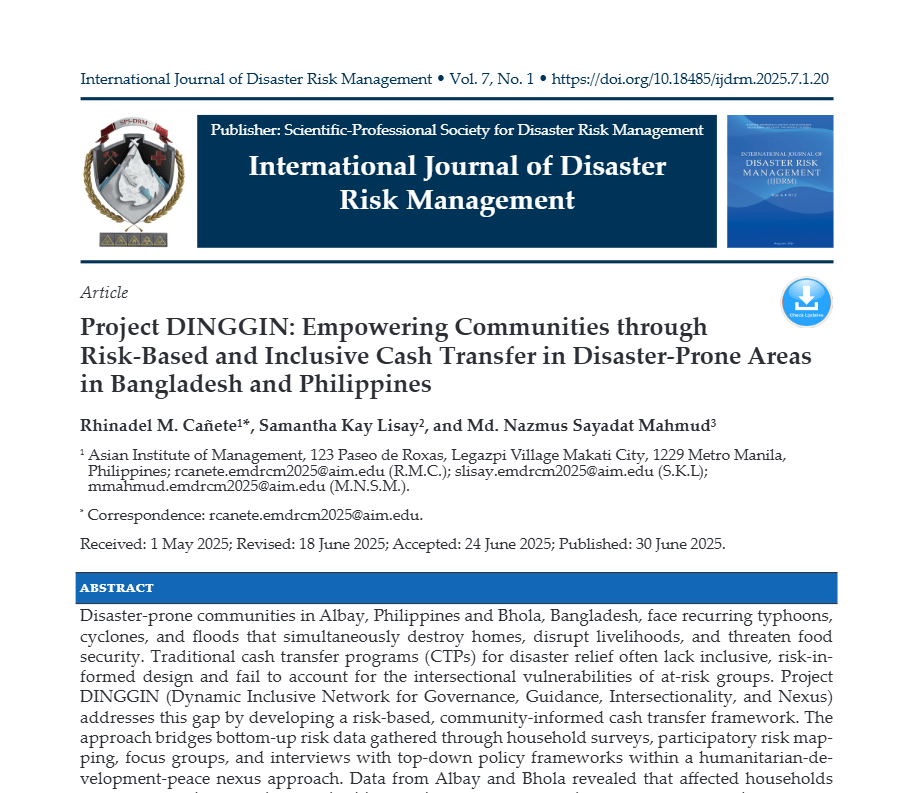
    Disaster-prone communities in Albay, Philippines and Bhola, Bangladesh, face recurring typhoons, cyclones, and floods that simultaneously destroy homes, disrupt livelihoods, and threaten food security. Traditional cash transfer programs (CTPs) for disaster relief often lack inclusive, risk-informed design and fail to account for the intersectional vulnerabilities of at-risk groups. Project DINGGIN (Dynamic Inclusive Network for Governance, Guidance, Intersectionality, and Nexus) addresses this gap by developing a risk-based, community-informed cash transfer framework. The approach bridges bottom-up risk data gathered through household surveys, participatory risk mapping, focus groups, and interviews with top-down policy frameworks within a humanitarian-development-peace nexus approach. Data from Albay and Bhola revealed that affected households prioritise simultaneous home rebuilding and income recovery; however, existing cash assistance is fragmented and not well-coordinated. Using a decision-support dashboard, local governments and communities co-developed tailored Cash Transfer Values (CTVs) reflecting each community’s specific disaster risks and socioeconomic needs. The results demonstrate that an integrated cash transfer strategy—addressing shelter, food, and livelihoods together—can provide immediate relief while strengthening long-term resilience. For example, households in high-risk zones received larger grants for shelter reinforcement and livelihood restoration, aligning assistance with locally identified needs. This risk-informed, inclusive CTP model improved community ownership and met humanitarian Sphere standards for equity and adequacy. The discussion of Project DINGGIN’s pilot indicates strengthened multi-sectoral coordination and highlights areas for improvement, such as providing multi-phase support beyond the emergency phase, offering financial literacy training to beneficiaries, and implementing adaptive disbursement schedules. The study concludes that empowering communities to co-design cash interventions not only ensures a more effective disaster response but also institutionalises resilience-building for future crises, aligning with national disaster management plans and international frameworks.

    Authors

    • Rhinadel M. CaneteAsian Institute of Management, 123 Paseo de Roxas, Legazpi Village Makati City, 1229 Metro Manila, PhilippinesAuthor
    • Samantha Kay LisayAsian Institute of Management, 123 Paseo de Roxas, Legazpi Village Makati City, 1229 Metro Manila, PhilippinesAuthor
    • Md. Nazmus Sayadat MahmudAsian Institute of Management, 123 Paseo de Roxas, Legazpi Village Makati City, 1229 Metro Manila, PhilippinesAuthor

    DOI:

    https://doi.org/10.18485/ijdrm.2025.7.1.20

    Keywords:

    community-managed disaster risk reduction (CMDRR), risk-based cash transfer, hybrid governance, participatory risk mapping, disaster preparedness, humanitarian nexus, community resilience

    https://internationaljournalofdisasterriskmanagement.com/index.php/Vol1/article/view/100

    Share. Facebook Twitter Pinterest LinkedIn Tumblr Telegram Email
    Previous ArticleGuardians of Safety: Assessing Awareness and Preparedness of Teachers along with School Initiatives for Disaster Risk Reduction
    Next Article Smart Life Safety Jacket For Rescuers
    Editor
    • Website

    Prof. Dr. Vladimir M. Cvetković is recognized as a leading expert in Disaster Risk Management, with a focus on Risk Reduction, Preparedness, Response, and Recovery. He has authored over 300 scientific papers published in domestic and international journals and proceedings, as well as 30 books.

    Related Posts

    From Vulnerability to Resilience: A Systematic Review of Odisha’s Integrated Approach to Disaster Risk Reduction

    August 9, 2026

    Evaluating Puntland’s Disaster Risk Management Policy: Institutional Preparedness, Community Engagement and Implementation Challenges

    August 9, 2026

    Declination of the Strategic Compass: Transatlantic Elites, German Leadership, and the Future of European Security

    August 9, 2026
    Add A Comment
    Leave A Reply

    You must be logged in to post a comment.

    Scientific-Professional Society for Disaster Risk Management (SPS-DRM) President’s Office: president@spsdrm.org Administrative Office: secretary@spsdrm.org Belgrade, Serbia | www.spsdrm.org
    Scientific-Professional Society for Disaster Risk Management, Belgrade, Serbia.

    The Association “Scientific-Professional Society for Disaster Risk Management”  (www.spsdr.com) is a non-governmental and non-profit association, established for an indefinite period, for the purpose of achieving objectives related to the advancement of scientific and professional knowledge and practice in the field of disaster risk management, emergencies, security, protection and community resilience, through the implementation of quantitative and/or qualitative research, publishing activities (journals, books and other publications), organizing national and international events, conducting formal and non-formal forms of education and professional development, preparing expert analyses, risk assessments and planning documents, developing digital platforms and knowledge bases, as well as other activities in accordance with the law and this Statute.

    International Journal of Disaster Risk Management

    The International Journal of Disaster Risk Management (IJDRM) is a double-blind peer-reviewed, open-access international scientific journal, published twice a year, dedicated to advancing interdisciplinary research, policy, and professional practice in the fields of disaster risk management, disaster risk reduction, hazards, emergencies, and resilience. The journal provides an international platform for researchers, academics, practitioners, policymakers, emergency managers, and other professionals to exchange knowledge, research findings, and innovative approaches to disaster prevention and management. IJDRM publishes theoretical, empirical, methodological, and applied contributions covering the entire disaster risk management cycle—prevention, mitigation, preparedness, response, recovery, reconstruction, and resilience-building.   www.ijdrm.com

    Scientific-Professional Society for Disaster Risk Management (SPS-DRM)

    Type above and press Enter to search. Press Esc to cancel.