


Poštovani,
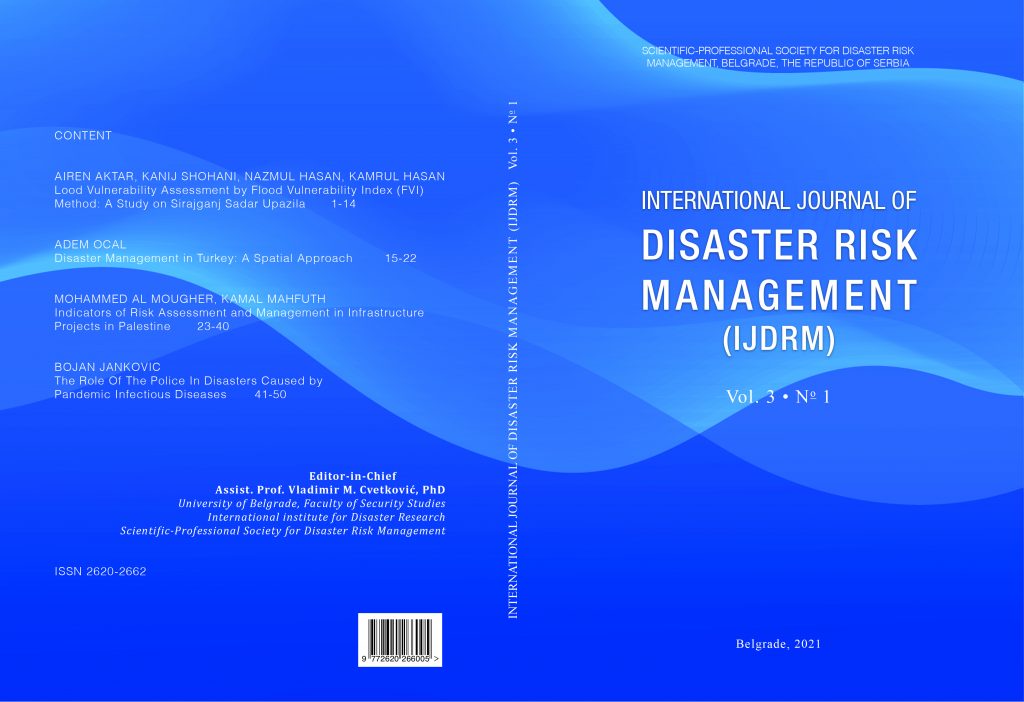
sa ponosom vam predstavljamo novu svesku našeg međunarodnog časopisa – INTERNATIONAL JOURNAL OF DISASTER RISK MANAGEMENT (IJDRM), Vol. 3, No. 1
Bojan Janković
University of Criminal Investigation and Police Studies, Belgrade, Serbia; bojan.jankovic@kpu.edu.rshttps://orcid.org/0000-0002-3872-3090
Keywords: police, disaster, pandemic, COVID-19
Abstract
So far, the police have played and are playing a very important role in the fight against pandemics in the current situation. Recent events have indicated the need to pay as much attention to the role of the police in emergencies caused by pandemics (epidemics) of infectious diseases, because it is noticeable that, in the previous period, either in practice or in scientific circles, not enough attention was paid to this segment of police work. The author’s wish was to provide an answer to the question whether and in what way the police coped with the natural disaster caused by the pandemic of the infectious disease COVID-19. The answer would be that the police did not cope during the COVID-19 pandemic. The paper provides guidelines that would help police organizations cope with possible future natural disasters caused by a pandemic of infectious diseases in a better way.
Janković, B. (2021). The role of the police in disasters caused by pandemic infectious diseases. International Journal of Disaster Risk Management, 3(1), in press. Retrieved from http://internationaljournalofdisasterriskmanagement.com/index.php/Vol1/article/view/29
Adem Ocal
Independent Researcher, Ankara, Turkey
Keywords: spatial approach, disaster, disaster management, earthquake, Turkey
Abstract
Disasters cause losses on people and residential areas, cause interruption of normal life and decision-making mechanism, collapse communication and communication even for a short time, and damage infrastructure and superstructure investments. In the traditional disaster management design, the regulations created by the legislation and rules issued are directed to each unit in the country at the same time. Administrative authorities must coordinate the emergency recovery process as a requirement of these protocols. In modern disaster management approaches, disasters are associated with spatially; the distribution, severity, type, and population affected by disasters are all considered. Starting with the spatial distribution of such disasters in Turkey, disaster management can be structured from space to center. The Turkish disaster management mechanism has issued recommendations as a consequence of this study.
Ocal, A. (2021). Disaster management in Turkey: a spatial approach. International Journal of Disaster Risk Management, 3(1), in press. Retrieved from http://internationaljournalofdisasterriskmanagement.com/index.php/Vol1/article/view/28
Mst. Airen Aktar
Department of Urban and Regional Planning, Pabna University of Science & Technology, Pabna, Bangladesh
Kanij Shohani
Department of Urban and Regional Planning, Pabna University of Science & Technology, Pabna, Bangladesh
Md. Nazmul Hasan
Department of Urban and Regional Planning, Pabna University of Science & Technology, Pabna, Bangladesh
Md. Kamrul Hasan
Department of Urban and Regional Planning, Pabna University of Science & Technology, Pabna, Bangladesh
Keywords: Vulnerability; Flood Vulnerability Index; Exposure; Susceptibility; Resilience
Abstract
Flood is one of the most common and extreme hazards in Bangladesh because of its geographical location. Sirajganj is a district with the highest flood propensity in Bangladesh. The study aims to evaluate the vulnerability in the ten Unions of Sirajganj Sadar upazila to the flood hazard. Different forms of vulnerability evaluation approaches differ in their method. The Flood Vulnerability Index (FVI) method has been implemented in this research to determine flood vulnerability in order to classify which areas of the study are the most vulnerable to flooding. For the study of flood vulnerability, three indicators (i.e. exposure, sensitivity and resilience, etc) are selected in four dimensions (social, financial, environmental and physical). The FVI calculation determines the flood vulnerability index scores for each union. Following the analysis of FVI, in Sirajganj Sadar Upazila Mechhra union is marked as being highly vulnerable. Since this union is very poor in adaptability, coping capacity and resilience; exposure and susceptibility are greater. The other syndicates are highly exposed to floods. Finally, the zoning map for flood risk was developed on the basis of vulnerability index ratings.
Aktar, M. A., Shohani, K., Hasan, M. N., & Hasan, M. K. (2021). Flood Vulnerability Assessment by Flood Vulnerability Index (FVI) Method: A Study on Sirajganj Sadar Upazila. International Journal of Disaster Risk Management, 3(1), in press. Retrieved from http://internationaljournalofdisasterriskmanagement.com/index.php/Vol1/article/view/25
Mohammed Mohammed El-Mougher
Architecture Eengineering – Palestine University, Program of Crisis and Disaster Management- IUG, Palestine
Kamal Mahfuth
Tunis El Manar University, Laboratory of Materials, Optimization, and Energy for Sustainability (LAMOED), B.P. 37 Le Belvédère, 1002 Tunis, Tunisia
Keywords: indicators, assessment, infrastructure, projects, Palestine
Abstract
This study aims to identify the risks which face the work environment in infrastructure projects in order to reduce them and protect human and material resources also it aims to identify indicators used in the assessment, management, and prevention of risks in infrastructure projects. Therefore, the study had adopted the analytical descriptive approach, which describes the phenomenon and analyses action taken and adopted in risk management and risk management approach. In infrastructure projects, there’s a lack of clear application models in the governmental institutions to implement a national approach for risk management, in addition to the poor knowledge related to risk management sciences. Consequently, the study recommended adapting a comprehensive program to qualify society and companies in the field of risk management and protection and following the national risk management approach in infrastructure projects.
El-Mougher, M., & Mahfuth, K. (2021). Indicators of Risk Assessment and Management in Infrastructure Projects in Palestine. International Journal of Disaster Risk Management, 3(1), in press. Retrieved from http://internationaljournalofdisasterriskmanagement.com/index.php/Vol1/article/view/26
