

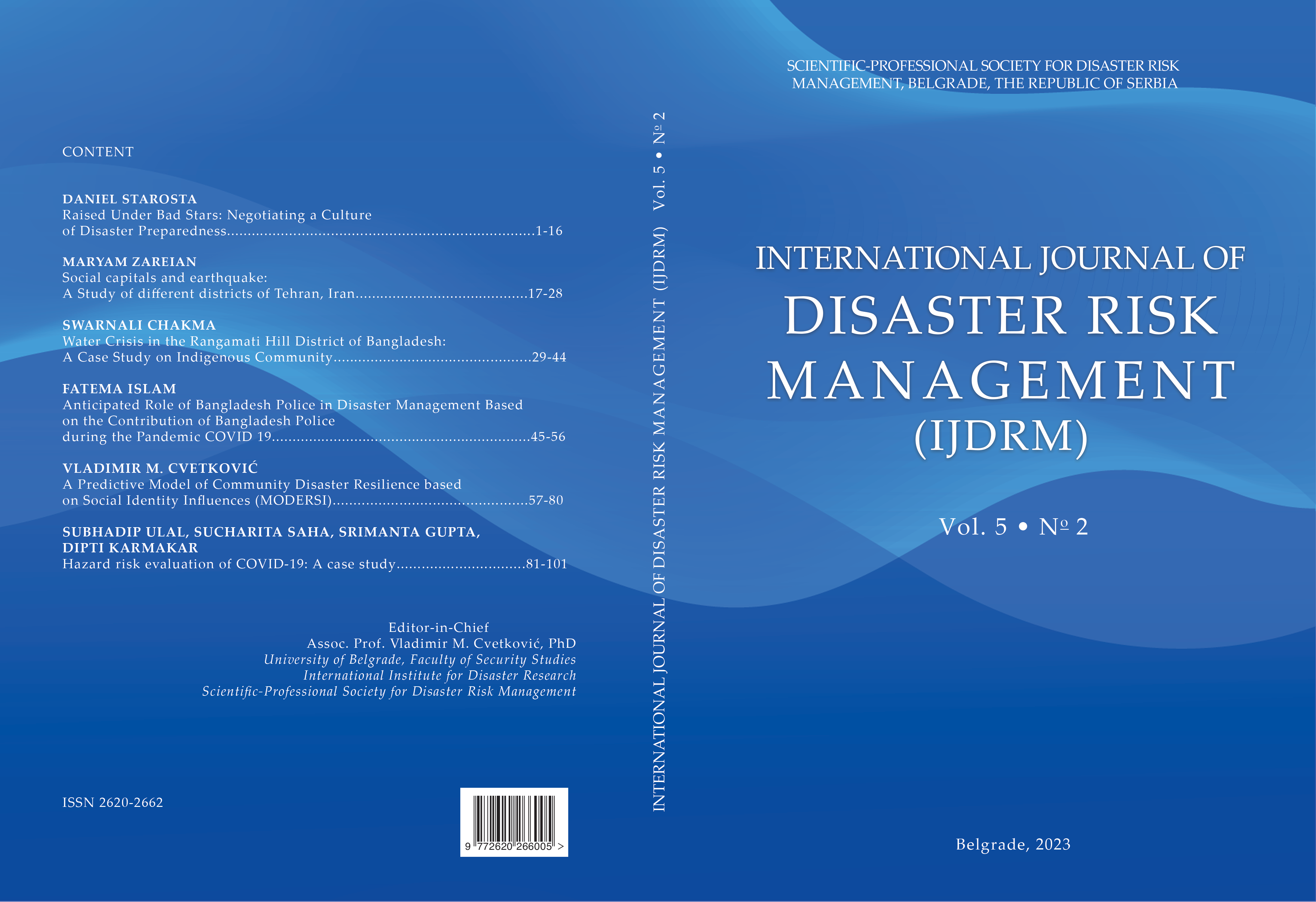
Published papers in Volume 5, No. 2
Raised Under Bad Stars: Negotiating a culture of disaster preparedness
Daniel Starosta
University of California Berkeley, Goldman School of Public Policy, California, United States
Keywords: culture, storytelling, folklore, climate adaptation, indigenous knowledge, informal infrastructure, contextual engineering
Abstract
In efforts to prevent, respond to, and recover from disasters, what alternatives are available to top-down strategies for imposing expert knowledge on lay publics? How is the context of communities’ socio-ecological context understood in the development of programs and policy on their behalf? What can be learned from community narratives and cultural practices to inform disaster risk reduction? The ways communities have regarded disasters and natural hazards in the cultural sphere can provide a lens to inform the understanding of their ability to withstand shocks and the factors that led to such conditions. Only by tracing the complexities of creating, transmitting, and preserving a culture of preparedness among disaster-vulnerable communities can we claim to be working towards policy that is informed by their own experience. I collected examples of how different communities perceive, prevent, and respond to disaster through art, music, and literature and analyzed how these were embedded into local narratives and how historical context influenced such approaches. My findings show that communities use cultural practices to contextualize experiences of hazards into their collective narrative; that is, storytelling and commemoration make disasters comprehensible. By framing disasters as an anthropological inquiry, practitioners can better recognize the influence of a place’s nuance in the disaster management canon–guided by these details, not despite them.
Social capitals and earthquake: A Study of different districts of Tehran, Iran
Maryam Zareian
Road, Housing and Urban Development Research Center (BHRC)
Keywords: Social capital, Tehran, earthquake, Iran
Abstract
Earthquakes occur suddenly and cause much physical and socioeconomic damage, especially in less developed countries. Many studies and strategies related to earthquake management in Iran emphasize the physical-based infrastructure, such as National Building Regulations or planning to renovate existing buildings. However, the relevance of social factors has been widely neglected. Addressing this gap, the present paper argues that social capital can play a vital role in different stages of natural disasters, such as preparedness, response, and recovery. Focusing on Tehran, that due to urban decay and geological fault lines is highly earthquake-prone, this study used secondary analysis to examine the data obtained from large cross-sectional studies conducted by Tehran Municipality in 2010 on social capital survey in Tehran and 2017 on quality of life in Tehran The present study is descriptive-analytical and applied research. Univariate analysis including measures of central tendency and dispersion was used to achieve the objectives of this research. The analyzed data show that four urban districts in Tehran (3, 21, 13, 4) have low bonding social capital, while the others have moderate bonding social capital. Moreover, four districts (9, 16, 19, 12) have very low bridging social capital, and the rest of the 22 districts have low bridging social capital. Demonstrating the relevance of social capital for preparing and supporting vulnerable communities during natural disasters, this study suggests social policies that would increase social cohesion, enhance generalized trust and strengthen social networks.
Water Crisis in the Rangamati Hill District of Bangladesh: A Case Study on Indigenous Community
Swarnali Chakma
Graduate School of International Cooperation Studies, Kobe University, Japan
Keywords: Water Crisis, Climate Change, Adaptation, Indigenous community, Chittagong Hill Tracts
Abstract
The ethnic communities are the most underprivileged and exposed areas in Bangladesh’s Chittagong hill tracts. Since the last decade, these areas have been facing severe challenges from climate change, such as drought leading to water scarcity, prolonged rainfall triggering landslides, dry-up of watersheds due to lack of rain, soil erosion, etc. This research aims to identify the key indicators of the causes and consequences of the water crisis caused by climate change and traditional water scarcity adoption practices in terms of sustainable upland water management. However, semi-structured and Key Informant Interviews were conducted following open-ended questionnaires in the Rangamati district. The study found that the locals in this region have few pure drinking water sources and often rely on nearby springs and lakes. It has also been discovered that rising deforestation is drying up the waterways. About 44% of the community states that deforestation is the main reason for the water crisis. According to the community, the situation gets worse during the dry season. The study results also show that women face difficulties because they are more likely to collect water for their family members and carry out their daily activities. Future studies should examine various mitigation strategies that are feasible for implementation locally, with a focus on expanding forest cover and afforestation, which could raise the groundwater level and improve the availability of water in the mountainous region. Finally, the findings can assist policymakers, practitioners, and the government in developing policies to benefit this community soon.
Anticipated Role of Bangladesh Police in Disaster Management Based on the Contribution of Bangladesh Police during the Pandemic COVID 19
Fatema Islam
Additional Superintendent of Police, Bangladesh Police, Dhaka, Bangladesh
Keywords: Bangladesh Police, Disaster management, Covid 19, pandemic, pre-disaster, post-disaster.
Abstract
This article explores the contribution of Bangladesh Police as a first responder in the pandemic COVID-19 in recent years. Bangladesh police played a vital role in maintaining law and order situation during prolonged lockdown, building awareness among mass people, ensuring safe transportation and mobility, and assisting people on humanitarian grounds. The article also identifies the anticipated potential responsibility of Bangladesh police in pre-disaster planning and post-disaster response based on the experience gathered during the pandemic. Bangladesh police faces some challenges regarding participating in disaster management task actively, such as limited resources, want of communication channel among various government and non-government agencies, and limited preparedness. The article found that during any kind of disaster, Bangladesh Police can enhance their service to the citizens through effective planning, training, utilizing modern technology, and willingness.
A Predictive Model of Community Disaster Resilience based on Social Identity Influences (MODERSI)
Vladimir M. Cvetković
The University of Belgrade, Faculty of Security Studies, Gospodara Vučića 50, Belgrade, Serbia
Keywords: disaster, community resilience, social identity, predictive model, factors
Abstract
The territory of Serbia is vulnerable to various types of natural and man-made disasters. The risk is not equal across the entire territory, depending on the type of hazard and the expected potential for damage. So far, the level of community disaster resilience has not been determined in Serbia. There are no scientific preconditions for its improvement to reduce the future material and intangible consequences of disasters. Regarding that, the project’s main objective is to develop and validate a predictive model of community disaster resilience based on social identity influences through an investigation impact of social identity indicators on the level of community disaster resilience in Serbia. The project is based on the upcoming research on whether the level of community disaster resilience can be predicted based on social identity indicators, how social identity indicators affect different dimensions of community disaster resilience, and how disasters shape social identity. The project is based on multimethod research in which quantitative (face-to-face interviews in 40 of the 191 municipalities), and qualitative (semi-structured interviews) research methodology will be applied. A developed predictive model with an index of community disaster resilience in Serbia will empower the creation of preconditions for designing public policies, strategies and procedures for improving resilience and reducing the consequences of disasters on people and their property and enhancing citizens’ security. The project will encourage the prediction of community disaster resilience based on social identity indicators, improving disaster foresight and preparing to limit disaster losses. Based on the development of analytical frameworks for understanding community disaster resilience and social identity in disasters, essential preconditions for designing innovative information systems will be created to enable local communities to increase their level of resilience.
Hazard risk evaluation of COVID-19: A case study
Subhadip Ulal
Department of Environmental Science, The University of Burdwan, Golapbag, Bardhaman – 713104, West Bengal, India.
Sucharita Saha
Department of Environmental Science, The University of Burdwan, Golapbag, Bardhaman – 713104, West Bengal, India.
Srimanta Gupta
Department of Environmental Science, The University of Burdwan, Golapbag, Bardhaman – 713104, West Bengal, India.
Dipti Karmakar
Department of Environmental Science, The University of Burdwan, Golapbag, Bardhaman – 713104, West Bengal, India.
Keywords: COVID-19, Kerala, Geo-environmental factor, C19RA model, AHP, C19HZ, C19VZ, Rainfall, Forest
Abstract
The present research deals with an in-depth analysis of COVID-19 risk in the state of Kerala using the integrated approach of the hazard and vulnerability in a GIS platform. Considering the probable causative factors of this disease, several geo-environmental indicators are analyzed through various statistical and geospatial techniques. Lorenz curve indicates an uneven distribution of COVID-19 instances in Kerala. Hazard analysis is formulated based on the proximity to hotspots and LULC followed by vulnerability analysis using an integrated analytical hierarchy process (AHP). Risk analysis reveals that COVID-19 infection poses a very serious threat to around 2.39% of Kerala’s total land area, with high, medium and low risks of 38, 44 and 14% respectively. The outcomes of this research will be a first-hand tool for policymakers to safeguard the population in high-risk potential zones from the future spread of infectious disease.
